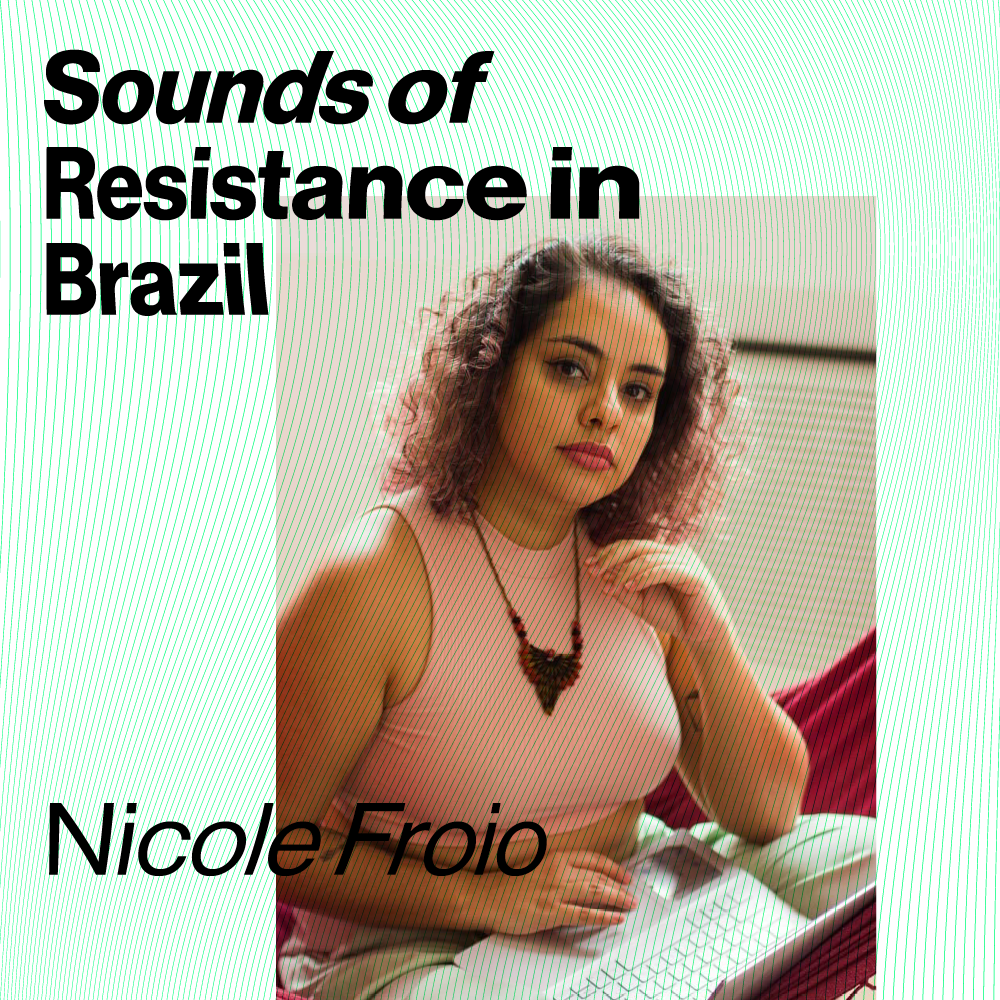
[vc_section css=”.vc_custom_1579170657650{margin-top: 20px !important;margin-right: 20px !important;margin-bottom: 20px !important;margin-left: 20px !important;border-top-width: 1px !important;border-right-width: 1px !important;border-bottom-width: 1px !important;border-left-width: 1px !important;padding-top: 0px !important;padding-right: 0px !important;padding-bottom: 0px !important;padding-left: 0px !important;border-left-color: #000000 !important;border-left-style: solid !important;border-right-color: #000000 !important;border-right-style: solid !important;border-top-color: #000000 !important;border-top-style: solid !important;border-bottom-color: #000000 !important;border-bottom-style: solid !important;border-radius: 1px !important;}”][vc_row fullwidth=”has-fullwidth-column”][vc_column padding_left=”30px” offset=”vc_col-lg-12″][vc_empty_space height=”40px”][agni_section_heading heading=”Sounds of Resistance in Brazil” heading_size=”40″ divide_line=””][vc_empty_space height=”40px”][/vc_column][/vc_row][vc_row fullwidth=”has-fullwidth-column” content_placement=”top” border_top=”1″ border_color=”#000000″ border_style=”solid”][vc_column width=”1/6″][/vc_column][vc_column width=”2/3″][vc_column_text]Nicole Froio
Nicole Froio is a Doctor in Women's Studies. Nicole has worked as a researcher, journalist, copywriter, translator, editor, and proofreader for nearly a decade. Publicly, she writes about pop culture, violence against women, inequality, Brazilian politics and news, digital cultures, and books.
When I was invited to speak at this conference, I was truly stumped about what to present. I kept thinking about my ways of listening as a journalist, and I realized how messy and unconventional my listening and writing processes are. I was invited to speak about my piece on Brazilian brega music, which I wrote for the queer magazine Xtra, and I will discuss that article and some of its music also, but I also want to talk about the political moment we are currently living here in Brazil.
In case you don’t know, Brazil is going through very polarizing elections at the moment. In the midst of this highly stressful political situation, I have been going out dancing to distract myself from the violent discourses of the extreme-right candidate — who doesn’t deserve his name in my mouth — and the possibility that he might be re-elected. I live in Rio de Janeiro, which is where samba was born, and one of the songs that have been played a lot in rodas de samba is Chico Buarque’s “Apesar de Você”.
“Apesar de Você” was written during the Brazilian dictatorship, and it’s about the repressive government of that era. However, to avoid censorship, Buarque sings in code, pretending his verses are actually about a romantic relationship where his partner was authoritarian. I translated the chorus so maybe we can understand why this song is still played in the streets of Rio: “Despite you / Tomorrow will be another day / I ask you / Where will you hide the happiness? / How will you forbid / The birds from singing / And new water from flowing / And people loving each other?”
The song itself can be described as overflowing joy, kind of like Buarque is bragging about how he can still feel joy during such dark times. And he’s saying despite the fascists, the sun still rises, the world still turns, birds still sing and people will still love each other. It’s a song that is in opposition to everything the Brazilian dictatorship tried to enforce: the heteropatriarchal family, poverty, surveillance, and the definitive lack of joy.
Fast forward to this year. Brazil is living through one of its worst moments in history, with a right-wing demagogue leading the country, and a left-wing broad coalition is trying to elect him out of government. Bolsonaro has majorly cut funds for artistic production across the country, and Rio de Janeiro feels this acutely. Rio is a city made of art and music, and living through the dark times of the Bolsonaro government could have dampened its spirit. And despite Bolsonaro, Rio’s artists have been creating and looking for joy — that’s the meaning I am giving to Buarque’s song in the current climate.
Brazil has a rich history of resistance that is articulated through its artistic production, and this is what I was trying to get at when I wrote my piece on the intersection of brega and LGBTQ+ musicians and performers. I wrote: “Brega music is a difficult genre to define, and even harder to explain to an Anglophone audience. The literal translation of the word “brega” is “tacky” or “corny,” but these translations don’t really capture the full dimensions of the genre, or the overdone production values of brega performances. Wikipedia intriguingly describes it as “popular romantic music with dramatic exaggeration or ingenuity, usually dealing with topics such as declarations of love, infidelity and love’s delusions.” Indeed, many brega numbers are about matters of the heart told with campy language and extravagant productions.”
I love that I have the option of sharing exactly what I mean with my audience here. I chose a snippet of drag queen pop star Pabllo Vittar’s song AMA SOFRE CHORA (which can be translated to LOVING, SUFFERING, CRYING). This song is about being a slut and suffering because of a careless lover, and the chorus goes “Sluts can love, sluts can cry, sluts will suffer if you leave.”1
AMA SOFRE CHORA – Pabllo Vittar
(0:11 to 1:30)
Here I want to give a little bit of historical perspective about the genre. When brega was first “discovered” by the Brazilian media in the 1980s, in the midst of Brazil’s military dictatorship (which ran from 1964 to 1985), the term “brega” was used as a put-down, a derogatory description of the music listened to by working-class people. Instead of relying on the flowery and poetic language used by mostly middle-class bossa nova artists at the time, brega artists got straight to the point, especially when it came to romance. It was also more popular in the northeast, a region that’s poorer and has a larger percentage of African-Brazilians than southern cities like Rio de Janeiro and São Paulo. The colourism and classism used against northeastern people by those in the south added to the stigma associated with brega—because the “underclasses” loved this music, it couldn’t possibly be considered good.
Middle-class journalists emphasized the lack of refinement and inferior musicality of brega. In the 1980s and ’90s, brega was often called “music for domestic workers,” characterized as the schmaltzy music that cleaners and cooks would play as they got on with their work. This is where I hope my work differs from most Brazilian journalists — I am queer and I listen to brega, so I wasn’t coming into writing about the genre as an outside. Since corniness and tackiness are subjective—as is classism—critics have ended up generalizing the rich musical landscape of brega. The music historian I consulted for my piece, Eder Sedano, a history teacher and a PhD candidate at Pontifical Catholic University of São Paulo, told me that: “The genre is incredibly rich in variety. I would define it as music by and for the working class.”
So, what was I seeing when I watched Pabllo Vittar’s music videos and listened to his music? I was seeing artistic production by the queer working class. Vittar is from the Northeast of Brazil, by his own admission, his family would not have survived if the Workers’ Party hadn’t provided benefits for his mother, who was a care worker. In a recent statement in support of presidential candidate Luis Lula Inácio da Silva, Vittar said he would not have become the artist he is today without these monetary benefits. What I was trying to emphasize in my original piece for Xtra Magazine is that brega has always been the artistic language of the Brazilian working class and that the recent LGBTQ+ power of the genre has further solidified this.
The next snippet gets to how brega has always been considered a vulgar genre, and how Pabllo Vittar has used this to make art about his queerness. The chorus goes: “You made me sad and horny / How could you leave me?”2
TRISTE COM T – Pabllo Vittar
(0:16 to 0:49)
This is in-line with the historical roots of the genre. Sexual freedom and brega have always been intertwined. That history dates back to Brazil’s millitary dictatorship when queer and trans people were criminalized and brutalized for their sexual orientation and gender expression. “A Galeria do Amor” (“Love Gallery”), released in 1975 by the late Agnaldo Timóteo, lovingly describes the queer dating spot in São Paulo called Galeria Alaska, a locale dismissed in the Brazilian media as “dangerous and full of bad people.” For Timóteo, Galeria Alaska was a space for love, dating, and pleasure: “The love gallery is/ A place for different emotions/ Where we understand each other/ Where we can love each other/ Freely.” Though only people who noticed the cruising at Galeria Alaska would recognize Timóteo’s references, this song marks an early intersection of queer allyship and the music of the Brazilian working class.
Of course, I don’t want to say LGBTQ+ brega artists are a new phenomenon because I think generalizations like that are reductive and don’t recognize the lack of legibility of queer people in the past. But I do think that brega has expanded in the last 20 years largely because of LGBTQ+ artists who used the stigma associated with brega to make space for their own sexualities and marginalized genders. I want to give one more example to show how the queer working-class aesthetic is being articulated through a queer brega music genre here in Brazil.
TCHECA – Danny Bond
(0:32 to 1:14)
Rising star Danny Bond, who identifies as travesti (a transfeminine non-binary identity unique to Brazil) shows us exactly how LGBTQ+ artists are using brega to express their sexuality. In “Tcheca” (“Pussy”), which has over four million plays on YouTube, Bond plays with straight cisgender people’s fixation on genitalia, singing over heavy trumpets and a funky beat: “My name is Danny Bond and I have a pussy/ If you don’t believe me, I’ll show it to you/ But when I show it to you, you have to lick it.”3
In conclusion, LGBTQ+ brega music continues a tradition of fighting conservative values and authoritarian rule with artistic production. Both Vittar and Bond are fighting a similar battle to Chico Buarque during the dictatorship, this time the freedom of singing things with full words rather than in code.
 ––––––––
[1] Pabllo Vittar, “AMA SOFRE CHORA.” May 7, 2021, Music video, 0:11 to 1:30, https://www.youtube.com/watch?v=7hZhmSmy8LU.
[2] Pabllo Vittar, “TRISTE COM T.” June 25, 2021, Music video, 0:16 to 0:49, https://www.youtube.com/watch?v=_K7WVDfOEYY
[3] Danny Bond, “TCHECA.” October 15, 2018, Music video, 0:32 to 1:14, https://www.youtube.com/watch?v=jJTArjsT9mw[/vc_column_text][/vc_column][vc_column width=”1/6″][/vc_column][/vc_row][/vc_section]