Author: alejandra

  • Auralidades de mundos heridos

    Auralidades de mundos heridos

    [vc_section css=”.vc_custom_1579170657650{margin-top: 20px !important;margin-right: 20px !important;margin-bottom: 20px !important;margin-left: 20px !important;border-top-width: 1px !important;border-right-width: 1px !important;border-bottom-width: 1px !important;border-left-width: 1px !important;padding-top: 0px !important;padding-right: 0px !important;padding-bottom: 0px !important;padding-left: 0px !important;border-left-color: #000000 !important;border-left-style: solid !important;border-right-color: #000000 !important;border-right-style: solid !important;border-top-color: #000000 !important;border-top-style: solid !important;border-bottom-color: #000000 !important;border-bottom-style: solid !important;border-radius: 1px !important;}”][vc_row gap=”5″ equal_height=”yes” content_placement=”top”][vc_column align=”center” padding_right=”30px” padding_left=”30px”][vc_empty_space height=”40px”][vc_column_text]

    Border-Listening/Escucha-Liminal 2020

    [/vc_column_text][vc_column_text]

    Susan Campos Fonseca

    Auralidades de mundos heridos

    [/vc_column_text][vc_empty_space height=”40px”][vc_column_text]

    Descargar PDF

    [/vc_column_text][/vc_column][/vc_row][vc_row gap=”5″ equal_height=”yes” content_placement=”top” el_class=”article-body”][vc_column padding_left=”30px” el_class=”footnotes”][vc_empty_space height=”40px”][vc_column_text]Susan Campos Fonseca, PhD. Profesora e investigadora de la Universidad de Costa Rica – UCR. Musicóloga y compositora, especialista en estudios sonoros decoloniales, y estudios transfeministas de la cultura y la tecnología. Artista del sello neoyorkino Irreverence Group Music. Web oficial: www.susancamposfonseca.net[/vc_column_text][/vc_column][/vc_row][vc_row gap=”5″ equal_height=”yes” content_placement=”top” el_class=”article-body”][vc_column padding_left=”30px”][vc_column_text]Introducción

    En este ensayo deseo compartir algunas inquietudes en cuanto a cómo se piensan el ruido y la colonialidad interior.[1] Con el propósito de explorar estas ideas, planteo un tejido guiada por dos objetivos:

    • El primero es conceptual, e implica repensar categorías como “arte sonoro”, “paisaje sonoro” y “sonograma”, en apelación a la “desobediencia epistémica” propuesta por el “giro decolonial”.
    • El segundo es epistemológico, interesado en comprender ecologías de saberes y conocimientos a partir de “obras artísticas” que utilizan diversos componentes y/o representaciones aurales.

    En consecuencia con sendos objetivos, propongo un tejido “chixi” para pensar “esa extraña mezcla que somos” a partir del pensamiento de Silvia Rivera Cusicanqui (Rivera, 2018). En segundo lugar, empleo dos propuestas de Donna J. Haraway: la primera sobre estudios decoloniales multiespecies (que [incluirían] idiomas humanos y no humanos, diversos y multimodales) y la segunda, un enfoque de transconocimiento llamado EcoEvoDesaHistoEtnoPsico (estudios Ecológicos Evolutivos del Desarrollo Histórico Etnográfico Tecnológico Psicológico), (2019, p.229).

    Ambas autoras me ayudan a pensar la idea de comunidades que procuran vivir-con y morir-con, es decir, aprender a (con)vivir en el desastre. Para Haraway se trata de confrontar un conservacionismo alineado con especies en vía de extensión, de posibilitar “Comunidades del Compost” que entiendan la tarea de inventar y cultivar las artes de vivir con y para mundos heridos, de morir y vivir en lugares en ruinas (2019, p.218). Dicha idea la amalgama bajo el concepto de “humus de la simbiosis” (2019, p.215). Por otro lado, Rivera propone pensar el “Pasado como futuro” e incluir la “multi- temporalidad” del “colonialismo interno” (Fernández, 2019) en sintonía con los saberes de las lenguas indígenas y las filosofías de la historia. [2]

    Haraway propone pensar “las prácticas o categorías colonizadoras de naturaleza, cultura y biología” a partir de una historia de ciencia ficción feminista que titula “Historias de Camille. Niñas y Niños del Compost”. El personaje creado por la autora realiza este ejercicio de desobediencia epistémica dada su “necesidad urgente de profundizar y transformar los términos de intercambios y colaboraciones entre personas, pueblos y bichos no humanos a partir de las migraciones y residencias sureñas de las [mariposas] monarcas en México”, debido a su relación de simbionte con ellas (Haraway, 2019, p.233).

    Las historias de Camille se subdividen en cinco partes, cada una de ellas retrata la vida de un personaje con el mismo nombre que abarca cinco generaciones. El argumento de esta simbionte de las mariposas monarca (re)presenta un viaje al sur, es decir un distanciamiento de las concepciones occidentales nordo-céntricas, justificado por “las demandas epistemológicas, ontológicas y prácticas [de la] cosmopolítica indígena”, frente a los principios de una modernidad filosófica y política, científica y artística occidental (Haraway 2019, p.238).

    Este pensamiento sur-sur global tendrá sus contingencias geobiopolíticas, especialmente cuando Haraway recurre a la artista inuit Tanya Tagaq y a su álbum Animism (2014). Para Haraway, el trabajo de Tagaq puede comprenderse y estudiarse según el “animismo experimental” de la antropóloga Sandra Harding,[3] aquel donde la relacionalidad y la realidad van más allá de simples opciones binarias (Haraway, 2019, p.247). La relación entre el viaje al sur de Camile, y el animismo experimental de Tagaq, revela para mí una visión sur-sur/ártica-antártica en el pensamiento de Haraway, evidenciando el “mundo chixi” en sus planteamientos. Su necesidad de pensar-con comunidades indígenas que conservan vivas ecologías de saberes inter-especies, parece retorcer la polaridad hemisférica y a su vez cartesiana; y es aquí donde los “estudios decoloniales multiespecies” aparecen como posibilidad.

    Para Haraway: “Las prácticas de transformar sonido, carne y especie de Tagaq eran animistas en un sentido inuit, antiguo y nuevo, y en el sentido relacional propuesto por Eduardo Viveiros de Castro.” Haraway lo explica cuando enuncia: “Importa qué mundos hacen reales otros mundos. Importa quién come a quién y cómo”. Ella alega que para Viveiros de Castro “el animismo es la única versión sensible del materialismo” (Haraway 2019, p.248). La genealogía de estas ideas nos guía de vuelta a las Metafísicas caníbales (2011) de Viveiros de Castro, y a su sintonía con el Manifiesto antropófago (1928) de Oswald de Andrade. En ambos los saberes indígenas son utilizados para construir desobediencia epistémica.

    Haraway, Viveiros de Castro y de Andrade son pensadores/as occidentales que necesitan desobedecer epistémicamente, y para hacerlo recurren a “lo indígena” y a “lo multiespecies”. La relación entre decolonialidad y pensamiento sur global mediada por indigenismos de diversa índole exponen tanto la colonialidad del ser, el saber, el conocer, el cuerpo, etc., como la propia colonialidad interior que los/as tres autores/as desean confrontar.

    Los estudios sonoros decoloniales propuestos por artistas e investigadores/as como Mayra Estévez Trujillo, Leandro Pisano, Pedro J. S. Vieira de Oliveira coinciden con esta necesidad de pensar un planeta herido, tomando en consideración prácticas de transformación entre “sonido, carne y especie.”  Estos estudios también han realizado sus propios viajes al sur como demuestran las publicaciones e investigaciones realizadas por Estévez, y su propuesta de unos estudios sonoros desde la región andina (2008, 2016); Pisano, en sus trabajos sobre arte sonoro sur-americano (2020); y Oliveira, en su investigación sobre arte sonoro y decolonialidad (2020).

    Este ensayo propone pensar tejidos donde estas colonialidades se manifiestan a nivel micropolítico, explorándolas a partir de obras creadas por personas de América Central, es decir, ciudadanas de Guatemala, Belice, Honduras, El Salvador, Nicaragua, Costa Rica y Panamá. Una primera indagación me ha permitido identificar más de 100 obras producidas en un margen de tiempo que va de 1971 a 2020. Estas obras suman trabajos de múltiples artistas, entre quienes destacan: Pavel Aguilar, Juan Alfaro aka “Melómana Distorsión”, Mar Alzamora-Rivera, Alejandro Arturo aka OVSICORI, el colectivo aUtoPerro (Fernando Arce, Mauricio Ordóñez y Douglas Morales), Alejandro Cabezas, Otto Castro,  Benvenuto Chavajay, Bernal Chaves, Eve Cordero, Coraima Díaz aka “Rompiste mis flores”, Orlando Díaz, Jessica Gamboa, Alejandro de la Guerra & Raúl Quitanilla (Somoto Blues Band), Mauricio Kabistán, Alexia Miranda & Catapulta, Josué Miranda, Priscila Monge, Tamara Montenegro, Joaquín Orellana, Vera Yolanda Picado Fernández, Alejandro Ramírez Salas, Abigail Reyes, Alejandro Sánchez Núñez aka Begotten, Ela Spalding, Walter Suazo, Jonathan Torres Rodríguez, Simón Vega, Paulina Velázquez, y Joan Villaperros, entre otros/as.

    Las obras identificadas oscilan entre las categorías de arte sonoro, escultura sonora, paisaje sonoro, instalación sonora, Noise, Ambient, artes multimediales, artes electrónicas e inclusive performance; y abordan temáticas que incluyen desde conflictos bélicos, migratorios, ecológicos y tecnológicos hasta estéticas indigenistas, conceptualistas, retro-futuristas, post-minimalistas, entre otras. De ahí que este ensayo explore la posibilidad -propuesta por Haraway- de unos estudios decoloniales multiespecies, a partir de las obras de algunos/as de estos/as artistas, pensado las auralidades de mundos heridos que contienen.

    Este texto es un tejido de inquietudes conceptuales y epistemológicas. En él elijo estudios de caso que me permiten continuar reflexionando acerca de las relaciones entre ruido y colonialidad interior. En torno a estas temáticas he escrito “Noise, Sonic Experimentation, and Interior Coloniality in Costa Rica” (2018), “Experimentalismo(s) y microcolonialidad de la escucha” (2019), y “Sonoridades supervivientes” (2020).

    1. Micrófonos de arcilla

     Este primer apartado se enfoca en el ámbito conceptual del primer objetivo establecido.  La serie 4’33”, que el guatemalteco Benvenuto Chavajay dedica al compositor y artista estadounidense John Cage, me ayuda a pensar el problema de la desobediencia en términos decoloniales. Mi primer encuentro con esta serie fue en enero de 2017. Chavajay había sido invitado por la Fundación Teorética para participar en la exposición Un reino de las horas, comisariada por Robert Leckie y Miguel A. López, e inaugurada en octubre de 2016.[4]

    La elección de John Cage me parece especialmente relevante, más aún cuando la instalación estaba compuesta por stands de metal que sostenían micrófonos de arcilla. Mi reacción al verla fue colocarme frente a ella y emular el gesto de emitir sonido, enfocando mis manos en relación con la microfonía de arcilla.


    Fig. 1. Benvenuto Chavajay, “4’33” Versión 2 (John Cage)” de 2015, en Teorética, Costa Rica.Fotografía del encuentro entre Susan Campos Fonseca y la instalación.

    La obra 4’33” (1952) es considerada una de las más radicales del compositor, no solo por pensar la sonoridad del espacio, sino por realizar un ejercicio post-colonial de escucha. La obra cuestiona categorías como sonido, música, silencio, y ruido. Utiliza la performance a partir de la parodia del concierto y la postura de los compositores-pianistas del siglo XIX, quienes además habían pensado la posibilidad de una música absoluta, capaz de materializar  lo absoluto de la idea en sonido.[5] John Cage realizaba este ejercicio explorando el pensamiento oriental, especialmente el Zen.

    Irónicamente, Cage alcanzaba con 4’33” lo absoluto de la idea en el arte conceptual, pero lo hacía como un occidental que buscaba la desobediencia epistémica, tomando para sí ideas sobre vibración, sonido, ruido y silencio, provenientes del pensamiento oriental, por ejemplo, el concepto de Nada brahman (sonido creador), en los Vedas. Su texto “Lecture of Nothing” (1949), incluido como prefacio de Silence. Lectures and Writings by John Cage (1961) es una prueba de esta apropiación que evidencia su orientalismo.

    Chavajay continuará trabajando en esta revisión del pensamiento de Cage y su apropiación post-colonial. En la XIV Bienal de Cuenca (2018) se explica la serie 4’33” en los siguientes términos:

    Inspirado en la célebre y controvertida obra 4´33´ (1952) de John Cage, donde el intérprete debe guardar silencio y no tocar su instrumento durante cuatro minutos y treinta y tres segundos —según las instrucciones del compositor— la propuesta de Chavajay sugiere la amplificación del silencio como forma de comunicación, mediante la presentación de un conjunto de partituras elaboradas en barro, evocando por un lado la cosmogonía de la cultura Maya tz’utujil a la que pertenece —según la cual el primer hombre se modeló con lodo—, y por otro, imputando la memoria de las comunidades aborígenes, silenciadas por el progreso y las dinámicas globales.[6]

    La elección de materiales como la arcilla y el metal, al igual que en la pieza incluida en Un reino de las horas, están justificadas por lo que  Chavajay entiende como una “desobediencia visual”, cuando explica la tensión entre “formación en arte y subjetividad indígena”, y cita: “No es que sea monstruo, si no que esa palabra arte que siempre nos ha colonizado; entonces también el arte es una forma de colonizarnos, y es mejor alejarnos un poco pero acercarnos más a lo más importante, a nosotros mismos, a la tierra, a nuestra cultura, y a la espiritualidad” (2014, párr. 1).

    La serie 4’33” construye partituras de arcilla y micrófonos, y las coloca sobre stands y atriles de metal. Chavajay construye tecnologías de registro y sistematización sonora en arcilla. La arcilla es una roca sedimentaria. Esto es importante porque Haraway también recurre a la tierra conformada por compuestos sedimentarios como el humus o el compost. En este punto, podría decirse que los biomateriales tienen su propia historia, al igual que los metales. Esta necesidad de pensar la memoria del material y del arte como colonizadores y decolonizadores del conocimiento, del cuerpo o del ser, expone las relaciones entre historia conceptual y epistemología.

    Resulta interesante de qué manera el arte sonoro ha sido pensado en contraposición a la música, es decir, como desobediencia epistémica. El caso de John Cage es un buen ejemplo. Sin embargo, cuando Helga de la Motte-Haber (1996) propone una cronología del arte sonoro en el siglo XX, encuentra rastros desde 1900. De tomar en consideración los criterios que ella aplica en su selección, toda experimentación teórica y/o tecnológica que piense el ruido como materialidad artística, en el amplio sentido del término, sería arte sonoro, y esto aplicaría a una extensa gama de artefactos. Por esta razón el principio de desobediencia es tan importante a la hora de diferenciar entre arte sonoro y música. La intencionalidad conceptual será determinante para elegir en qué categoría se incluye una obra, creando genealogías que a su vez constituyen canon.

    En el caso de Chavajay, la serie 4’33” puede ser pensada desde lo que Mayra Estévez denomina “régimen colonial de la sonoridad.” La serie 4’33” confronta el relato histórico acerca de la música y el arte sonoro; además, cuestiona el régimen colonial que estas instituyen con toda su carga occidocéntrica. La elección del material sedimientario es fundamental para pensar esta intencionalidad. Al respecto, la utilización de arcilla, barro y otros biomateriales está presente en acciones de desobediencia epistémica, tanto en el arte como en la ciencia, un ejemplo es el proyecto Robótica Mestiza de Gustavo Crembil y Paula Gaetano Adi.[7] Montse Hidalgo Pérez lo resume en la sentencia que utiliza como título en su artículo sobre el proyecto: “Los robots que nacen del fango no quieren ser como usted” (2018).

    Las tecnologías de registro sonoro (micrófonos, partituras) propuestas por Chavajay remiten a la abstracción del tiempo y al silencio como un ruido, tal y como demuestra 4’33” de Cage. Un ruido sedimentario, arcilloso, sostenido/contenido por artefactos de metal, que suma historias contingentes. Kency Cornejo en una entrevista a Chavajay lo expone como una relación entre “La desobediencia visual y lo decolonial”

    Entonces, si partimos desde ese punto podemos ver que lo que se dice “arte experimental contemporáneo” es solamente en términos occidentales porque esto ya existía mucho más antes en otros conocimientos. Entonces regresar a eso es una forma de alejarse de estos nuevos términos, y regresar a otros (Cornejo, 2014, párr. 5).

    El cuestionamiento conceptual y epistémico de Cornejo aplica al estudio la experimentación sonora en la música occidental. Gran parte de los compositores -hombres-blancos- buscaron en las llamadas músicas étnicas elementos para renovar sus lenguajes, que para sí entendían como artísticos, pero que para sus “otros” eran entendidos como ancestrales, tradicionales o folklóricos. Esto significa que el sentido “experimental contemporáneo” es resultado de la colonialidad conceptual y epistemológica. La serie de Chavajay materializa estas contingencias.

    1. Sonogramas multiespecies

    Para este segundo apartado elegí una obra del hondureño Pavel Aguilar y otra del salvadoreño Mauricio Kabistán. Continuaré con la meditación acerca del sonido, la carne y la especie propuesta por Haraway. Aguilar y Kabistán aúnan el rastro/resto del ruido antropogénico a partir de la migración. Si en Chavajay el silencio detona la desobediencia, en Aguilar y Kabistán es el ruido antropogénico. Esta categoría es utilizada para separar el ruido producido por la especie humana y sus tecnologías de los producidos por otras especies. Se emplea especialmente para medir cómo afectamos los ecosistemas.

    Pavel Aguilar trabaja al igual que Chavajal des-componiendo tecnologías provenientes de la música para crear arte sonoro. Para llevarlo a cabo utiliza sonogramas de registros testimoniales relacionados con la migración centroamericana a México y Estados Unidos. La obra de Aguilar que deseo compartir es “Rastros / Restos” (2017). Esta obra imprime el sonograma de la frecuencia de una voz humana sobre una pieza de madera de pino. El artista explica que son: “Ondas sonoras grabadas en trozos de madera recolectados de las casas de inmigrantes ilegales que regresaron a Honduras. Cada uno tiene el testimonio del viaje y su experiencia cruzando la frontera de manera indocumentada.”[8]

    Fig. 2. “Rastros / Restos” (2017) de Pavel Aguilar. Cortesía del artista.

    Las tablas de madera de pino utilizadas en la obra fueron recolectadas por el artista, quien las obtuvo del proyecto “Un techo para mi país.”[9] Este detalle es relevante en torno a los estudios decoloniales multiespecies. Para contextualizar, durante el gobierno de Miguel Paz Barahona, mediante acuerdo No. 429, emitido el 14 de mayo de 1928, se declaró el pino (Pinus Oocarpa) como árbol nacional de Honduras. Esta decisión parece estar relacionada con el hecho de que el pino es el árbol que predomina de manera natural en estos territorios. La relación entre los testimonios de migración humana y la madera de árboles locales es realmente inquietante. El sonograma del ruido antropogénico está tatuado en la madera muerta que contiene el registro de la vida del árbol.  Las líneas que vemos en la madera, bajo el sonograma, son resultado de las espirales concéntricas que marcan el crecimiento de dicha especie. Se yuxtaponen así dos testimonios.

    Esta pieza materializa las historias contingentes de un planeta herido en los términos de Haraway. De manera simultánea suma dos sonogramas: el de la vida del árbol y el testimonio de la vida humana.  Por ende, procuro pensar en auralidades de mundos heridos, en lugar de arte sonoro centroamericano. Con ello tejo mi investigación como un testimonio multiespecies del vivir-con y el morir-con. Para mí la historiografía del arte basada en autores/as y obras que conforman genealogías y cánones debe ser decolonizada a partir de ejercicios de desobediencia como estos que, cuestionen el occidentalismo y el antropocentrismo.

    La otra obra que deseo sumar a este tejido es “Partitura No. 1” (2015-18) de Mauricio Kabistán. En palabras del artista:

    “Partitura No. 1” [es] El primer proyecto realizado a partir del Monumento a la Memoria y la Verdad que conmemora a las víctimas de la guerra civil salvadoreña. “Partitura No. 1” consiste en un sonido generado a partir de puntos que separan los nombres de las víctimas que conforman el Memorial. En la imagen [se aprecia] una de las placas que conforma el monumento después de borrarle los nombres y dejar sólo los puntos que les separan, previo al tratamiento con un programa de computadora para generar su respectivo sonido.[10]

    Consideré para este ensayo dos versiones de la obra: la primera para Ipod, sonido generado por computadora y auriculares; y la segunda (“Placa #3”) edición especial presentada en Relocating Sal, curada por Claire Breukel en HilgerBROTKunsthalle (Viena, Austria). La explicación del artista me dirige al proceso de sonificación de datos. Este proceso es muy importante para el objetivo epistemológico de este ensayo porque el conocimiento se construye en mediación con un computador que piensa en “ceros y unos”. El programa de computador sistematiza la información en proporciones numéricas que pueden dar como resultado alturas, timbres y duraciones diversas.[11]


    Fig. 3. “Partitura No. 1” (2015-18) de Mauricio Kabistán. Cortesía del artista.

    La acción de borrar los nombres generó un resultado; no obstante, de haberse conservado en la placa, también podrían haber sido sonificados. La intención de Kabistán parece estar dirigida a la ausencia, específicamente a la sonificación de esta por medio de la abstracción algorítmica que realiza el computador. Acá el horror se data como un infierno blanco marcado como si fuera un mapa de datos sin nombre. Esta partitura para mí es un paisaje distópico. Kabistán al sonificarlo expone el problema conceptual y epistemológico de la espectralidad y la auralidad de mundos heridos.

    1. Tejidos aurales del vivir-con y morir-con

    El concepto de “paisaje sonoro” (soundscape) que R. Murray Shafer propone en 1969 me interesa aquí para pensar -desde- la sonificación, con el objetivo de preguntar acerca del conocimiento que podemos construir a partir de obras entendidas como paisajes sonoros y afines, aplicando paradigmas de las ciencias. Son un ejemplo proyectos como Wild Sounds of Nicaragua (2017) de la nicargüense Tamara Montenegro y Estudio Nuboso de la panameña Ela Spalding.

    Recientemente Montenegro colaboró en A Guide to the Birdsong of Mexico, Central America and the Caribbean, producido por el sello Shika Shika de Berlín (2020). Si en Wild Sounds of Nicaragua se proponía realizar grabaciones en HD para conservar la memoria sonora de selvas arrasadas (Montenegro en Campos 2017, párr. 5), en A Guide to the Birdsong, elige trabajar con el Guardabarranco, ave nacional de Nicaragua, la cual está amenazada por la pérdida de su hábitat debido a la deforestación.  Montenegro afirma: “This bird represents a lot of symbology in my area of the world because it represents freedom,” […] “And these Central American countries have been striving for political, social, economic freedom for a long time.” (Montenegro citada por Johnson 2020, párr. 8-9).

    Estudio Nuboso, de Ela Spalding, es una plataforma nómada para intercambios entre arte, ecología, cultura y sociedad. Spalding explica que Estudio Nuboso busca

    […] re-conectar a las personas con la naturaleza, generar y divulgar conocimientos que promuevan la resiliencia y sustentabilidad en individuos, comunidades y el medio ambiente. Para ello [diseñan] formatos de intercambio de conocimientos y encuentros multidisciplinares e intersectoriales en distintos ecosistemas, desde residencias y talleres cortos hasta publicaciones y proyectos audiovisuales.[12]

    Estos proyectos podrían parecer conservacionistas y no “compostistas”, como los que Haraway propone, pero me ayudan a pensar que un paisaje sonoro puede considerarse también como un tejido de saberes aurales multiespecies. La bioacústica realiza estudios en este sentido, pero citando a Cornejo “estos conocimientos ya estaban antes” y podemos encontrarlos en los “mundos audibles, cosmogonías y prácticas sonoras indígenas” (Barbec de Mori, 2015).  Actualmente se le llama biomimética, pero antes de ser pensada por la ciencia occidental, la simbiosis inter-especies y el diseño bioinspirado ya habían sido pensados por los pueblos no-occidentales con otras epistemes. Entonces, un paisaje sonoro puede ser pensado como una ecología de saberes.  Montenegro y Spalding evidencian esta posibilidad con sus proyectos.

    Consecuentemente, en lugar de reducir la posibilidad del paisaje sonoro a una herramienta para recolectar materiales que puedan ser utilizados en composiciones de diversa índole, podemos pensarlos como acervo epistémico. La comunicación acústica inter-especies construye modelos de mundo: un paisaje, un entorno o un hábitat son construidos sonoramente. Necesitamos considerar la posibilidad de epistemologías aurales multiespecies que también requieren ser decolonizadas. Para mí esto queda expuesto en la videoinstalación “Ye stsöke. Yo cantar” (2017) del costarricense Joan Villaperros.


    Fig. 4. “Ye stsöke. Yo cantar” (2017) de Joan Villaperros. Catálogo de Inquieta Imagen, MADC.[13]

    Esta videoinstalación se teje con la argumentación de Haraway, la cual es motivada por el trabajo de Tagaq en cuanto a la posibilidad de un “animismo experimental”. Ye stsöke, en lengua indígena bribri, se traduce al castellano como “Yo cantar”. La obra fue seleccionada para la Exposición Inquieta Imagen “ultra_Contaminados”. En el catálogo de la exposición realizada en el Museo de Arte y Diseño Contemporáneo – MADC de Costa Rica, se indica que: “[…] es una obra que parte de cantos indígenas, grabados en la época de los años ochenta por Jorge Luis Acevedo, y reproducido en un dispositivo por medio del cual somos testigos de la mediación misma del Awá: un médico chamán, que conoce el canto específico para curar la enfermedad que aqueja al paciente.” (Soto, 2018, p. 24).

    La descripción del catálogo no nos cuenta que mientras el registro de la voz del Awá es reproducido por un parlante el dispositivo electrónico gotea tintas y aceite. El archivo que contiene el registro de la voz humana “sin nombre”, también contiene el entorno sonoro en que fue realizado. Entramos en el mundo aural multiespecies dentro del cual habita el Awá. Se escucha una tormenta mientras él “canta” (Ye stsöke), el goteo del agua se mezcla con el goteo del dispositivo. La videoinstalación construye una experiencia inquietante, el vivir-con y morir-con pueden ser pensados también aquí. Villaperros, como Haraway, no es indígena, pero acude al registro audible fosilizado de saberes bribri para desobedecer, y exponer un espistemicidio.

    En Ye stsöke  se manifiestan las auralidades de mundos heridos. Las luchas de los pueblos indígeneas en Costa Rica para defenderse de la explotación y destrucción de su territorio, y con este, de las especies de flora y faura, de la tierra y el agua, que co-habitan con ellos/as. A partir de los términos de Haraway podría pensar que esta videoinstalación materializa el desangramiento multiespecies de un planeta herido.

    Conclusión
    Fig. 5. “La flor, el circuito y el insecto”. Fotografía de Susan Campos Fonseca, 2020.

     No deseo concluir con más palabras, en su lugar prefiero compartir una imagen que realicé mientras caminaba y grababa en los bosques aledaños a mi casa, en Turrialba (Costa Rica). El título, me dijo un colega, podría detonar un cuento de ciencia ficción feminista. Quizás este ensayo lo sea.[/vc_column_text][/vc_column][/vc_row][vc_row gap=”5″ equal_height=”yes” content_placement=”top” el_class=”article-body”][vc_column padding_left=”30px” el_class=”footnotes”][vc_column_text]Notas

    [1] Este ensayo es parte de un proyecto de investigación dedicado a pensar el ruido y la colonialidad interior, en el marco del Programa Connected Worlds: The Caribbean, Origin of Modern World (ConnecCaribbean-823846) “This project has received funding from the European Union’s Horizon 2020 research and innovation programme under the Marie Skłodowska-Curie grant agreement No 823846”.El proyecto está dirigido por la Dra. Consuelo Naranjo Orovio, desde el Instituto de Historia del CSIC, entre 2019 y 2022.

    [2] Silvia Rivera Cusicanqui ha mencionado en varias entrevistas y escritos, que existe una coincidencia entre su pensamiento y el del filósofo Walter Benjamin. A mi entender, un ejemplo de esta coincidencia puede encontrarse en su “Tesis sobre la filosofía de la historia” (1940), específicamente en el extracto que dedica al Angelus novus (1920) de Paul Klee.

    [3] A este respecto, The Science Question in Feminism (1993), de Sandra Harding, es fundamental.

    [4] Acerca de la exposición: “La exposición colocaba una serie de preguntas sobre cómo ciertas propuestas artísticas ofrecen maneras de confrontar los modelos hegemónicos de temporalidad, ya sean las contabilidades oficiales, los ritmos biológicos o las cronologías históricas. El trabajo de Chavajay ofrece reflexiones agudas en torno a los procesos históricos de violencia contra cuerpos subalternizados, ya sea por sus marcas de género o étnicas.” En: “Un reino de las horas: conversación con Benvenuto Chavajay”. Recuperado de: http://teoretica.org/2016/09/26/reino-las-horas-conversacion-priscilla-monge-benvenuto-chavajay/

    [5] Acerca de la historia de la “música absoluta”, los estudios de Carl Dahlhaus son especialmente relevantes.

    [6] Recuperado de: http://anterior.bienaldecuenca.org/menu/detalle/data/aWQ9Njkx%20%20-%20Entrevista:%20https://ww2.elmercurio.com.ec/2018/09/04/arcilla-la-materia-prima-de-benvenuto-chavajay/

    [7] Página Oficial: https://www.mestizorobotics.org/

    [8] Recuperado de: http://pavel-aguilar.com/2020/07/19/rastos-restos/

    [9] Comunicado personal de Pavel Aguilar a Susan Campos vía Instagram con fecha del 14 de agosto de 2020. Acerca del proyecto “Un techo para mi país” consultar la página oficial: www.techo.org

    [10] Comunicado de Mauricio Kabistán publicado en Instagram el 8 de enero de 2018.

    [11] Audio de “Partitura No. 1”: https://soundcloud.com/mauriciokabistan/score-number-1-of-the-project-essay-about-silence

    [12] El proyecto inicio en 2014 y se mantiene hasta la actualidad. Página oficial: https://estudionuboso.org/

    [13] En el catálogo se indica: “Videoinstalación: dispositivo electrónico, parlante, tintas, aceite, agua, sonido y video en streaming”. Video de la instalación disponible en: https://vimeo.com/265911222[/vc_column_text][vc_empty_space height=”40px”][vc_column_text]Bibliografía

     Brabec de Mori, B. & Lewy, M. (2015). Sudamérica y sus mundos audibles: cosmologías y prácticas sonoras de los pueblos indígenas. Berlín: Edic. Ibero-Amerikanisches Institut. Gerbr. Mann Verlag, Recuperado de http://biblioteca.clacso.edu.ar/Alemania/iai/20161116053824/pdf_1108.pdf

    Campos, S. (2020). Sonoridades supervivientes. LiminaR. Estudios Sociales y Humanísticos, 18 (2), 91-112. Recuperado de http://liminar.cesmeca.mx/index.php/r1/issue/view/41

    Campos, S. (2019). Experimentalismo(s) y microcolonialidad de la escucha. En Escucha, por favor. 13 textos sobre sonido para el arte reciente. (pp. 225-240). Madrid: Exit Publicaciones.

    Campos, S. (2018). Noise, Sonic Experimentation, and Interior Coloniality in Costa Rica. En Experimentalisms in Practice. Music Perspectives from Latin America. (pp.161-185). NYC: Oxford University Press.

    Campos, S. (2017) Tamara Montenegro y la sonoridad superviviente. En Inquire Mag. Recuperado de: https://inquiremag.com/feminoise-latinoamerica-tamara-montenegro/

    Chavajay, B. & Cornejo, K. (Productor). (2014). Desobediencia visual: Una entrevista con Benvenuto Chavajay y Kency Cornejo. En E-Misfénica 11. 1. Gesto Decolonial. NYC: Hemispheric Institute. Recuperado de https://hemi.nyu.edu/hemi/es/e-misferica-111-gesto-decolonial/cornejochavajay

     Estévez, M. (2016). Estudios sonoros en y desde Latinoamérica: del régimen colonial de la sonoridad a las sonoridades de la sanación. Tesis (Doctorado en Estudios Culturales Latinoamericanos). Quito: Universidad Andina Simón Bolivar, Sede Ecuador. Área de Estudios Sociales y Globales.

    Estévez, M. (2008). Estudios sonoros desde la Región Andina UIO-BOG. Tesis (Maestría en Estudios Culturales. Mención en Políticas Culturales. Quito: Universidad Andina Simón Bolívar, Sede Ecuador.

    Fernández, E. (2019). “Pasado como futuro” y “multi-temporalidad” en Silvia Rivera Cusicanquio. 1er Congreso Internacional de Ciencias Humanas – Humanidades entre pasado y futuro. Escuela de Humanidades, Universidad Nacional de San Martín, Gral. San Martín. Recuperado de https://www.aacademica.org/1.congreso.internacional.de.ciencias.humanas/1456.pdf

    Haraway, D. (2019). Seguir con el problema. Generar parentesco en el Chthuluceno. Bilbao: Edición Cansonni.

    Hidalgo, M. (22 de noviembre de 2018). Los robots que brotaron del fango no quieren ser como tú. En El País. Recuperado de https://retina.elpais.com/retina/2018/11/20/tendencias/1542732564_457889.html

    Johnson, C. (16 de julio 2020). New Album Turns The Sound Of Endangered Birds Into Electronic Music. En NPR. Recuperado de: https://www.npr.org/2020/07/16/891432319/a-new-album-turns-the-sound-of-endangered-birds-into-electronic-music

    Oliveira, P. y Vieira de, J.S. (2020). Dealing with Disaster. Notes toward a Decolonizing, Aesthetico-Relational Sound Art. En The Bloomsbury Handbook of Sound Art (Sanne Krogh Groth and Holger Schulze, eds.), Bloomsbury Academic, pp.71-88.

    Pisano, L. (2020). Navegando hacia un sur sonoro: Two Sound Stories From South America. En Journal of Sonic Studies 19. Recuperado de https://www.researchcatalogue.net/view/823463/823464

    Rivera, S. (2018). Un mundo ch’ixi es posible. Ensayos desde un presente en crisis. Buenos Aires: Tinta Limón.

    Soto, D. (2018). Inquieta Imagen 2017: ultra_contraminados. San José, C.R.: Museo de Arte y Diseño Contemporáneo.[/vc_column_text][vc_empty_space height=”40px”][vc_column_text]© 2020 Radical Sounds Latin America and the author

    Published Oct. 02, 2020[/vc_column_text][vc_empty_space height=”40px”][/vc_column][/vc_row][vc_row fullwidth=”has-fullwidth-column” equal_height=”yes” content_placement=”middle” margin_bottom=”0px” padding_top=”0px” padding_right=”0px” padding_bottom=”0px” padding_left=”0px”][vc_column width=”1/2″ margin_bottom=”0px” padding_bottom=”0px”][agni_image img_url=”2255″][/vc_column][vc_column width=”1/2″ margin_bottom=”0px” padding_bottom=”0px”][vc_column_text]

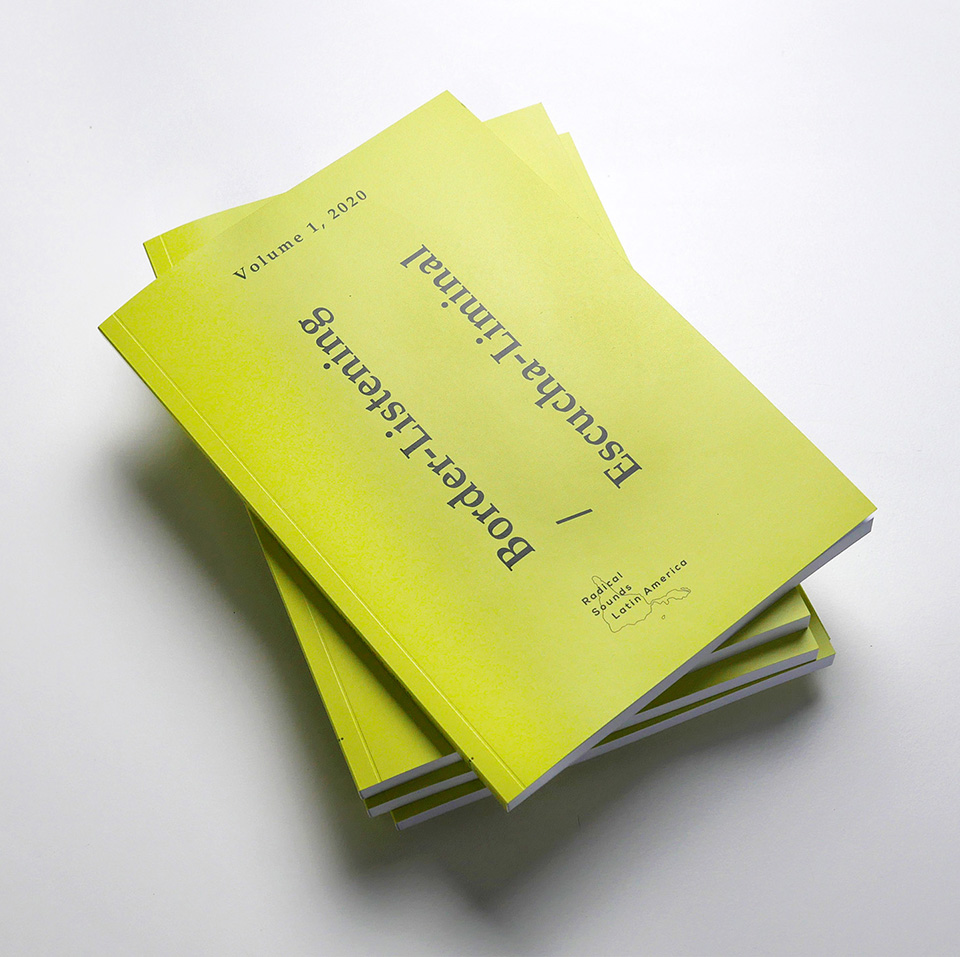
    Border-Listening/Escucha-Liminal 2020

    €7.00 + shipping costs

    14.8 x 21.0 cm / Softcover, 170 pages, English/Spanish texts

    BUY PRINTED EDITION[/vc_column_text][/vc_column][/vc_row][/vc_section]

  • Forbidden Music, Forbidden Jukeboxes: Listening Anxieties and the Hyper-amplification of Violence in Rio de Janeiro

    Forbidden Music, Forbidden Jukeboxes: Listening Anxieties and the Hyper-amplification of Violence in Rio de Janeiro

    [vc_section css=”.vc_custom_1579170657650{margin-top: 20px !important;margin-right: 20px !important;margin-bottom: 20px !important;margin-left: 20px !important;border-top-width: 1px !important;border-right-width: 1px !important;border-bottom-width: 1px !important;border-left-width: 1px !important;padding-top: 0px !important;padding-right: 0px !important;padding-bottom: 0px !important;padding-left: 0px !important;border-left-color: #000000 !important;border-left-style: solid !important;border-right-color: #000000 !important;border-right-style: solid !important;border-top-color: #000000 !important;border-top-style: solid !important;border-bottom-color: #000000 !important;border-bottom-style: solid !important;border-radius: 1px !important;}”][vc_row gap=”5″ equal_height=”yes” content_placement=”top”][vc_column align=”center” padding_right=”30px” padding_left=”30px”][vc_empty_space height=”40px”][vc_column_text]

    Border-Listening/Escucha-Liminal 2020

    [/vc_column_text][vc_column_text]

    Pedro J S Vieira de Oliveira

    Forbidden Music, Forbidden Jukeboxes
    Listening Anxieties and the Hyper-amplification of Violence in Rio de Janeiro

    [/vc_column_text][vc_empty_space height=”40px”][vc_column_text]

    Download PDF

    [/vc_column_text][/vc_column][/vc_row][vc_row gap=”5″ equal_height=”yes” content_placement=”top” el_class=”article-body”][vc_column padding_left=”30px” el_class=”footnotes”][vc_empty_space height=”40px”][vc_column_text]Dr. Pedro J S Vieira de Oliveira is a Brazilian researcher, sound artist, and educator working with the (colonial) articulations of sound and listening in the policing of border and urban spaces. He holds a PhD from the Universität der Künste Berlin, and is a former research and teaching assistant in Media and Cultural Studies at the Heinrich-Heine Universität Düsseldorf, as well as lecturer in Musicology at the Humboldt-Universität zu Berlin.[/vc_column_text][/vc_column][/vc_row][vc_row gap=”5″ equal_height=”yes” content_placement=”top” el_class=”article-body”][vc_column padding_left=”30px”][vc_column_text]Listening is a mediating and mediated phenomenon; it produces and is produced by an interplay of haptic, affective, cultural, social, and political responses, engaged not only in the ear but with the whole body. Listening occurs inside and outside, moving outwards and inwards in resonance with the world and the power relationships that constitute it. That this mediation process is always an articulation of power demands an interrogation of its use as a means of exercising, sustaining, enforcing, and reproducing violence.

    Studies on sound and power and their violent articulations are abound; from the instrumentalization of sonic media by the Nazi regime in Germany (Birdsall 2012) to discussions on the affective power of noise and its cultural implications (Thompson 2017). From the ubiquity of music (Kassabian 2013) to its use as a torture mechanism in US prisons (Cusick 2006, 2008a, 2008b, 2011), to sound as “vibrational affect” (Goodman 2010). These studies expose the multifaceted ways in which sound is appropriated, manipulated, and deployed as a device for oppression and control. My aim here is to expand on this notion by focusing not solely on the act of listening to music in itself, but also on the creation of an entire ecology of listening devices and practices that make use of music – and its absence – to mediate social and political narratives.

    The device I am particularly interested in here is a Jukebox. In 2015 I was researching the political role of sound and listening in Brazil, particularly after the wave of demonstrations of 2013 and the increasing political turmoil building up in the country. I wanted to speak with people whose listening practices are in constant negotiation, particularly in correlation with experiences of police violence. Helping mediate some of the contacts I wanted to chat with was Samara Tanaka, a designer and educator who lives in the Complexo do Lins, the militarized name for a group of 12 favelas whose borders seamlessly blend with the mostly residential neighborhood of Lins de Vasconcelos, in the northern part of Rio de Janeiro. Lins, as this massive part of the city is best known for, has more than 20000 residents, and in 2013 was the 36th region of the city to be occupied by the so-called “pacifying forces” of the military police (known as UPPs). There, Samara and I met for a few beers, and in our conversation she casually mentioned how she would often closely listen to a Jukebox which sat in another bar, uphill and very close to her house. My attention then shifted to this machine and the listening practices around it.

    This particular Jukebox dwells on the fringes of legality, illegality, and a third state of “imposed” illegality by the Military Police, articulated via the listening practices it affords. It is embedded in a system of practices and policies which defy the scope of written — and in turn generate new forms of unwritten — laws. The cultural and political function of this type of jukebox – illegally assembled and distributed over a network on the fringes of the economic system –, subvert and extend well beyond its intended design, embracing the contingency of localized listening practices in order to become, in itself, an ambiguous device. It is capable of encapsulating the tension between a long history of racial and class-based segregation in Brazil and particularly in Rio, as well as the social, cultural, and political implications of one of the most brutal Police forces in the world. Because of the ways in which its presence and absence articulate a non-verbal language within the social configuration of Lins, this jukebox enables temporary governances that might be particular to that place, but nevertheless reflect a larger sociopolitical scenario. It is an invisible nodal point of the social life around it, narrated not only by the songs it plays but also how, why, when, by whom, and for whom it does.


    A (very) brief history of Jukeboxes in Brazil

    The presence of jukeboxes at the margins of urban life in Brazil mirrors their social and cultural origins within racial segregation in the United States. Kerry Segrave argues that the emergence of music machines for collective listening in the US was a response to the absence of, in his words, “race records” (i.e. music made by African-American artists) in radio programming (2002, 45–6). With Jim Crow legislations forcefully preventing African-Americans from freely moving and dwelling, jukeboxes emerged as markers of African-American leisure and entertainment (ibid.) – a marker that also reflected on its naming choice. Coffee houses and bars frequented by African-Americans were largely perceived by racist, white US Americans as being “inadequate places” – or “jook joints” (ibid., 17). Segrave argues that the term ‘juke’ is believed to be originated from the word ‘jook,’ “an old Southern word of African origins” which stands for dancing (ibid.). Nevertheless, jukeboxes were a promising enough business to be whitewashed into a symbol of US American popular culture. With World War II, jukeboxes functioned as a way to keep patriotic morale up via listening to music that could speak directly to the ‘good spirits’ of (white) US Americans, exactly by focusing on the so-called “masses […] who frequented the taverns, restaurants, and so on from which the armed forces were drawn.” (ibid., 129)  Thus, to trace back the origins of the name jukebox – and its placement within an imperialist and racialized consumer culture – is to trace back a history of racialized listening.

    As the cultural branch of US imperialism expanded after WW2, so did the jukebox business. US companies began exporting music machines to places fueled by and flooded with US American media, music, and lifestyle. The largest of them was South America: according to Segrave, while in 1939 only 16 jukeboxes were exported from the US to Brazil, that number skyrocketed to over 650 machines ten years later (ibid., 327–330). Until the late 1990s all jukeboxes in the country were imported, and foreign investment policies in Brazil at the time prevented the emergence of a local manufacturing market (Aprova 2013, 1). Yet digital jukeboxes, which can be easily assembled with a desktop computer set and fed with digital music and video files, supplied that demand quite easily, and popularized the device all around Brazil. Digital jukeboxes are also in high demand for buying and renting on the Internet, with video tutorials for setting up and downloading unlicensed content for jukebox software being easily found on a quick YouTube search.

    Jukeboxes in Brazil are a profitable commodity, albeit not always conforming to a traditional top-down distribution and copyright model. In 2013 it was estimated that there were more than 27000 jukeboxes in operation in Brazil (Aprova 2013); machines like these are easily found in dive bars, mostly in unprivileged neighborhoods, outskirts of big cities, and in the countryside (Feltrin 2016). In Rio, precise information about jukeboxes are scarce – mostly because the absolute majority of these music machines are considered to be illegal. In 2015, 98 percent of the more than 20000 machines installed in bars and restaurants in the state of Rio were outside the scope of those controlled by ABLF (Brazilian Association for Phonographic Licensing).[1] Having the proper license to install these machines means a way to ensure royalties are paid back to the artists whose music is stored in the hard drive of these jukeboxes. For 2 Brazilian Reais (approximately forty cents of Euro) a listener can choose two songs to be played from a rather comprehensive catalog – more often than not downloaded from torrent websites or added directly via USB sticks by unlicensed distributors or bar owners. Media reports affirm that unregistered machines are mostly controlled by either drug lords or milicianos (factions within the Military Police which perform illegal activities in most favelas in Rio),[2] who collect around 30 to 40 percent of the money spent in music playing deposited in the machines (Barreto Filho, 2012; O Dia 2015). This means that by licensing the jukebox, a substantial amount of the profit from each machine would be immediately out of the distributor’s hands — a narrative that supports the selling and using of these machines outside the scope of the law. Indeed this ‘fee,’ the reports claim, is allegedly used by the factions in money laundry schemes, as well as for financing the illegal trade of drugs and firearms.

    The ubiquity of jukeboxes in Rio shows that apart from being a profitable source for these activities, they also function as a marker of control and influence over territory. Every faction designs its own jukebox label or ‘seal’ — some use images of cute little animals, others pictures of beautiful landscapes (Anonymous cited in Band, 2015); such a visual marker ensures that no other service provider, covered by law or otherwise, may profit from the jukebox business in that neighborhood. Knowing how to identify these labels gives clues as to whom each jukebox originally belongs; it is a subtle mechanism for understanding which faction is in control of that area. Jukeboxes are a contentious piece of technology, often forbidden, subtracted, or destroyed by dominant factions; business owners then either resort to licensed devices  — operating in accordance with the Police – or avoid dealing with music machines altogether (Barreto Filho 2012).


    Understanding Proibidão

    Another reason for keeping unlicensed jukeboxes is the possibility these machines offer for adding music falling outside mainstream distribution channels. One key example is proibidão, also known as “funk proibido (forbidden funk), rap de contexto (context rap) or funk de facção (faction funk)” (Palombini 2011, 103, original emphasis). One of the most controversial subgenres of funk carioca, proibidão is often acknowledged as a direct response from the favelas to the ongoing criminalization of funk and its MCs and DJs by the Brazilian media (Lopes 2009; Palombini 2014). Proibidão usually re-appropriates melodies from well-known songs, adapting them to the ubiquitous beat of tamborzão and replacing the original texts with lyrics celebrating violence, or extolling the activities of a faction (Sneed 2008, 71). Its lyrics often serve as a direct provocation or confrontation towards the Military Police, the milícias, or rival factions. According to the historiography of proibidão offered by Brazilian scholar Carlos Palombini the term can be traced back to 1995 with a series of homemade CD-Rs containing live recordings of songs praising the leaders of Comando Vermelho (one of the biggest and oldest factions in Brazil). Indeed, Proibidão is seldom circulated via the usual means, relying instead on bootleg recordings from live performances or informal file sharing in USB-drives, bluetooth exchange, Facebook, or WhatsApp.[3]

    In Lins, proibidão is everywhere; much like any other neighborhood in Rio, Lins has its own roster of MCs, producers, and studios creating music specific to that community. This is another reason why jukeboxes are a reliable business activity expanding and reaching beyond peer-to-peer distribution models: they allow for music specific to that area, and in turn from the specific faction in control, to be not only played but also permanently stored, functioning as a sonic marker in that specific place of a particular and wider territory. Indeed, playing a proibidão song celebrating the leaders and events from one faction in a favela controlled by another might lead to rather violent backlash.


    The Jukebox of Lins

    When Samara described to me the jukebox sitting outside a bar near her house in Lins, she immediately remarked how the machine was a key element for everyday life in her part of the neighborhood. She told me that, specially because the machine was placed outside the bar, it could be used at any time of the day or night, often working non-stop until the wee hours of the morning. Listening is essential to understand the flow of everyday life and the hidden cultural codes of Lins. Samara told me she used the jukebox as a “thermometer,” as paying attention specifically to the music being played in the jukebox near her house was fundamental for sensing what was the general mood of the street, and, more importantly, whether it would be safe to go out and walk around.

    Samara also noticed that this particular machine was being constantly confiscated by the Police whenever there was a raid in her area, to the point in which the machine was eventually replaced by another, smaller, wall-mounted one, which now stays inside the bar. When I asked her if she knew, or could at least guess the reasons for the constant subtraction of the first machine, she said that she did not know for sure but had a strong feeling it was not necessarily because the machine was unregistered, but rather that the ‘problem’ was in its content, or in other words, in the proibidão songs in its hard drive:

    Whenever the Police noticed they were playing these illegal songs, I’m not sure but I think they confiscated the machine, or only confiscated the songs […] The bar owner pays a monthly fee for the machine to be there, and also for maintenance. She told me this new, smaller machine they have now is a ‘legal’ one, because it does not come with proibidão songs in it, so people had to sort of ‘hack’ the machine […] while the older one, which stayed outside, had proibidão songs in it by default. So this new one, which in theory does not have proibidão, is not a problem [for the Police]. But I am still not sure the machine itself is legal.

    Playing and listening to proibidão is not forbidden by law, although it lies on a blurry legal zone between freedom of speech and inciting crime (apologia ao crime) — a felony under Brazilian law. Samara was right: according to O Dia, the Police does not have legal authorization to confiscate and remove jukeboxes even when the machines are not licensed. In an official note to the newspaper, a spokesperson stated that pay-for-music-playing “is not characterized as gambling, and as such these machines are outside the scope of action by the Police.” (O Dia, 2015) Nevertheless, for the Military Police at the UPPs, proibidão poses a threat to the alleged peace of ‘pacification’; its very presence in the hard drive of any given jukebox yields a tense and anxious environment of conflict, governed by a micro-universe of sonic possibility. The listening of proibidão is a sonic manifestation that takes up the auditory space, suspending the fabricated ‘state of normalcy’ created by Police presence, and replacing it with the realities of everyday life in the favelas. It creates a permanent situation of listening anxiety, which affords and prepares for direct confrontation.

    Paying attention to the choice of playlists also gave Samara hints as to who was around the bar; certain songs were indicative of specific persons, while a predominance of proibidão made the atmosphere around the bar tenser. Samara commented that, in her experience, longer sessions of proibidão played in the jukebox meant different codes. She described them to me as “teasing playlists”: it might mean that key figures of the faction or its local branch could be around the bar; it might also be a form of celebrating the success of an operation or raid by the faction; and lastly, it is the code with which to indicate that something bad is about to happen anytime soon. The latter served as both a warning sign for the people from Lins – so they stay in, shut the windows and remain quiet at their homes, as well as a ‘warm-up’ for the listeners themselves. Conversely, silence is another auditory code for orientation; she also remarked that the sudden absence of music in the jukebox might mean that conflict has already arisen, with silence working as a way of allowing the neighborhood to identify the source and location of the gunfire. It is clear, then, that the idea of the jukebox as a ‘thermometer’ was not a practice constrained to Samara.

    Michael Bull (2007) argues for the potential of music of “syncing of mood to place” (2007, 126), and the use of long, repeating playlists to “maintain a specific cognitive state in contrast to the ebb and flow of time” (2007, 125) For Tia deNora, this represents an “attempt to ‘orchestrate’ social activity” (2000, 111); her research illustrates how listeners rely on music to regulate mood or to manage social agency, using it as a way “to move out of dispreferred states (such as stress or fatigue) [… Music’s] specific properties — its rhythms, gestures, harmonies, styles and so on — are used as referents or representations of where they wish to be or go, emotionally, physically and so on.” (ibid., 53) The proibidão playlists crafted in the jukebox of Lins are not necessarily meant solely for personal consumption, but rather for shared, public mood enhancement, due to both its sonic character as well as lyrical content. They perform a slightly different activity which resembles more of what J. Martin Daughtry describes, in his study on the use of personal listening devices by the US Troops in the invasion of Iraq, as “technologies of self-regulation in combat” (Daughtry 2014, 230). For Daughtry, the often unauthorized use of personal stereos by deployed soldiers in Iraq, either in earbuds or connected to PA systems, was a device for “attain[ing] the mildly altered state of heightened awareness and aggression that is necessary in order to be an effective warrior.” (ibid., 231)


    The hyper-amplification of listening anxieties

    The auditory space of Lins is governed by the anxiety of militarization, of wartime as normalcy. The presence of the jukebox blurs the distinction between the auditory space of civilian and military life, negotiating the permanent imminence of combat through situations of perceived quietness of everyday life in the neighborhood. The soundscape of Lins in this act of listening to long proibidão playlists is in neither and both states at the same time: conflict is always lurking ahead, be it because the faction is ready for taking action, or because the listening to these songs may attract the Police to the area to check on the alleged ‘illegality’ of the jukebox, which in turn poses the risk of engaging in direct confrontation with the listeners. This is the reason why, for instance, Samara advised me not to photograph the jukebox, as doing so could potentially draw suspicion.

    Whether or not listening to proibidão actually leads to conflict is irrelevant; the connection between the jukebox and violence is not one of correlation-causation. Rather, the sonic affordances of the jukebox trigger  anxieties which shift the auditory codes of that community. The possibility of criminalizing certain listening practices creates an auditory state of exception, which justify actions falling outside the scope of written law. This in turn creates what Stuart Hall et al. have discussed as the “amplification” character of the Police (1978, 38): engaging in performative acts such as raiding bars full of local residents to subtract ‘illegal jukeboxes’, the act of policing creates and foments the conditions for more violent acts to happen. Hall et al. claim that this “translation of fantasy into reality […] can elicit from a group under suspicion the behaviour of which they are already suspected.” (ibid., 42) It is a self-fulfilling prophecy of creating conflict by violently silencing the (possibility of) sounds that are perceived to generate conflict in the first place.

    The listening practices fostered and made possible by this specific jukebox extend the notion of legality under the perspective of copyright law,to the notion of legality of the auditory space in and by itself. It is through the way it occupies the auditory space of Lins that the jukebox allegedly ‘allows’ the Military Police to bend the rules, exacerbating and overstating their already strong authoritarian position in the favelas, so as to be able to turn these machines into illegal devices. Because the machines are perceived to be menacing to the comfortable fiction of the pacification project, the Police abuses the State apparatus with the excuse of protecting private interests. Therefore it is not by being unregistered, but rather by how the jukebox creates tension and anxiety in both the bar’s neighbors and in the Police of the UPP, that the machine becomes illegal.

    This jukebox is, then, a designed installment of Rio’s Drug Wars in the neighborhood. It dictates the overall spirit of that part of Lins, while at the same time reasserting a faction’s hegemony. It is a form of shared listening that expands the original sonic affordances of the device — casual listening, background listening, or simple musical entertainment — to become an instrument for the non-verbal communication of the threat of violence. Listening to proibidão in the jukebox re-frames the original design of the machine in order to subvert its functionality: sharing music amongst its immediate listeners as a code and mood enhancer for mutual recognition of one another as members of a community; inwards listening, to the community as a warning sign for their own safety; and lastly, broadcasting music outwards to the targeted enemy — be they the rival faction or the Police – as a direct affront and provocation.

    The jukebox of Lins shows an insidious and subtle relationship with the perception of criminality, as well as with the very agents responsible for enforcing this notion. In fact, the machine of Lins functions in itself, and most importantly in the ears of the Military Police of the UPPs, as a provisional vector not only for criminality but also for the threat of violence. The tense environment afforded by the jukeboxes’ proibidão songs become an excuse for an auditory authoritarianism enacted by the Police; their actions, conversely, only sustain and reinforce the very existence of this listening anxiety. It creates a temporary set of unwritten laws, which are enforced by the armed wing of the State in order to render the machine’s sonic affordances – and consequently the populations who are subject to or make use of them – silent.[/vc_column_text][/vc_column][/vc_row][vc_row gap=”5″ equal_height=”yes” content_placement=”top” el_class=”article-body”][vc_column padding_left=”30px” el_class=”footnotes”][vc_column_text]Notes

    [1] O Dia estimates that only three hundred machines are properly licensed (O Dia, 2015); the report from Band, however, claims the number of registered and licensed machines might be over five hundred (Band, 2015).

    [2] The relationship between the Military Police and the drug factions is complex and marked by disputes over territory. The milícias are factions that evolved from death squads and vigilante groups in the late 1980s in Rio. Composed mostly by policemen, ex-policemen, firefighters or reformed military officers, these factions have overtaken power in many favelas in Rio in the early 2000s, and function as their parallel power, extorting business owners and taking control of services and infrastructure in these communities. With the ascension of Bolsonaro to power in 2018, the milícias in Rio have become stronger than ever, and their ties with politicians in Rio more evident. Comprehensive discussions on the emergence and actions of the milícias can be found in Zaluar and Conceição (2007).

    [3] Despite its constant portrayal in the media as a “threat” to the middle class, one of the most famous examples of proibidão has made international news in a different way — as the soundtrack and main theme of the movie Tropa de Elite. While the version used in the movie presents different lyrics, the original “Rap das Armas” by MC Junior and Leonardo describes a broad range of firearms; indeed, the beat is built around sampled gunshots, and the chorus is an onomatopoeic rendition of the sounds of an automatic rifle. Listen:

    (access August 25, 2020).[/vc_column_text][vc_empty_space height=”40px”][vc_column_text]References

    Aprova. 2013. “Informativo Institucional.” http://www.aprova.org.br/pdf/COMUNICADO-INSTITUCIONAL-2013_Jan.pdf.

    Barreto Filho, Herculano. 2012. “Máquinas de Música Viram Alvo de Contraventores, Milicianos e Traficantes.” Extra Online. June 16, 2012. http://extra.globo.com/casos-de-policia/maquinas-de-musica-viram-alvo-de-contraventores-milicianos-traficantes-5225874.html.

    “Bicho e Milícia Lucram Com as Máquinas de Música No Rio.” 2015. O Dia. May 24, 2015. http://odia.ig.com.br/noticia/rio-de-janeiro/2015-05-24/bicho-e-milicia-lucram-com-as-maquinas-de-musica-no-rio.html.

    Birdsall, Carolyn. 2012. Nazi Soundscapes: Sound, Technology and Urban Space in Germany, 1933-1945. 01 ed. Amsterdam: Amsterdam University Press.

    Bull, Michael. 2007. Sound Moves: IPod Culture and Urban Experience. Routledge Chapman & Hall.

    Cusick, Suzanne G. 2006. “Music as Torture / Music as Weapon.” Trans. Revista Transcultural de Música. 2006. http://www.redalyc.org/articulo.oa?id=82201011.

    ———. 2008a. “Musicology, Torture, Repair.” Radical Musicology 3. http://www.radical-musicology.org.uk/2008/Cusick.htm.

    ———. 2008b. “‘You Are in a Place That Is out of the World’: Music in the Detention Camps of the ‘Global War on Terror.’” Journal of the Society for American Music 2 (1): 1–26.

    Cusick, Suzanne G., and Branden W. Joseph. 2011. “Across an Invisible Line: A Conversation about Music and Torture.” Grey Room (January): 6–21. https://doi.org/10.1162/GREY_a_00024.

    Daughtry, J. Martin. 2014. “Aural Armor: Charting the Militarization of the IPod in Operation Iraqi Freedom.” In The Oxford Handbook of Mobile Music Studies, Volume 1, edited by Sumanth Gopinath and Jason Stanyek, 221–258. Oxford University Press. http://www.oxfordhandbooks.com/view/10.1093/oxfordhb/9780195375725.001.0001/oxfordhb-9780195375725-e-011.

    DeNora, Tia. 2000. Music in Everyday Life. 1 edition. Cambridge ; New York: Cambridge University Press.

    Estado Tem Apenas 2,5% Das Máquinas de Música Legalizadas. 2015. Band. http://noticias.band.uol.com.br/jornaldorio/video/2015/06/04/15496275/estado-tem-apenas-25-das-maquinas-de-musica-legalizadas.html.

    Feltrin, Camilla. 2016. “O Happy Hour Do Proletário Paulistano é Na Jukebox — Parte 1.” Noisey–VICE. February 2016. https://noisey.vice.com/pt_br/article/jukebox-sao-paulo-mais-tocadas-parte-1.

    Goodman, Steve. 2010. Sonic Warfare. Mit University Press Group Ltd.

    Hall, Stuart, Chas Critcher, Tony Jefferson, John Clarke, and Brian Roberts. 1978. Policing the Crisis: Mugging, the State, and Law and Order. 1978 edition. London: Palgrave.

    Kassabian, Anahid. 2013. Ubiquitous Listening: Affect, Attention, and Distributed Subjectivity. 1st ed. Berkeley, CA: University of California Press.

    Lopes, Adriana Carvalho. 2009. “A Favela Tem Nome Próprio: A (Re)Significação Do Local Na Linguagem Do Funk Carioca.” Revista Brasileira de Linguística Aplicada 9 (2): 369–90. https://doi.org/10.1590/S1984-63982009000200002.

    Palombini, Carlos. 2011. “Notes on the Historiography of Música Soul and Funk Carioca.” Historia Actual Online 0 (23): 99–106. http://historia-actual.org/Publicaciones/index.php/haol/article/view/501.

    Segrave, Kerry. 2002. Jukeboxes: An American Social History. Jefferson, N.C: McFarland.

    Sneed, Paul. 2008. “Favela Utopias: The Bailes Funk in Rio’s Crisis of Social Exclusion and Violence.” Latin American Research Review 43 (2): 57–79. https://doi.org/10.1353/lar.0.0031.

    Thompson, Marie. 2017. Beyond Unwanted Sound: Noise, Affect and Aesthetic Moralism. Paperback. New York: Bloomsbury Publishing Plc.

    Zaluar, Alba, and Isabel Siqueira Conceição. 2007. “Favelas Sob o Controle Das Milícias No Rio de Janeiro: Que Paz?” São Paulo Em Perspectiva 21 (2): 89–101.[/vc_column_text][vc_empty_space height=”40px”][vc_column_text]© 2020 Radical Sounds Latin America and the author

    Published Oct. 02, 2020[/vc_column_text][vc_empty_space height=”40px”][/vc_column][/vc_row][vc_row fullwidth=”has-fullwidth-column” equal_height=”yes” content_placement=”middle” margin_bottom=”0px” padding_top=”0px” padding_right=”0px” padding_bottom=”0px” padding_left=”0px”][vc_column width=”1/2″ margin_bottom=”0px” padding_bottom=”0px”][agni_image img_url=”2255″][/vc_column][vc_column width=”1/2″ margin_bottom=”0px” padding_bottom=”0px”][vc_column_text]

    Border-Listening/Escucha-Liminal 2020

    €7.00 + shipping costs

    14.8 x 21.0 cm / Softcover, 170 pages, English/Spanish texts

    BUY PRINTED EDITION[/vc_column_text][/vc_column][/vc_row][/vc_section]

  • Introduction

    Introduction

    [vc_section css=”.vc_custom_1579170657650{margin-top: 20px !important;margin-right: 20px !important;margin-bottom: 20px !important;margin-left: 20px !important;border-top-width: 1px !important;border-right-width: 1px !important;border-bottom-width: 1px !important;border-left-width: 1px !important;padding-top: 0px !important;padding-right: 0px !important;padding-bottom: 0px !important;padding-left: 0px !important;border-left-color: #000000 !important;border-left-style: solid !important;border-right-color: #000000 !important;border-right-style: solid !important;border-top-color: #000000 !important;border-top-style: solid !important;border-bottom-color: #000000 !important;border-bottom-style: solid !important;border-radius: 1px !important;}”][vc_row gap=”5″ equal_height=”yes” content_placement=”top”][vc_column align=”center” padding_right=”30px” padding_left=”30px”][vc_empty_space height=”40px”][vc_column_text]

    Border-Listening/Escucha-Liminal 2020

    [/vc_column_text][vc_column_text]

    Alejandra Luciana Cárdenas

    Introduction

    [/vc_column_text][vc_empty_space height=”40px”][vc_column_text]

    Download PDF

    [/vc_column_text][vc_empty_space height=”40px”][/vc_column][/vc_row][vc_row gap=”5″ equal_height=”yes” content_placement=”top” el_class=”article-body”][vc_column padding_left=”30px”][vc_column_text]Our world is marked by wounded borders.

    Some of us have occasionally experienced an illusion of having crossed to a different territory—physically or mentally—only to later realize we were still inhabiting the borderlands. To paraphrase Gloria Anzaldúa, we carry “home” on our backs wherever we go, and with that “home” we carry the invisible borders marked on our skins, passports, accents, life stories, and desires.

    “Borderlands” are “una herida abierta”—“an open wound”—, Anzaldúa wrote in her 1987 memoir Borderlands/La Frontera: The New Mestiza, into which she compressed the struggle and pain of existing in the borderlands. However, this struggle also opens potentially fertile lands to cross-pollination.

    Anzaldúa, a Chicana poet and activist, from her own lived reality as a “border woman” in the region between Texas/the U.S. Southwest and Mexico, in an assemblage of prose and lyrical autobiographical passages, mixed with historical, spiritual, and psychological reflections. Her self-narration is an autohistoria, a term she coins to describe a relational form of writing that goes beyond autobiography, [1] and includes both personal and collective (hi)stories: “it deals with who tells the stories and what stories and histories are told” (Anzaldúa, 1993: 183).

    Her proposal for a border consciousness— “a new mestiza consciousness”—changes the locus of enunciation to, in her words, those “who cross the confines of the normal,” that is, those at the peripheries of the intersections of race, class, ethnicity, and sexual orientation. Against a universal, rational, uniform, and monolithic view of the production of knowledge and historical discourse that, arguably, does not produce uniform, rational, nor objective knowledge, but affords instead ignorance about the power relations that structure those worldviews, the situatedness of her accounts echoes an embodied subject—a perspective shaped by her particular social, cultural and political experience and knowledge. Her border is an embodied border.  The central role of the body is not as a colorless mode of embodied being-in-the-world;[2] the materiality of the space she inhabits is contingent upon her own border flesh and colonial wound.

    1,950 mile -long open wound

    dividing a pueblo, a culture,

    running down the length of my body,

    staking fence rods in my flesh,

    splits me splits me

    me raja me raja (Anzaldua: 1987, 2)

    Pensamiento fronterizo (Border thinking), a concept inspired by Anzaldúa’s theoretical perspective, her “theory in the flesh” (Moraga and Azaldúa, cited in Yarbro-Bejarano 1994, 6), has been further advanced by Latin American decolonial thinkers, such as Walter Mignolo. Mignolo’s borders are not restricted to geographic lines, that is, nation-state borders, but defined by epistemic, political, and subjective differences within modernity/coloniality,[3] the “psychological racial barriers, borders of gender, sexuality, and racial classification, and so forth” (2012, xvi).  The paradox of the border is that it emerges from a duality that is inherent in the metaphor, but simultaneously opens a space of liminality that resists binary classification. In short, within the tension between modernity and coloniality, where binaries break down, is a place where new hybrid territories can emerge.

    Recognizing the need to rearticulate the of modernity, that is, “the outside created from the inside” (Mignolo & Tlostanova, 2006), border thinking is an epistemological position that emerges from colonial difference. Not the result of rejecting modernity, but of holding onto a thinking and sensing that is ingrained in a body situated in the exteriority of modernity. (Mignolo, 2001), Mignolo calls this an “epistemic disobedience.”

    Embracing this epistemic disobedience, listening from the borders—the Border Listening/Escucha-Liminal referred to in this publication’s title—advocates that a listening practice that dwells on the borders should bring to the foreground the situated sonic encounters that inhabit these margins. Moving from normative listening to border listening entails putting one’s ear to modernity’s wall to hear its silenced side.

    An acoustic modernity/coloniality

    Jonathan Sterne argues that audile techniques [4] and the practices of listening were articulated within the fabrics of modernity, because “sound, hearing, and listening are foundational to modern modes of knowledge, culture, and social organization,” against “the pervasive narrative that says that, in becoming modern, Western culture moved away from a culture of hearing to a culture of seeing” (2003, pp.2-3). Sterne’s “acoustic modernity,” is a concept he establishes in correlation to rationalism, capitalism, colonialism, racism, corporate power, mass communication, confidence in progress, and a “universal abstract humanist subject” (2003).

    Sterne’s conception of acoustic modernity opens up the question of how auditory perception is affected by colonial legacies. Moreover, assumptions about the difference between seeing and listening (what Sterne calls “the audiovisual litany”), [5] which he describes as “presumed and somewhat clichéd attributes” (2012, 9), are conversely historically intertwined and coeval with colonial and imperial processes. Ana Maria Ochoa Gautier’s (2014) trajectories in Aurality provide an important account of how listening, alterity, and orality were central to the constitution of modernity, via her skillful mapping of voice and listening in the nineteenth-century Colombian historiography.

    The resonant relationships between listening and coloniality speak of extraction, depletion and commodification of our wounded planet. In examining the new landscapes of precarity and ecological devastation, longstanding and ongoing debates on ecology that emerge from our sonic fields often disregard this significant connection.  Ecological and Climate Change-themed artworks, questions about the Anthropocene period and new conceptualizations of nature/culture have been a fertile source of interest within acoustic ecology and sound studies.[6] Departing from R. Murray Schafer’s 1970s ubiquitous and totalizing notion of the soundscape that engages with “the relationship between man and the sounds of his environment and what happens when those sounds change” (1977, 4), Mayra Estévez Trujillo challenges Schafer’s vision, as it omits consideration of the power relations, control and geopolitics that condition the generation of sound worlds, “[the] product of anthropic actions based on development and economic growth without limits” (2015, 2016). Schafer’s soundscape studies (and acoustic ecological debates) concerned with the awareness that can be attained through the act of listening become questionable when they neglect the colonial exploitation and oppression that lie at the heart of Man’s problematic relation with the environment. Ecological disaster is constitutive to the history of colonialism, and insofar as the biopolitics of silence (2015, 186), as Ana María Ochoa describes it, permeates our listening practices, the soundscape will remain a site of environmental romanticism.

    Sound and the listening experience, asserts the Brazilian sound artist and researcher Pedro Oliveira, cannot be thought of outside their political dimension (2020). Oliveira advocates for sound (and sound art) as a situated practice, rather than divorced from the social, cultural, and political contexts they stem from (ibid). His proposal of “dealing with disaster” explores the sonic possibilities of relating sound and source, against the ongoing colonial process of disaster, presented as a chain of events that is obscured and made invisible from its own points of enunciation (ibid). The detachment between sound and sources from phonographic archives, field recordings, sonification of data, laboratory formats and eco-sound artworks, some of them presented as scientific and objective,[7] when depoliticized and neglectful of reengagement with their sources, contribute to the construction of an abstract, disembodied landscape.

    Although the term “decolonization” has slipped more often into sound/music conferences and workshops, it is often presented in something of the light of a trending, yet tired trope, detached from local debates, and devoid of the ethical responsibility to deeply rethink the apparatus of knowledge of the Western knowing subject.

    Situated knowledges, as Donna Haraway holds (1988), underlines the material, social and political conditions in which knowledge is produced. In the same sense, situating listening on a border demarks a geopolitical and social position, and accounts for the dimensions of the lived experience, which must lead us towards questions, conditions, and categories local to the complex realities of the specific places of enunciation.

    Raíz (“root”), is a meaningful word that resounds in my mind when I think of an embodied and situated practice of listening, due to its relation to earth. The expression echar raíces refers to the act of rooting, but also to settling, to embracing deepness as a way of relating to the world. Echar raíces, as a radical mode of demarking a locus of sensing and knowing, avoids being entrenched in the present—it grows inversely, deepening into the ground—to project itself outwards, to new, fertile, future-oriented territories.

    Addressing a listening practice that emerges from situated and local experiences of the world, as opposed to the horizon of perception that is presented as universal is one of the strongest motivations that drive this publication. This effort brings together ten sonic stories from the “global South,” in two different languages, and begins the series “Border-Listening/Escucha-Liminal.” This seed that we sow here is planted in the hope that it will continue to take root.

    The ten transdisciplinary pieces presented here engage with new perspectives and expressions, articulate coexisting multiple temporalities, and embrace layered contradictions and complexities within Latin American soundscapes. These sensorial landscapes arise from Guatemala, Belize, Honduras, El Salvador, Nicaragua, Costa Rica, Panama Brazil, Mexico, Peru, Argentina, Guajira Peninsula. This effort is built upon (and indebted to) the work of all scholars working from the liminal spaces of the sonic field.

    Finally, to close this introduction, a passage from Anzaldúa’s memoirs that I believe carries a future-oriented prescription:

    “Knowing” is painful because after “it” happens I can’t stay in the same place and be comfortable. I am no longer the same person I was before (1999, 48).

    [/vc_column_text][/vc_column][/vc_row][vc_row gap=”5″ equal_height=”yes” content_placement=”top” el_class=”article-body”][vc_column padding_left=”30px” el_class=”footnotes”][vc_column_text]Notes

    [1] See “Border Arte: Nepantla, el lugar de la frontera” (Anzaldúa, 1993: 113).

    [2] See Frantz Fanon’s critique of Merleau-Ponty’s embodied phenomenology in Black Skin, White Masks. Fanon articulates a critique of the universal body schema by examining how black bodies experience the world differently. The black body is relentlessly signified and objectified through the historico-racial schema sketch that lies beneath its corporeal schema, thus, portrayed in the passage:

    “Look, a Negro!” It was an external stimulus that flicked over me as I passed by. […] “Mama, see the Negro! I’m frightened!” Frightened! Frightened! Now they were beginning to be afraid of me. I made up my mind to laugh myself to tears, but laughter had become impossible. I could no longer laugh, because I already knew that there were legends, stories, history, and above all historicity, […] the corporeal schema crumbled, its place taken by a racial epidermal schema. […] I was responsible at the same time for my body, for my race, for my ancestors. I subjected myself to an objective examination, I discovered my blackness, my ethnic characteristics; and I was battered down by tom-toms, cannibalism, intellectual deficiency […] (Fanon 2008, 84).

    [3] Modernity/coloniality’ is a concept first articulated by Aníbal Quijano, beginning a thought movement with Andean roots. See Quijano’s seminal article Colonialidad y modernidad/racionalidad (1991) [Coloniality and modernity/rationality]. Quijano articulates the notion of coloniality of power, a system that organized the distribution of epistemic, moral, and aesthetic resources in a way that both reflects and reproduces empire. Race, in its modern meaning, did not pre-exist the colonization of America, but is a mental category of modernity established as an instrument for granting legitimacy to relations of dominance (2000).  For Quijano, as for Walter Mignolo, colonialism did not end with the culmination of the transatlantic expansion of Europe—he recognizes it as an ongoing process termed coloniality. It identifies the first stage of modernity (in the sixteenth-century European imperial project) as the underside of colonialism, to co-constitute the coeval notion of modernity/coloniality (Quijano 2000, Mignolo 2011). The process of modernity/coloniality is a two-sided operation: modernity’s ‘worlding-the-world’ affirms itself as the universal reality (although built on ambivalent ideas of innovation, secularization, rationality, and scientific progress), while coloniality’s ‘un-worlding-the-world’ inflicts a negation on the otherness outside that reality (Quijano 2000, Vasquez 2012, 2017).

    [4] Sterne’s concept of audile techniques refers to a set of practices of listening that were articulated via a system of science, reason, and instrumentality that encouraged coding and rationalization, borrowing from the field of medicine. This occurred in the first decades of the nineteenth century, and in the context of emergent sonic media: sound telegraphy, telephony, phonography, and radio (2003, 22-23).   

    [5] [T]he audiovisual litany: […] hearing is concerned with interiors, vision is concerned with surfaces; hearing involves physical contact with the outside world, vision requires distance from it; […] hearing tends toward subjectivity, vision tends toward objectivity; […] hearing is about affect, vision is about intellect; […] hearing is a sense that immerses us in the world, while vision removes us from it (Sterne 2012, 9)

    [6] See Vandsø, Anette. 2020. The Sonic Aftermath: The Anthropocene and Interdisciplinarity after the Apocalypse. In S. Krogh Groth & H. Schulze (Authors), The Bloomsbury Handbook of Sound Art (pp. 21–40). London: Bloomsbury Academic.

    [7] See Vandsø, Anette. 2020. The Sonic Aftermath: The Anthropocene and Interdisciplinarity after the Apocalypse. In S. Krogh Groth & H. Schulze (Authors), The Bloomsbury Handbook of Sound Art (pp. 21–40). London: Bloomsbury Academic, for an account of sound artists exploring the ecologies of the Anthropocene and environmental problems.[/vc_column_text][vc_empty_space height=”40px”][vc_column_text]References

    Anzaldúa, Gloria Evangelina. 1999. Borderlands/La Frontera: The New Mestiza, San Francisco: Aunt Lute Books

    Estevez Trujillo, M. E. 2015. “Mis ‘manos sonoras’ devoran la histérica garganta del mundo: sonoridades y colonialidad del poder.” In Calle 14 Revista De investigación En El Campo Del Arte, 10(15), 54-73. https://doi.org/10.14483/udistrital.jour.c14.2015.1.a05

    Estévez Trujillo, Mayra. 2016. “Suena el capitalismo en el corazón de la selva.” Nómadas, (45), 13-25. Retrieved September 12, 2020, from http://www.scielo.org.co/scielo.php?script=sci_arttext&pid=S0121-75502016000200002&lng=en&tlng=es.

    Haraway, Donna. 1988. “Situated Knowledges: The Science Question in Feminism and the Privilege of Partial Perspective.” Feminist Studies 14, no. 3, 575-99.

    Mignolo, Walter & Tlostanova, Madina. V. 2006. Theorizing from the Borders: Shifting to Geo- and Body-Politics of Knowledge. European Journal of Social Theory, 9 (2), 205–221.

    Mignolo, Walter. 2000. Local Histories/Global Designs, Coloniality, Subaltern Knowledges, and Border Thinking, Princeton: Princeton University Press.

    Mignolo, Walter. 2013. “Geopolitics of sensing and knowing: On (de)coloniality, border thinking, and epistemic disobedience.” In Confero, Vol. 1, no. 1. North Carolina: Duke University, 129–150.

    Quijano, Anibal. 2000. Coloniality of Power, Eurocentrism, and Latin America, Neplanta: Views from South, vol. 1, no. 3, 533-580.

    Schafer, R. Murray. 1977. The Soundscape, the Tuning of the World. Vermont: Destiny Books.

    Sterne, Jonathan. 2003. The Audible Past: Cultural Origins of Sound Reproduction. Durham, NC: Duke University Press.

    Sterne, Jonathan. 2012. The Sound Studies Reader. London: Routledge.

    Ochoa Gautier, Ana María. 2014. Aurality, Listening and Knowledge in Nineteenth-Century Colombia. Durham, NC, and London: Duke University Press

    Ochoa Gautier, Ana María. 2015. “Silence”. In Keywords in Sound, ed. David Novak and Matt Sakakeeny, 183–192. Durham, NC: Duke University Press.[/vc_column_text][vc_empty_space height=”40px”][vc_column_text]© 2020 Radical Sounds Latin America and the author

    Published Oct. 02, 2020[/vc_column_text][/vc_column][/vc_row][vc_row fullwidth=”has-fullwidth-column” gap=”20″ equal_height=”yes” content_placement=”middle”][vc_column width=”1/2″][agni_image img_url=”2255″][/vc_column][vc_column width=”1/2″][vc_column_text]

    Border-Listening/Escucha-Liminal 2020

    €7.00 + shipping costs

    14.8 x 21.0 cm / Softcover, 170 pages, English/Spanish texts

    BUY PRINTED EDITION[/vc_column_text][/vc_column][/vc_row][/vc_section]

  • Live performances at radialsystem, Berlin

    [vc_section css=”.vc_custom_1579170657650{margin-top: 20px !important;margin-right: 20px !important;margin-bottom: 20px !important;margin-left: 20px !important;border-top-width: 1px !important;border-right-width: 1px !important;border-bottom-width: 1px !important;border-left-width: 1px !important;padding-top: 0px !important;padding-right: 0px !important;padding-bottom: 0px !important;padding-left: 0px !important;border-left-color: #000000 !important;border-left-style: solid !important;border-right-color: #000000 !important;border-right-style: solid !important;border-top-color: #000000 !important;border-top-style: solid !important;border-bottom-color: #000000 !important;border-bottom-style: solid !important;border-radius: 1px !important;}”][vc_row fullwidth=”has-fullwidth-column”][vc_column padding_left=”30px” offset=”vc_col-lg-12″][vc_empty_space height=”40px”][agni_section_heading heading=”Live performances at radialsystem, Berlin” divide_line=””][vc_empty_space height=”40px”][/vc_column][/vc_row][vc_row fullwidth=”has-fullwidth-column” equal_height=”yes” margin_top=”0px” margin_right=”0px” margin_bottom=”0px” margin_left=”0px” padding_top=”0px” padding_right=”0px” padding_bottom=”0px” padding_left=”0px” border_top=”1″ border_color=”#000000″ border_style=”solid”][vc_column align=”right” width=”1/2″ animation=”1″ animation_duration=”0.8″ animation_delay=”0.4″ margin_top=”0px” margin_right=”0px” margin_bottom=”0px” margin_left=”0px” padding_top=”0px” padding_right=”0px” padding_bottom=”0px” padding_left=”0px” offset=”vc_col-lg-6″][agni_image img_url=”2100″ alignment=”right” img_style=”background” animation=”1″ animation_duration=”0.8″ animation_delay=”0.4″][/vc_column][vc_column bg_choice=”2″ width=”1/2″ animation=”1″ animation_duration=”0.8″ animation_delay=”0.4″ margin_top=”0px” margin_right=”0px” margin_bottom=”0px” margin_left=”0px” padding_top=”30px” padding_right=”30px” padding_bottom=”30px” padding_left=”30px”][vc_column_text]

    SHOWTIME 1 – SAT 3 OCT 18:00 – GET TICKETS

    Laura Mello

    Live Performance

    Mesías Maiguashca presents: La canción de la tierra

    Live Performance

    ¿Cómo Baila el Camaleón? (Re-processed) by Joel Suárez Gómez/Kiko Faxas

    Live Dance Performance

    SHOWTIME 2 – SAT 3 OCT 21:00 — GET TICKETS

    Mesías Maiguashca presents: La canción de la tierra

    Live Performance

    ¿Cómo Baila el Camaleón? (Re-processed) by Joel Suárez Gómez/Kiko Faxas

    Live Dance Performance

    CATNAPP

    Live Performance[/vc_column_text][/vc_column][/vc_row][vc_row fullwidth=”has-fullwidth-column”][vc_column offset=”vc_col-lg-12″][vc_empty_space height=”60px”][/vc_column][/vc_row][vc_row gap=”5″ equal_height=”yes” content_placement=”top”][vc_column width=”1/4″][agni_image img_url=”2094″ img_size=”large” animation=”1″ animation_duration=”0.8″ animation_delay=”0.4″][vc_column_text padding_top=”0px” padding_bottom=”0px” padding_left=”10px” animation=”1″ animation_duration=”0.8″ animation_delay=”0.4″]

    Mesias Maiguascha

    Is an Ecuadorian composer based on Freiburg and an advocate of New Music. He belongs to a generation of South American sound composers that in the 1960s, along with Edgar Valcárcel, César Bolaños, Beatriz Ferreyra, contributed to expanding the possibilities of musical language beyond the prevailing Western canon. This occasion will be the European premiere of his composition Canción de La Tierra first performed in Quito in 2013. A concert that took place within the frame of the Andean celebration of the Inti-Raymi with the “Orquesta de Instrumentos Andinos,” a wind ensemble, a choir, and several sound objects created by Maiguashca. The audiovisual work is a document and reminder of this event, with original recordings of the concert, spatialized audio, and a video by the artist Carlos Poete about the world of the Ecuadorian Andes. [/vc_column_text][/vc_column][vc_column width=”1/4″][agni_image img_url=”2104″ img_size=”large” animation=”1″ animation_duration=”0.8″ animation_delay=”0.4″][vc_column_text padding_left=”10px” animation=”1″ animation_duration=”0.8″ animation_delay=”0.4″]

    Cómo baila el camaleón?

    (Re-processed)
    Joel Suárez Gómez and Kiko Faxas will present a dance and sound piece, structured upon an experimental poem.
    Suárez Gomez has danced for the National Ballet of Cuba (BNC), the Cuban company Danza Contemporanea (DCC ) and toured within Cuba and throughout Latin America, the USA, Australia and Europe. The artist has performed in houses such as Gran Teatro de La Habana, Auditorium Nacional de Mexico, Teatro Opera Nova in Bydgoski Poland, Sadler’s Wells Theater, Mercat de les Flors, Teatro Real de Madrid and the Joyce Theater.
    Kiko Faxas is an avant-garde composer, sound artist, and Cuban experimental coder.[/vc_column_text][/vc_column][vc_column width=”1/4″][agni_image img_url=”2096″ img_size=”large” animation=”1″ animation_duration=”0.8″ animation_delay=”0.4″][vc_column_text padding_left=”10px” animation=”1″ animation_duration=”0.8″ animation_delay=”0.4″]

    Laura Mello

    The Brazilian artist will be presenting the piece Composing for many media including me, an ongoing performance series exploring the relationships among sound, visual, and movement. The Radical Latinamerica Sounds issue focusses on the idea of spinning in its broadest sense. A performer is supposed to drill her instruments and ends up being drilled by them into an environment on stage where hierarchies melt together in one. Her work has been seen and heard at Heroines of Sound, Transparent Sound Budapest, Dystopia Festival, Tonspur MQ Wien, CTM, Festival der Regionen, Dfunk Kultur, Ö1, BBC3, Resonance FM, Orange 94 FM from Vienna and Reboot FM from Berlin. In 2018 she released the double-groove 7“ LP Ringing Still Life and the CD Está Verde!, the last one being released in 2020 as a digital album.[/vc_column_text][/vc_column][vc_column width=”1/4″][agni_image img_url=”2098″ img_size=”large” animation=”1″ animation_duration=”0.8″ animation_delay=”0.4″][vc_column_text padding_left=”10px” animation=”1″ animation_duration=”0.8″ animation_delay=”0.4″]

    CATNAPP

    Favoring emotional expressionism and intense beats, Catnapp (Amparo Battaglia) is pushing the boundaries of electronic music with a unique and bold take on songwriting and production. Her music and live shows are at once challenging and highly relatable, as she combines cutting-edge millennial aesthetics with openhearted lyricism and barely filtered feelings. Her performing style was widely acknowledged as she played some of the biggest stages available for electronic underground artists, from Melt! to Sonar Festival, from SXSW to Berghain. She launched her own label NAPP Records in 2017, allowing her to push and support exciting new artists that explore similarly experimental and idiosyncratic sounds. [/vc_column_text][/vc_column][/vc_row][/vc_section]

  • Live Performances at Cashmere Radio

    Live Performances at Cashmere Radio

    [vc_section css=”.vc_custom_1579170657650{margin-top: 20px !important;margin-right: 20px !important;margin-bottom: 20px !important;margin-left: 20px !important;border-top-width: 1px !important;border-right-width: 1px !important;border-bottom-width: 1px !important;border-left-width: 1px !important;padding-top: 0px !important;padding-right: 0px !important;padding-bottom: 0px !important;padding-left: 0px !important;border-left-color: #000000 !important;border-left-style: solid !important;border-right-color: #000000 !important;border-right-style: solid !important;border-top-color: #000000 !important;border-top-style: solid !important;border-bottom-color: #000000 !important;border-bottom-style: solid !important;border-radius: 1px !important;}”][vc_row fullwidth=”has-fullwidth-column”][vc_column padding_left=”30px” offset=”vc_col-lg-12″][vc_empty_space height=”40px”][agni_section_heading heading=”Mario de Vega, Slim Soledad, ALADA Live” divide_line=””][vc_empty_space height=”40px”][/vc_column][/vc_row][vc_row fullwidth=”has-fullwidth-column” equal_height=”yes” margin_top=”0px” margin_right=”0px” margin_bottom=”0px” margin_left=”0px” padding_top=”0px” padding_right=”0px” padding_bottom=”0px” padding_left=”0px” border_top=”1″ border_color=”#000000″ border_style=”solid”][vc_column align=”right” width=”1/2″ animation=”1″ animation_duration=”0.8″ animation_delay=”0.4″ margin_top=”0px” margin_right=”0px” margin_bottom=”0px” margin_left=”0px” padding_top=”0px” padding_right=”0px” padding_bottom=”0px” padding_left=”0px” offset=”vc_col-lg-6″][agni_image img_url=”2067″ alignment=”right” img_style=”background” animation=”1″ animation_duration=”0.8″ animation_delay=”0.4″][/vc_column][vc_column bg_choice=”2″ width=”1/2″ animation=”1″ animation_duration=”0.8″ animation_delay=”0.4″ margin_top=”0px” margin_right=”0px” margin_bottom=”0px” margin_left=”0px” padding_top=”30px” padding_right=”30px” padding_bottom=”30px” padding_left=”30px”][vc_column_text]

    FRI 2 OCT 19:00 — 22:30

    Mario de Vega

    Live Performance
    7:00pm -8:10pm

    Slim Soledad

    Dj Set
    8:10pm – 9:20pm

    ALADA

    Dj Set
    9:20pm – 10:30pm

    Tune in at 07:00 pm – 10:30 pm CEST on cashmereradio.com or on FM 88.4 Berlin, 90.7 Potsdam.[/vc_column_text][/vc_column][/vc_row][vc_row fullwidth=”has-fullwidth-column”][vc_column offset=”vc_col-lg-12″][vc_empty_space height=”60px”][/vc_column][/vc_row][vc_row gap=”5″ equal_height=”yes” content_placement=”top”][vc_column width=”1/3″][agni_image img_url=”2037″ img_size=”large” animation=”1″ animation_duration=”0.8″ animation_delay=”0.4″][vc_column_text padding_top=”0px” padding_bottom=”0px” padding_left=”10px” animation=”1″ animation_duration=”0.8″ animation_delay=”0.4″]

    Mario de Vega

    Vega´s work is contextual, embracing the tension between documentation and performativity. Photographic documentation, video, dramaturges, objects, remains of actions, events, and situations producing ambiguous relations between objects and spaces. His work has been exhibited in Mexico, North America, Chile, South Africa, India, South Korea, China, Russia, Japan, and around Europe. He lives and works in Berlin and Mexico City. Since 2020, Mario de Vega is Professor for Sound at Kunsthochschule Kassel.[/vc_column_text][/vc_column][vc_column width=”1/3″][agni_image img_url=”2056″ img_size=”large” animation=”1″ animation_duration=”0.8″ animation_delay=”0.4″][vc_column_text padding_left=”10px” animation=”1″ animation_duration=”0.8″ animation_delay=”0.4″]

    ALADA

    The experimental artist from Rio de Janeiro but now residing in Berlin gained cultural relevance through her songs and remixes. They cover a range of unlikely rhythms and are highly inspired by the Afrofuturism movement. Part of her evolution and intention as an artist is to shock and question, bringing a new vision to what we understand as “music”, “art” and “genre”. Always with a paradigmatic break approach, her work has a strong content of emotion and sexuality.[/vc_column_text][/vc_column][vc_column width=”1/3″][agni_image img_url=”2057″ img_size=”large” animation=”1″ animation_duration=”0.8″ animation_delay=”0.4″][vc_column_text padding_left=”10px” animation=”1″ animation_duration=”0.8″ animation_delay=”0.4″]

    Slim Soledad

    Black travesty, performer, and multi-artist from São Paulo, based in Berlin. About 2 years ago she started acting as DJ and her research as a DJ starts from Brazilian funk extending something more experimental and then is kind of crazy frying with very specific points that cross your soul. Slim is part of the queer collective called Chernobyl focused on a POC and LGBTQIA+ audience.[/vc_column_text][/vc_column][/vc_row][/vc_section]

  • Mix 05: CAO

    Mix 05: CAO

    Cao

    Constanza Bizraelli (alias CAO) is a Peruvian electronic music composer and producer, sound artist and theorist, currently based in Amsterdam.
    She directs and edits the academic open access journal Cyclops, a publication dedicated to contemporary and experimental theory. Constanza states: “ the mix presents a wide palette of otherworldly Latin-American and international sounds which as a journey reflect on themes such as migration, discontinuity, fear and instability in the current times of global crisis.”
    The name “CAO” is originally from the archeological site of the pyramids of Cao in Peru, home of an ancestral civilization where a mummy was unearthed of a young empress- priestess. Elements from ancient Peruvian cultures and cosmologies have profoundly influenced CAO’s sound. CAO’s debut album Marginal Virgin was released in 2016 on Opal Tapes (UK) and she has recently released her latest EP titled “Flesh Luminescence” via Club Chai (US).
    Listen to her work on Soundcloud.
    Tracklist
    • Myke Towers – Diosa MASH UP
    • Direct Drive- Larry Heard BY Maria Chavez
    • Walking_In_Sam_Sky_Edit- Soulspeed
    • I’m Good For You (Tiago Remix) by Social Disco Club
    • Timbuktu · Jerome Sydenham & Dennis Ferrer
    • Them Jeans – Git It (Kolombo Remix) – OFFSPIN013 cut
    • Dominik Eulberg – Goldene Acht (Mind Against Remix)
    • Chicola – Velvet Afternoon MASH UP
    • Lennis Rodriguez & Juan Magán- Cucu BY Maria Chavez
    • Green Lights, Original Mix- Marcos Baiano, Noa
    • FUME- Ghetto_NO VOX_Reedit BY Maria Chavez
    • In Deep We Trust – Ba:sen (Pool Party Dub Mix)
    • Fly Robin Fly Remix_SECRET Reedit BY Maria Chavez
    • Paulo Olarte – Solo Dejate Llevar (Switchdance Remix)
    • FIESTA ELEKTRONIKA- FIESTA MIX
    • Ritual Original Mix- Floorplan
    • Mortal Trance (Original Mix) by Boo Williams
    • Muzz (Original Mix) – Crocy
    • Seeing Aliens (Extended Breakthrough Listen) by DJ Koze
    • Time Zone (Mix Two) by LNRDCROY
    • Dernière Danse- Ugg’A MASH UP w
    • Ghost Song (Prompt Remix) – Slam BY Maria Chavez
    • Hasoweh- Andhim & Super Flu Reeves
    • Naked in the Water (feat. Minha Luaa)- Alastair Lane
    • Casin Points of Interest- Glue70
    Cao
  • Mix 04: Dengue Dengue Dengue

    Mix 04: Dengue Dengue Dengue

    Dengue dengue dengue

    This year the audio-visual duo Dengue Dengue Dengue celebrates its 10th anniversary. Felipe Salmón (aka ZUFU) and Rafael Pereira (aka MAKUMBA) had met in 2005 in their hometown of Lima, Peru, and shortly after, began their artistic collaborations. In 2007, together with multidisciplinary artists Juan Barreto, Esteban Coronel, and Nadia Escalante founded ‘Colectivo Auxiliar,’ a multi-purpose platform that would become a fundamental piece of Lima’s underground electronic music scene.
    We are excited to release two mixes as the fourth installment of Radical Sounds Latin America Mix Series. In his set ZUFU articulates his love for complicated patterns, displaying Afro and Latin influenced beats from around the world, while MAKUMBA chose to present a collection of producers from North to South America, exploring polyrhythmic beats and experimental textures, and featuring some exclusive unreleased material from DDD’s upcoming label Kebrada.
    To know more about their work visit their website.
    TRACKLIST – ZUFU
    • Kelman Duran – 1984, primero, ultimo
    • Manara – Traitor meets Taal
    • Dany F – Los Días
    • Lello Fusco – Tropical Beat
    • Esa – Pantsula Traxx
    • Dengue Dengue Dengue – Flootz
    • Moro – Arrepiéntanse
    • Nick Leon – Totem
    • Frenquency – Tropic Al
    • Nuri – Drup
    • Funeral – Festividad
    • Lava Dome – Closer (galtier remix)
    • Saronde – Cold (Instrumental)
    • Denivel Line – Wild Spirits (Wild Mix)
    • Griffit Vigo – Ree’s vibe
    • TASO x Siete Catorce – 2 for 20
    • NA DJ – Rave slaps xtarri
    • Otik – Dioxide (Bruce´s carbon reduction)
    • Strick – Tiled Suite (Syn Remix)
    • Galtier – Gyals
    • Dj Nervoso – Vuto
    TRACKLIST – MAKUMBA
    • Catriel Nievas & Juan Manuel Patricio – Rio Deseado (Excerpt)
    • Dj Yohanna – Las 4 Estaciones
    • Boundary – Galope 034 (Amazondotcom Remix)
    • Milkshk – Driller (Unreleased)
    • Natureboy Flako – Aura Inocente
    • Ingaigna – Magia Negra
    • Tomas Urquitea – Equeletos
    • Superficie – Sequencia
    • Natureboy Flako – Blue Synthasy
    • Superficie – Chassi
    • El Irreal Veintiuno – Yuto Nahua (Baile Funk Version) (Unreleased)
    • Dengue Dengue Dengue – Honduras (Unreleased)
    • Nick Leon – Grillo
    • Tomas Urquieta – Cuerpo sin Organos
    • Nick Leon – Creation Story
    • El Irreal Veintiuno – Quatar (Unreleased)
    • Siete Catorce – Ajo (Unreleased)
    • Funeral – Flota (Unreleased)
    • Lechuga Zafiro Feat c1080 – Isla De Flores (Atrapamboril Mix)
    • Precolumbian & Estoc – CCT01
    • Dengue Dengue Dengue – Birthday (Outro)
    Dengue
  • Mix 03: Elysia Crampton Chuquimia

    Mix 03: Elysia Crampton Chuquimia

    Elysia Crampton Chuquimia

    Elysia Crampton Chuquimia’s Mi Tierra Triste Mix 2020 is a compilation of songs that proclaim resistance, survival, pain and love.
    A carefully and beautifully selected mix of music from Bolivia, Peru, Argentina, and North America that celebrates indigenous culture and moves through landscapes that continue to be forgotten, displaced, and/or underrepresented. A Bolivian-American musician, producer, composer, and poet Elysia Crampton Chuquimia’s music is a collage of contemporary sounds and samples that honor her Aymara heritage and is guided by her extensive travels through the Americas. Her work touches upon themes such as radical politics, LGBT rights, colonization, and Latinx culture through a wide range of American and Andean music both past and present.
    On the 1st of May 2020, the artist released ORCORARA her fifth album via Berlin-based record label PAN. Her work follows fugitives of Christian violence and intergenerational trauma and was originally commissioned and released in 2018 by Centre d’Art Contemporain, Geneva, CH for the first floor at the Biennale de l’Image en Mouvement 2018. All proceeds will go to the American Indian Movement West / AIM SoCal chapters.
    Listen to her work on Bandcamp.
    “Mi Tierra Triste Mix 2020” Tracklist
    • Floyd Red Crow Westerman – Goin’ Back
    • Fiddlin John Carson – Swanee River
    • Jorge Oporto – Ilusión Perdida (Huayño)
    • Mario Anagua – Consejos de Padre (Wayño) / Charango en Re..VOB
    • Jiramaycus Miguel Angel – Hierba Mala
    • Gian Mantilla – Salaque (Zapateo)
    • El Titi en el Lago Sagrado
    • Gato Barbieri – Vidala Triste
    • Markasata – Forastero
    • Aguita de Putina
    • Los Yatiris – Quiruvilca
    • Norman Leslie Jr. – NAC Native American Church Drum Practice
    • La Juvstar RPC (949161236) – Que Me Importa A Mi
    • Juliancito Waly Garcia – Recuerdos (w/ surtido colonial)
    • Edilberto Paucar – Hay Loma
    • Sergio Alvarez – Sambitay 2019
    • Yolanda Alcocer – Mariposita, Mariposita (Wayño)
    • Rossy Condori – Déjame Ser Yo Libre 2020
    Elysa Crampton Chuquimia
  • Mix 02: Dj Sentimiento (Carlycore)

    Mix 02: Dj Sentimiento (Carlycore)

    dj sentimiento (Carlycore)

    Dj Sentimiento’s mix is: “full of Sudaca, Andean energy, 200 bpm, rave music, emotions, memories, holidays.” With a special dedication to their grandfather Edgard “who in these moments of crisis is having a hard time.”
    Settled in all over the sound spectrum, from Hardcore to Huayno, the 17-year-old Peruvian producer, Dj Sentimiento, is interested in conveying teenage angst, our internal demons and the ups and downs of life. Sentimiento’s world is an existential-type of sonic adventure palpable in the project’s name: “I define myself as Sentimiento because I feel we have to search for diversity in life. We have to explore where we come from and get rid of stereotypes of how we should be seen, heard or felt.”
    When not busy on their solo endeavors, Sentimiento gets together with Kornea (an equally talented, young DJ/producer from Lima who runs the label Entrometida), to collaborate under the moniker of Eutanasia. Sentimiento is part of Lima’s underground scene—currently expanding towards the whole of South America —often involved in projects with innovative queer collectives, artists and designers.
    Tracklist
    • Lotic – BADMIND W BJÖRK WAILS AND ETHNIC DRUMS
    • Arca – Travesti
    • Plan B – Fronteo
    • Terrorfakt – Welcome To Hell (Reshanked By Manufactura)
    • Klaxons – Atlantis To Interzone (Crystal Castles Remix)
    • AN System – Torture
    • Doon Kanda – Womb
    • Yarita Lizeth Yanarico – Tu y Yo
    • K.Hole Kardashian – Me Encanta Duro Edit
    • Krolik – RACE FAST BREAK HARD
    • Leo Dan – Te He Prometido
    • DJ ALDAIR EL REY DE LA CHANCADERA – Reynoso Girls
    • Grupo Pacha – La Anaconda
    • Hyperactive-D – Project Alpha
    • CrystalMess – Just Because This is A Funeral It Doesn’t Mean We Can’t Rave
    • Louis ME – Stro (OG Mix)
    • Moro – MY LOVE DON’T COST A SHIT
    • t0ni – Rain Eyes
    • Kablam – Spirito Sarrando
    • Tayhana – Amarte Azul
    • Abssyss & MT X Belinda – TR15T30 (DJ Rankng Remix) X Si No Te Quisiera [Cherra Bootleg]
    • Pocz & Pacheko feat. Dj Yirvin – Tukada
    • Bea Pelea – Loka
    • A.K.A. X IMAABS X LA ZOWI – OSCURO X EXTRAVÍO MASHUP
    • Pujollll – Bye Bye
    • Chapped Lip Twins – Figment
    • Dengue Dengue Dengue – R2
    • Kamixlo – ICE2CU {NIGHTCORE}
    • Amnesia Scanner – AS Acá (feat. Lalita)
    • Driado – Seducción en el fin del mundo
    • Arca – Fetiche
    • Toxe – XIC
    • Parte de Breakdown:
    • Yume Station – Sekai Isshū (en El Año 3000) (Arequipa, Sonidos Noxa)
    • Korn – Twist (Acapella)
    • Aphex Twin – Laughable Butane Bob
    • Sister Y Brother – Hate or Culo [Deconstruide]
    • Bled Runner – Kenza Kreyol
    • Lyzza – La Unica
    • Galantis – U & I Hardstyle
    • Laza y Ray Castelo – Policromia
    • Alada – Brechó Replay Musical Contra Cultura
    • Dina Paucar – Que lindos son tus ojos
    • Precolumbian & Estoc – INGA [Unreleased]
    • Dj New Jersey Drone – Cell Dope One
    • Fernando Morello – Canción de Aniversario, audio extraido del CD “Felicitaciones”
    DJ Sentimiento
  • Mix 01: Rakta

    Mix 01: Rakta

    Rakta

    We’re happy to introduce our new mix series with post-punk Brazilian trio RAKTA who describe their mix as “São Paulo caos”
    Since the release of their first self-titled record in 2013, Rakta lived a vertiginous rise. Somewhat rare for a band hailing from the do-it-yourself punk scene of São Paulo, where the options are few and everything is done with “blood, sweat and tears.” The band arouses immediate international attention with their unique sound, both rough and psychedelic accompanied by the instinctive, free performances of their members, today comprised by Paula Rebellato (synth and voice), Carla Boregas (bass and electronics) and Mauricio Takara (percussion).
    Other releases include 2019’s Falha Comum and FORMA/SIGILO EP, a split with Deafkids, 2017’s Oculto Pelos Seres EP and 2016’s III.
    Tracklist
    • Patrícia – A vida é a melhor
    • Lula Cortês & Zé Ramalho – Pedra Templo Animal
    • Bella e Cadu – Vazios
    • Rakta & Deafkids – Forma
    • Pedro Santos – Quem sou eu
    • Teto Preto – Bate mais
    • Magim – Ignis (ab igne ignem)
    • Juliana R. – Energia
    • Os Tincoãs – Promessa ao Gantois
    • DJ Guerrinha – Estação Cidade Nova
    • Objeto Amarelo – Coisa Zen
    • Cankro – Cabeça em um poço
    • Ricardo Carioba – Projeto Discursivo
    • Saskia – Tô Duvidando
    • Felinto – Devs T Lovwe
    Rakta