Author: radical sounds latin america

  • Nicole Froio

    Nicole Froio

    [vc_section css=”.vc_custom_1579170657650{margin-top: 20px !important;margin-right: 20px !important;margin-bottom: 20px !important;margin-left: 20px !important;border-top-width: 1px !important;border-right-width: 1px !important;border-bottom-width: 1px !important;border-left-width: 1px !important;padding-top: 0px !important;padding-right: 0px !important;padding-bottom: 0px !important;padding-left: 0px !important;border-left-color: #000000 !important;border-left-style: solid !important;border-right-color: #000000 !important;border-right-style: solid !important;border-top-color: #000000 !important;border-top-style: solid !important;border-bottom-color: #000000 !important;border-bottom-style: solid !important;border-radius: 1px !important;}”][vc_row fullwidth=”has-fullwidth-column”][vc_column padding_left=”30px” offset=”vc_col-lg-12″][vc_empty_space height=”40px”][agni_section_heading heading=”Sounds of Resistance in Brazil” heading_size=”40″ divide_line=””][vc_empty_space height=”40px”][/vc_column][/vc_row][vc_row fullwidth=”has-fullwidth-column” content_placement=”top” border_top=”1″ border_color=”#000000″ border_style=”solid”][vc_column width=”1/6″][/vc_column][vc_column width=”2/3″][vc_column_text]Nicole Froio
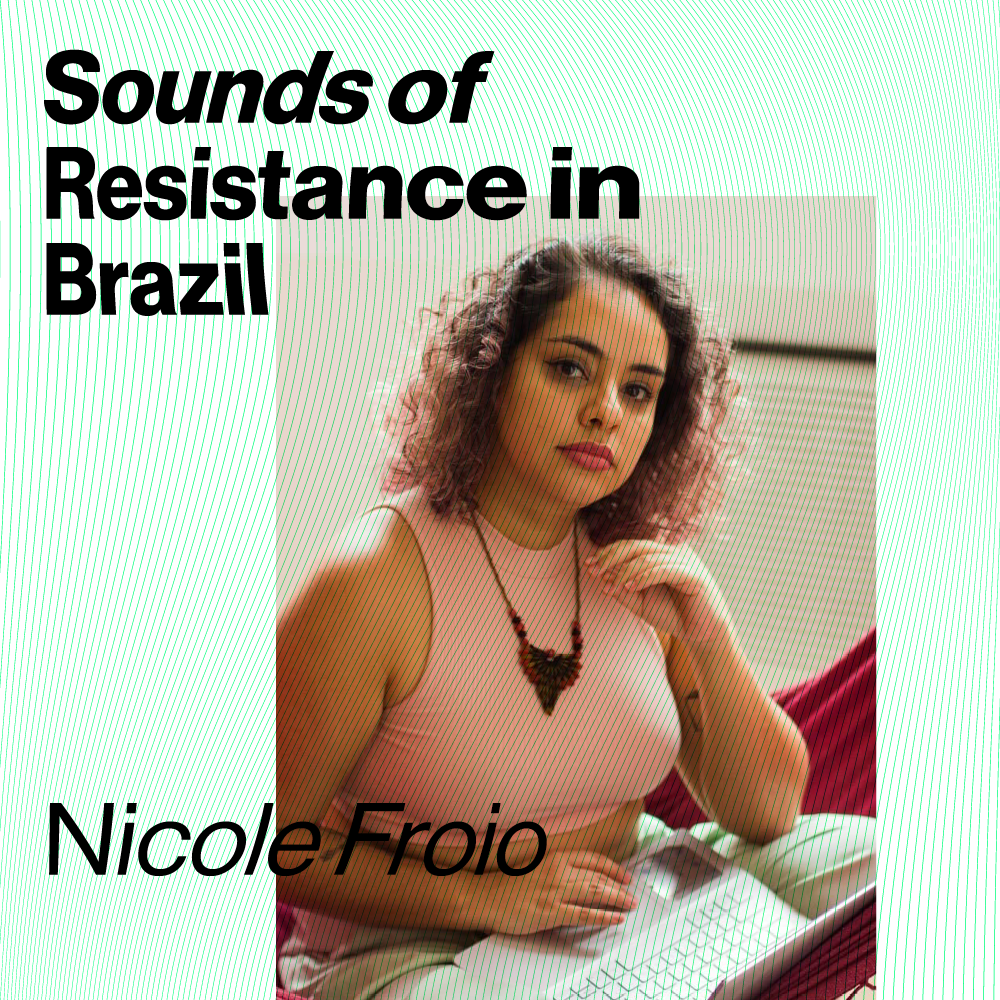
    Nicole Froio is a Doctor in Women's Studies. Nicole has worked as a researcher, journalist, copywriter, translator, editor, and proofreader for nearly a decade. Publicly, she writes about pop culture, violence against women, inequality, Brazilian politics and news, digital cultures, and books.

    When I was invited to speak at this conference, I was truly stumped about what to present. I kept thinking about my ways of listening as a journalist, and I realized how messy and unconventional my listening and writing processes are. I was invited to speak about my piece on Brazilian brega music, which I wrote for the queer magazine Xtra, and I will discuss that article and some of its music also, but I also want to talk about the political moment we are currently living here in Brazil.

    In case you don’t know, Brazil is going through very polarizing elections at the moment. In the midst of this highly stressful political situation, I have been going out dancing to distract myself from the violent discourses of the extreme-right candidate — who doesn’t deserve his name in my mouth — and the possibility that he might be re-elected. I live in Rio de Janeiro, which is where samba was born, and one of the songs that have been played a lot in rodas de samba is Chico Buarque’s “Apesar de Você”.

    “Apesar de Você” was written during the Brazilian dictatorship, and it’s about the repressive government of that era. However, to avoid censorship, Buarque sings in code, pretending his verses are actually about a romantic relationship where his partner was authoritarian. I translated the chorus so maybe we can understand why this song is still played in the streets of Rio: “Despite you / Tomorrow will be another day / I ask you / Where will you hide the happiness? / How will you forbid / The birds from singing / And new water from flowing / And people loving each other?”

    The song itself can be described as overflowing joy, kind of like Buarque is bragging about how he can still feel joy during such dark times. And he’s saying despite the fascists, the sun still rises, the world still turns, birds still sing and people will still love each other. It’s a song that is in opposition to everything the Brazilian dictatorship tried to enforce: the heteropatriarchal family, poverty, surveillance, and the definitive lack of joy.

    Fast forward to this year. Brazil is living through one of its worst moments in history, with a right-wing demagogue leading the country, and a left-wing broad coalition is trying to elect him out of government. Bolsonaro has majorly cut funds for artistic production across the country, and Rio de Janeiro feels this acutely. Rio is a city made of art and music, and living through the dark times of the Bolsonaro government could have dampened its spirit. And despite Bolsonaro, Rio’s artists have been creating and looking for joy — that’s the meaning I am giving to Buarque’s song in the current climate.

    Brazil has a rich history of resistance that is articulated through its artistic production, and this is what I was trying to get at when I wrote my piece on the intersection of brega and LGBTQ+ musicians and performers. I wrote: “Brega music is a difficult genre to define, and even harder to explain to an Anglophone audience. The literal translation of the word “brega” is “tacky” or “corny,” but these translations don’t really capture the full dimensions of the genre, or the overdone production values of brega performances. Wikipedia intriguingly describes it as “popular romantic music with dramatic exaggeration or ingenuity, usually dealing with topics such as declarations of love, infidelity and love’s delusions.” Indeed, many brega numbers are about matters of the heart told with campy language and extravagant productions.”

    I love that I have the option of sharing exactly what I mean with my audience here. I chose a snippet of drag queen pop star Pabllo Vittar’s song AMA SOFRE CHORA (which can be translated to LOVING, SUFFERING, CRYING). This song is about being a slut and suffering because of a careless lover, and the chorus goes “Sluts can love, sluts can cry, sluts will suffer if you leave.”1


    AMA SOFRE CHORA – Pabllo Vittar
    (0:11 to 1:30)

    Here I want to give a little bit of historical perspective about the genre. When brega was first “discovered” by the Brazilian media in the 1980s, in the midst of Brazil’s military dictatorship (which ran from 1964 to 1985), the term “brega” was used as a put-down, a derogatory description of the music listened to by working-class people. Instead of relying on the flowery and poetic language used by mostly middle-class bossa nova artists at the time, brega artists got straight to the point, especially when it came to romance. It was also more popular in the northeast, a region that’s poorer and has a larger percentage of African-Brazilians than southern cities like Rio de Janeiro and São Paulo. The colourism and classism used against northeastern people by those in the south added to the stigma associated with brega—because the “underclasses” loved this music, it couldn’t possibly be considered good.

    Middle-class journalists emphasized the lack of refinement and inferior musicality of brega. In the 1980s and ’90s, brega was often called “music for domestic workers,” characterized as the schmaltzy music that cleaners and cooks would play as they got on with their work. This is where I hope my work differs from most Brazilian journalists — I am queer and I listen to brega, so I wasn’t coming into writing about the genre as an outside. Since corniness and tackiness are subjective—as is classism—critics have ended up generalizing the rich musical landscape of brega. The music historian I consulted for my piece, Eder Sedano, a history teacher and a PhD candidate at Pontifical Catholic University of São Paulo, told me that: “The genre is incredibly rich in variety. I would define it as music by and for the working class.”

    So, what was I seeing when I watched Pabllo Vittar’s music videos and listened to his music? I was seeing artistic production by the queer working class. Vittar is from the Northeast of Brazil, by his own admission, his family would not have survived if the Workers’ Party hadn’t provided benefits for his mother, who was a care worker. In a recent statement in support of presidential candidate Luis Lula Inácio da Silva, Vittar said he would not have become the artist he is today without these monetary benefits. What I was trying to emphasize in my original piece for Xtra Magazine is that brega has always been the artistic language of the Brazilian working class and that the recent LGBTQ+ power of the genre has further solidified this.

    The next snippet gets to how brega has always been considered a vulgar genre, and how Pabllo Vittar has used this to make art about his queerness. The chorus goes: “You made me sad and horny / How could you leave me?”2


    TRISTE COM T – Pabllo Vittar
    (0:16 to 0:49)

    This is in-line with the historical roots of the genre. Sexual freedom and brega have always been intertwined. That history dates back to Brazil’s millitary dictatorship when queer and trans people were criminalized and brutalized for their sexual orientation and gender expression. “A Galeria do Amor” (“Love Gallery”), released in 1975 by the late Agnaldo Timóteo, lovingly describes the queer dating spot in São Paulo called Galeria Alaska, a locale dismissed in the Brazilian media as “dangerous and full of bad people.” For Timóteo, Galeria Alaska was a space for love, dating, and pleasure: “The love gallery is/ A place for different emotions/ Where we understand each other/ Where we can love each other/ Freely.” Though only people who noticed the cruising at Galeria Alaska would recognize Timóteo’s references, this song marks an early intersection of queer allyship and the music of the Brazilian working class.

    Of course, I don’t want to say LGBTQ+ brega artists are a new phenomenon because I think generalizations like that are reductive and don’t recognize the lack of legibility of queer people in the past. But I do think that brega has expanded in the last 20 years largely because of LGBTQ+ artists who used the stigma associated with brega to make space for their own sexualities and marginalized genders. I want to give one more example to show how the queer working-class aesthetic is being articulated through a queer brega music genre here in Brazil.


    TCHECA – Danny Bond
    (0:32 to 1:14)

    Rising star Danny Bond, who identifies as travesti (a transfeminine non-binary identity unique to Brazil) shows us exactly how LGBTQ+ artists are using brega to express their sexuality. In “Tcheca” (“Pussy”), which has over four million plays on YouTube, Bond plays with straight cisgender people’s fixation on genitalia, singing over heavy trumpets and a funky beat: “My name is Danny Bond and I have a pussy/ If you don’t believe me, I’ll show it to you/ But when I show it to you, you have to lick it.”3

    In conclusion, LGBTQ+ brega music continues a tradition of fighting conservative values and authoritarian rule with artistic production. Both Vittar and Bond are fighting a similar battle to Chico Buarque during the dictatorship, this time the freedom of singing things with full words rather than in code.


    ––––––––

    [1] Pabllo Vittar, “AMA SOFRE CHORA.” May 7, 2021, Music video, 0:11 to 1:30, https://www.youtube.com/watch?v=7hZhmSmy8LU.

    [2] Pabllo Vittar, “TRISTE COM T.” June 25, 2021, Music video, 0:16 to 0:49, https://www.youtube.com/watch?v=_K7WVDfOEYY

    [3] Danny Bond, “TCHECA.” October 15, 2018, Music video, 0:32 to 1:14, https://www.youtube.com/watch?v=jJTArjsT9mw[/vc_column_text][/vc_column][vc_column width=”1/6″][/vc_column][/vc_row][/vc_section]

  • Alma G. Ferrer ´Mim´+ Chris Christou

    Alma G. Ferrer ´Mim´+ Chris Christou

    [vc_section css=”.vc_custom_1579170657650{margin-top: 20px !important;margin-right: 20px !important;margin-bottom: 20px !important;margin-left: 20px !important;border-top-width: 1px !important;border-right-width: 1px !important;border-bottom-width: 1px !important;border-left-width: 1px !important;padding-top: 0px !important;padding-right: 0px !important;padding-bottom: 0px !important;padding-left: 0px !important;border-left-color: #000000 !important;border-left-style: solid !important;border-right-color: #000000 !important;border-right-style: solid !important;border-top-color: #000000 !important;border-top-style: solid !important;border-bottom-color: #000000 !important;border-bottom-style: solid !important;border-radius: 1px !important;}”][vc_row fullwidth=”has-fullwidth-column”][vc_column padding_left=”30px” offset=”vc_col-lg-12″][vc_empty_space height=”40px”][agni_section_heading heading=”Theophany’s Thirst” heading_size=”40″ divide_line=””][vc_empty_space height=”40px”][/vc_column][/vc_row][vc_row fullwidth=”has-fullwidth-column” content_placement=”top” border_top=”1″ border_color=”#000000″ border_style=”solid”][vc_column width=”1/6″][/vc_column][vc_column width=”2/3″][vc_column_text]Alma G. Ferrer ´Mim´+ Chris Christou
    Alma G. Ferrer ´Mim´+ Chris Christou. Alma is an art historian and consultant dedicated to the development of alliances, strategic planning, communication, and cultural management for a diversity of artistic projects. MitamineLab, a long-running contemporary sound archive, and curatorial platform, is one of her outstanding projects with which she has carried out activities in places such as the Museum of Contemporary Art (MUAC), The Centre of Digital Culture (CCD), and Ruta de la Amistad México 68, among others. She was a radio host on Ibero 90.9FM (MX)  for almost 6 years and is currently on Resonance Extra (LDN).

    Chris Christou is a storyteller, culture activist, and chocolate maker. Born and raised in Toronto, Canada, he moved to Oaxaca, Mexico in 2015 where he founded Oaxaca Profundo, a deep-learning organization focused on food culture and radical hospitality. In 2021, alongside friends and strangers, he organized and launched the End of Tourism Podcast.


    This story was written/recalled as a confrontation with memory, migration, and in the midst of having completed a four-year commitment to fasting. It reflects the sonámbulous and sonorous arising in the places of disappearing peasantry, both in Mexico and in Europe. It is a plea as much as it is a warning, contending with the disappearance of water and our ability to care for and conjure it. Taking to task the often self-righteous self-absorption that cradles modern identity, the poem-narrative asks its listeners to consider that the lack/loss of roots, glorified, is of dire consequence to the world we live in, as it is for the worlds we wish to live in.

    Contemplating voice, sounds, and music as a medium to reflect on our own acoustic consciousness, this musical storytelling takes inspiration from visual and sound poetry from the mid-70s, attempting to use these sound sources out of the domain of physical tangible reality to reinvigorate language as a passionate poetic tool that commemorates memories of the past, memories of people and fading memories.

    ———

    Esta historia fue escrita/recuperada como una confrontación con la memoria, la migración, y en medio de haber cumplido un compromiso de ayuno de cuatro años. Refleja el sonambulismo que surge en los lugares de desaparición del campesinado, tanto en México como en Europa. Es una súplica tanto como una advertencia, que se enfrenta a la desaparición del agua y a nuestra capacidad de cuidarla y conjurarla. El poema-narración, que cuestiona el ensimismamiento, a menudo santurrón, de la identidad moderna, pide a sus oyentes que consideren que la falta/pérdida de raíces, glorificada, tiene consecuencias nefastas para el mundo en el que vivimos, así como para los mundos en los que deseamos vivir.

    Contemplando la voz, los sonidos y la música como medio para reflexionar sobre nuestra propia conciencia acústica, esta narración musical se inspira en la poesía visual y sonora de mediados de los años 70, intentando utilizar estas fuentes sonoras fuera del dominio de la realidad física tangible para revigorizar el lenguaje como una herramienta poética apasionante que conmemora los recuerdos del pasado, los recuerdos de las personas y los recuerdos que se desvanecen.

    Alma G. Ferrer ‘Mim’ (musical storytelling) / Chris Christou (poetry)

    Tracklist

    Blank Wall Season – Spell D.D.I

    Yutaka Hirose – Soundscape 2 Nova

    Pataphysical – Dream Reveal

    Jerry Hunt – Transform

    Nyokabi Kariuki – home piano

    Nico Georis – mirror iii

    Siavash Amini & Eugene Thacker – Demented Skies (For Alejandra Pizarnik)

    Andy Stott – Missing

    Paul Schütze – God Box

    Sam Gendel – Nakamura kōshi  (中村格子, plaid design of the Nakamura family)


     Theophany’s Thirst

    Alma G. Ferrer ´Mim´+ Chris Christou


    lost
    in a dark copse, where the creek’s course forked
    i came
    a cross
    a man

    here, he

    hear he,

    was

    inclined

    to speak:

    stranger
    where i come from
    we wear memory on our sleeves
    stitched by hand through warp and weft
    a pattern language following food
    and forebears
    embroiled and embroidered

    ((he stopped and slowly stretched his arms outwards
    his hands turning downwards
    as if pouring the remnants of two chalices
    onto the forest floor))

    seasons tinted
    the dead, dyed and woven

    donned and dressed
    our royalty, our reality
    here, stranger, we mummify memory
    and clothe ourselves in her blessings

    ((from crown to sole, he was harboured by regalia
    the coloured courtship of birds, the curled locks of flocks,
    the thermal husk of his people, the evidence of village))

    on our saint days
    we dance to goat and sheepsong
    the shimmering coins shake and shuffle, sonorous
    echoing the bronze bell barn orchestra of singing land
    following orbital ancestors
    and telluric tracks
    we comb the plains
    and iron the amulets

    following four legged noses
    attuned to blood and bone
    compassed on the path of predecessors
    parading the procession of time hitched to place

    a death march
    in.
    other.
    words.

    masticate, migrate
    compost, commune
    they are family
    they
    our food

    tutors of tale, travel, and tradition
    apprenticed by hoof and hearth
    a covenant, contained (from the Latin continere, “to hold, together”)

    the Grand Mystery of Dreams
    like the Great Mercy of Life
    is that such things
    their re-membering
    is not guaranteed

    and so it must be learned
    and so it must be taught
    kneel, stranger, and sip the syrup of life at the river of your days
    that your inner visions might properly serve outerworlds, otherworlds

    water
    is the wombmilk sacrament of time longing to be remembered
    the dendritic veins of a dreaming body

    water
    is the memory of the dead, manifest
    the wellspring of olders, of elders

    water
    feeds the soils that fertilize the seeds
    that root and remember

    a chorus of angels
    the katabasis of culture

    Thirst
    Thirst is our way of being claimed
    by all of this

    by all of them

    by all of
    us

    an earthly insurance
    that the living practice
    laying alms in the riverbed of the dead
    the architecture of the underworld
    the tide of amniotic uprisings
    all fed by Hunger and Thirst

    to forget this is to allow the umbilicus to run dry to capture rain and intubate dreams
    to fabricate fire and fleece food

    Hunger and Thirst are slender Gods
    the only of their kind to get fat off of neglect who, if feared and unfed
    go looking for ways to starve

    Hunger and Thirst are
    not the absence of Flesh and Flow, stranger but their twins
    the elder brothers
    the guides and guardians

    orphan the invocations for one and all are famished not a failure to cook, but to be cooked

    and the memory of how this has come to pass
    sit, stranger, and pray over your last sip,  that it might serve the sap of memory.

    drink
    the afterbirth
    the umbilical cord

    the deerskin we draped over our days the antlers that carved our remembrance the leaves, the bark, the bone, the blood

    to live sewn to the nape of the world

    to remember these things
    one must be a village
    one must be many

    to forget these things
    one must be themself
    and nothing more

    with-out village
    all you have is identity

    with-out the world
    you are divided among your poverty and become a people out of bounds
    one for whom a question becomes a cancer:  who are we?

    fill in the b l a n k s  with

    ancestral geography burned into the skin
    imposed tongues
    monomyths
    biology
    racecraft
    nation
    states
    of mind

    all aliases of exile
    all examples of
    falling
    out of love
    out of place

    when where we are is undermined by where we are from… when the dreams of the dead are forgotten… when the tears for their lives are forsaken… Flow and Flesh will wither
    Thirst and Hunger will return
    and all will be remembered
    one way or another

    on the eclipse of the fourth mourning

    i

    rose

    awake

    and couldn’t tell
    if I was a prayer, a flower, a teardrop
    or a great dream being spun by an old man.

    [/vc_column_text][/vc_column][vc_column width=”1/6″][/vc_column][/vc_row][/vc_section]
  • Mariangela Aponte Núñez

    Mariangela Aponte Núñez

    [vc_section css=”.vc_custom_1579170657650{margin-top: 20px !important;margin-right: 20px !important;margin-bottom: 20px !important;margin-left: 20px !important;border-top-width: 1px !important;border-right-width: 1px !important;border-bottom-width: 1px !important;border-left-width: 1px !important;padding-top: 0px !important;padding-right: 0px !important;padding-bottom: 0px !important;padding-left: 0px !important;border-left-color: #000000 !important;border-left-style: solid !important;border-right-color: #000000 !important;border-right-style: solid !important;border-top-color: #000000 !important;border-top-style: solid !important;border-bottom-color: #000000 !important;border-bottom-style: solid !important;border-radius: 1px !important;}”][vc_row fullwidth=”has-fullwidth-column”][vc_column padding_left=”30px” offset=”vc_col-lg-12″][vc_empty_space height=”40px”][agni_section_heading heading=”“Con nada se hace algo y con algo se hace bastante”” heading_size=”40″ divide_line=””][/vc_column][/vc_row][vc_row fullwidth=”has-fullwidth-column” content_placement=”top” border_top=”1″ border_color=”#000000″ border_style=”solid”][vc_column width=”1/2″][vc_column_text]Mariangela Aponte Núñez
    Mariangela Aponte Núñez is a transdisciplinary artist. From individual to collective creation, her practices explore the intersection of traditional media, handcrafted techniques, low-fi and inexpensive experimental electronics, and address aesthetic, environmental, social, and political concerns, often through methodologies inspired by collaborative art and DIWO practices. Aponte Núñez has been an artist-in-residence with France-Colombia 2017 (La Chambre), with El Puente_lab, RESÒ 2015 (Cittadellarte – Fondazione Pistoletto), and with ELAP Prize 2012 (DFAIT, Canada). She is currently interested in the study of biomaterials, plants, and fungi to create holistic artistic processes.

    La Habana, noviembre del 2016. El son cubano viajaba en la brisa cálida del caribe mezclado con cubatón, reguetón y los demás ritmos antillanos, junto a sonoridades únicas en las que incluso el hablar es canto. Asere, la constancia e’ la cachimba tumba la quijá. La más grande de las Antillas a finales del 2014, luego de más de medio siglo, había restablecido temporalmente las relaciones bilaterales con los Estados Unidos. El 25 de noviembre del 2016 se decretaron 9 días de duelo nacional sin eventos públicos, música o ron por la muerte de Fidel Castro. Algo nunca antes escuchado.

    En este contexto efervescente y boyante al tiempo de confuso nace (d)estructura. El objetivo: realizar un mapa de las necesidades humanas a través de un juego de mesa para generar reflexiones deconstructivas de la teoría de la Pirámide de Maslow. El juego como metodología no fue un dispositivo para la cartografía social producto del azar, sino más bien, de una observación previa en la que se identificara la importancia de la lúdica en el espacio público como medio para discutir temáticas incluso de índole nacional. Parqués, ajedrez o damas chinas reunían a grupos de personas en las calles calurosas y recordemos que para entonces el internet de acceso público entraba lentamente en la ecuación porque la técnica es la técnica y sin técnica no hay técnica.

    Para la Dra. Elvira Edwards Vásquez[1], investigadora cubana de la complejidad, “(d)estructura apuesta por el arte que se constituye en componente de la situación discursiva durante el intercambio de subjetividades, mientras las personas juegan.” El juego es pues, motivador de conversaciones y de construcción de formas colectivas en donde cada jugador tiene el poder de elegir cómo afectar en escenario común a partir de una pregunta ¿Cómo te imaginas tu vida en 10 años y qué crees que necesitas para lograrlo? Es conocido cómo en el contexto latinoamericano y en concreto cubano la creatividad nace de la necesidad de los habitantes que deben imaginar cómo resolver los problemas. Oye, no fue ni fácil, ni difícil, sino todo lo contrario.

    Un total de 24 juegos entre el 2016 y el 2017 realizados en varias provincias de la isla componen el análisis de frecuencias de valores jugados, (d)estructuras construidas e imaginarios del escenario cambiante cubano. En el análisis se destacaron los 10 valores más jugados, en su orden de importancia: salud(20), amor(17), familia(16), paz(14), trabajo(10), libertad(10), responsabilidad(9), espiritualidad(9), educación(8) y amistad(8). En la observación atenta del contexto se destaca que dadas las condiciones sociales, económicas, políticas y ambientales de la isla, sus habitantes han desarrollado modos de socialidad particulares que les permiten enfrentar los desafíos materiales cuando se trata de acceso a artículos de primera necesidad, así como a aquellos aspectos más abstractos y espirituales de la vida. La interrogante con la que inicia el juego motiva un ambiente de intercambio comunicativo entre grupos de personas que imaginan y dialogan cómo construir/deconstruir las necesidades humanas a nivel individual y colectivo, creando así un escenario proyectivo a futuro que expresa en presente sus sueños, realidades y posibilidades. En un contexto en el que aún existen muchas problemáticas por resolver, tampoco es producto del azar que se exprese lo que se tiene y lo que falta. La libertad es el sexto valor citado como fundamental para realizar el futuro y que recientemente en el 2021 motivó enfrentamientos por una parte de la población, incluyendo a un amplio sector del gremio artístico, contra las medidas establecidas por el gobierno en temas de libertad de expresión y regulación al trabajo cultural que resultara en el encarcelamiento y expulsión del territorio de varios artistas y agentes culturales[2].

    “libertad

    -libertad

    -ah, libertad

    -ja ja ja ja!!”

    “-¿usted quiere tener libertad de quién? no será de mí

    -de prensa de prensa”

    -libertad, sí, libertad

    -¿ya?”[3]

    Clave del juego: funciona cuando no funciona y la estructura que emerge se aleja de lo piramidal. El juego como metodología de observación dinamizadora de la escucha en escenarios en transformación se hace necesario llevar a Colombia posterior a la firma de los acuerdos de paz e incluso Turquía durante el conflicto con Siria. ¿Cómo un juego permite activar la escucha atenta de las necesidades particulares en una micro-sociedad?

    El juego se opone a la entrevista directa registrada audiovisualemente para dar espacio a que los grupos humanos expresen sus imaginarios íntimos de una manera espontánea y lúdica de tal manera que se encontraran menores predisposiciones con respecto a lo que se espera de un ideal de vida ante la mirada de 3 extranjeros.

    En este sentido la decisión tomada por el grupo de artistas apostó por la retirada con observación participante y la disposición a la escucha como roles fundamentales, justamente las fichas de azar metodológico, pues el juego expresa sus propias divergencias a medida que los jugadores lo transforman para permanecer abierto a la participación y la escucha, cualidades indispensables a la hora de trazar una cartografía social con el arte como vehículo de investigación creativa. (d)estructura entiende la cartografía social a partir de las características psicogeográficas[4] de los participantes en donde el “mapeo” colectivo no es un calco, sino que se compone de estructuras emergentes temporales de los imaginarios de un futuro en una micro-sociedad[5]. (d)estructura esconde la evocación a un grupo punk, un desbarate filosófico, una revolución de pachanga[6], una acción democrática en pequeña escala, una utopía de futuro and if you say run rum, i run rum with you[7].

    Entre los distintos aportes creativos que dan vida al juego por el grupo de artistas, la agrupación  curartorial y el de personas jugando en distintos contextos, está la inspiración que nace de los puentes que se tienden entre arte y pedagogía. El llamado a la emancipación de la participación y la construcción de conocimiento colectivo[8], así como aquellas estimuladas justamente en la práctica docente para la clase Arte y Tecnología del programa de Diseño de Medios Interactivos de la Universidad Icesi. (d)estructura es una confluencia creativa en la que interna y externamente cada participante encuentra espacio de expresión en la que se pone en juego procesos de creación en co-diseño, diseño especulativo y arte participativo.

    “Todo lo que se analiza y se debate aquí en cuanto a los valores me interesa mucho, porque ¿a quién no le va a interesar su patria, la paz, la estabilidad y el trabajo?. Yo considero que el valor de una persona está dado por su trabajo, por la responsabilidad poseída; y de ahí parte el hombre con su dignidad. Sé igualmente que hace mucha falta el ocio, la diversión, el arte”. (Transcripción Jugador 2, Juego 1)

    Mira chica, con nada se hace algo y con algo se hace bastante.

    [1]  Las apreciaciones de la Dra. Edwards se dieron durante conversaciones con los integrantes del proyecto (d)estructura, asistencia a actividades y juegos en el espacio público y posterior análisis de datos recolectados por el proyecto.

    Elvira Edwards Vázquez es Doctora en Ciencias Históricas. Actualmente Miembro del Consejo Científico del Instituto Cubano de Investigación Cultural Juan Marinello y profesora para la educación postgraduada en la propia institución. Miembro de la directiva de la Cátedra de Estudios de la Complejidad adscrita a la Sociedad Cubana de Psicología y al Centro de Investigaciones Psicológicas y Sociológicas y Miembro de la directiva de la Cátedra Nelson Mandela del propio Centro de Investigaciones Psicológicas y Sociológicas de Cuba, adscrita a CLACSO.

    [2] Véase Decreto 349 http://juriscuba.com/legislacion-2/decretos-2/decreto-no-349/ recuperado el 24/10/2022 y réplica de Esfera Pública de la carta NO al decreto 349 Carta abierta al Presidente de Cuba Miguel Díaz-Canel publicada por Yanelys Nuñez en la plataforma avaaz.org https://esferapublica.org/nfblog/no-al-decreto-349-criminaliza-el-arte-independiente/

    [3]Transcripción de conversaciones durante los juegos. Los 24 juegos realizados fueron grabados en audio y video. Las conversaciones fueron transcritas para estudio como parte de las categorías de análisis a identificar por la Dra. Edwards ibid.

    [4] Ver texto aparecido en el #2 de Internationale Situationniste. Traducción extraída de Internacional situacionista, vol. I: La realización del arte, Madrid, Literatura Gris, 1999.

    [5]  5º y 6º Principios de cartografía y de calcomanía: Si el mapa se opone al calco es porque está orientado hacia una experimentación que actúa sobre lo real. El mapa no reproduce un inconsciente cerrado sobre sí mismo, lo construye. Contribuye a la conexión de los campos, al desbloqueo de los cuerpos sin órganos (…) Forma parte del rizoma. El mapa es abierto, conectable en todas sus dimensiones, desmontable, alterable, susceptible de recibir constantemente modificaciones. Puede ser roto, alterado, adaptarse a distintos montajes, iniciado por un individuo, un grupo, una formación social. Puede dibujarse en una pared, concebirse como una obra de arte, construirse como una acción política o como una meditación. Gilles DELEUZE, Félix GUATTARI, 1988 (edición original en francés de 1980), Mil Mesetas. Capitalismo y Esquizofrenia, Pre-textos, Valencia.

    [6] Forma en la que describe Erick González León, parte de la agrupación curatorial para Cuba, al resultado de décadas de socialismo cubano en el caribe.

    [7] Adaptación de la canción Let´s Dance de David Bowie hecha en el contexto cubano por Alejandro Vásquez Salinas, uno de los artistas integrantes del El Puente_lab.

    [8] La lectura de Ranciere en El espectador emancipado y El maestro ignorante aportan puntos de quiebre en mi práctica como artista-docente frente a la necesidad de mantener una acción crítica del hacer en contextos diversos.


    Curado por: Laura Salas Redondo, Erick González León y Cecilia Guida+info: https://d-estructura.tumblr.com/ / https://www.elpuentelab.org/copy-of-exposiciones /[/vc_column_text][/vc_column][vc_column width=”1/2″][agni_gallery img_url=”3094,3092,3091,3093,3086,3087″ column=”1″][/vc_column][/vc_row][/vc_section]

  • AM Medina

    AM Medina

    [vc_section css=”.vc_custom_1579170657650{margin-top: 20px !important;margin-right: 20px !important;margin-bottom: 20px !important;margin-left: 20px !important;border-top-width: 1px !important;border-right-width: 1px !important;border-bottom-width: 1px !important;border-left-width: 1px !important;padding-top: 0px !important;padding-right: 0px !important;padding-bottom: 0px !important;padding-left: 0px !important;border-left-color: #000000 !important;border-left-style: solid !important;border-right-color: #000000 !important;border-right-style: solid !important;border-top-color: #000000 !important;border-top-style: solid !important;border-bottom-color: #000000 !important;border-bottom-style: solid !important;border-radius: 1px !important;}”][vc_row fullwidth=”has-fullwidth-column”][vc_column padding_left=”30px” offset=”vc_col-lg-12″][vc_empty_space height=”40px”][agni_section_heading heading=”Listening for Trans* Latinx Lives” heading_size=”40″ divide_line=””][vc_empty_space height=”40px”][/vc_column][/vc_row][vc_row fullwidth=”has-fullwidth-column” content_placement=”top” border_top=”1″ border_color=”#000000″ border_style=”solid”][vc_column width=”1/6″][/vc_column][vc_column width=”2/3″][vc_column_text]AM Medina
    University of California, San Diego
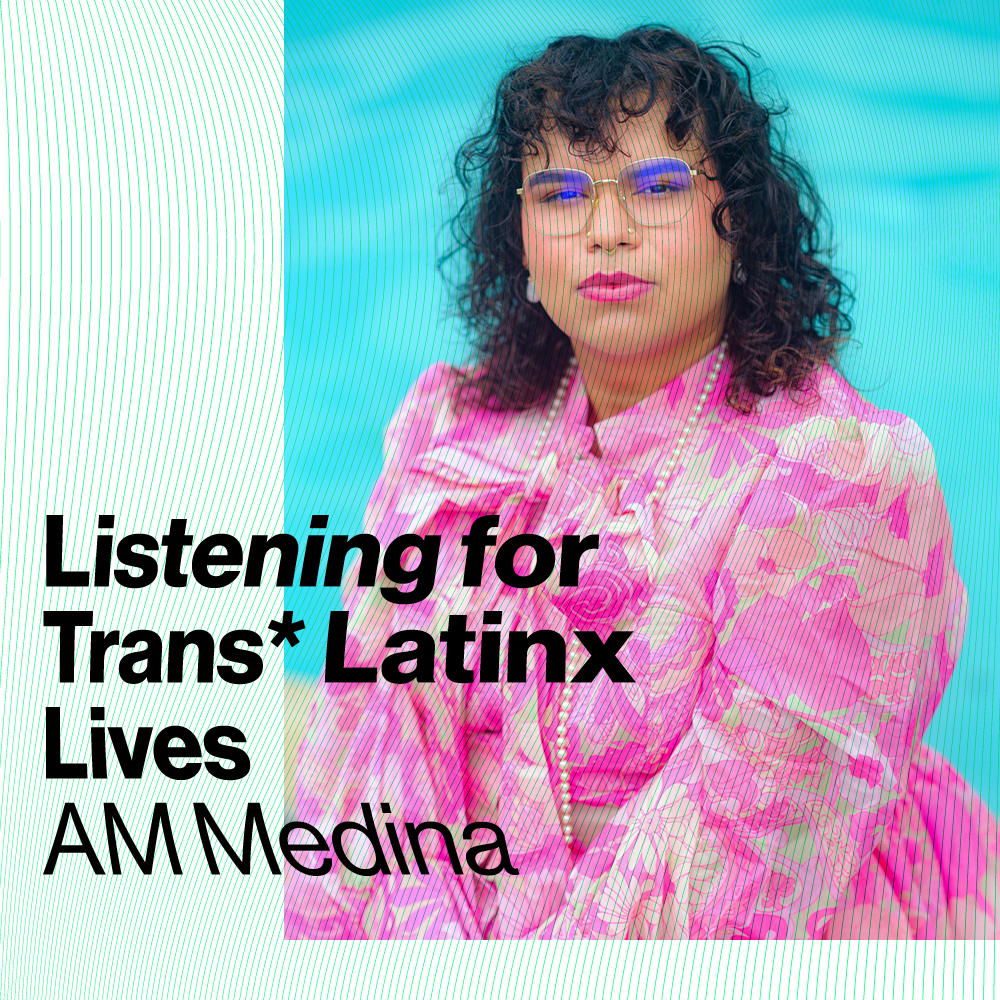
    PhD Student in Integrative Studies

    “Y’all better quiet down!” yells trans Latina activist, thinker, and organizer Sylvia Rivera at a 1973 Gay is Good rally in New York City. But, who is the “y’all” that Rivera is addressing? A mostly cis, white, middle-class, gay and lesbian audience booing and screaming at Rivera before her speech, a speech where she lashes out against the apathy of this audience for not attending to the needs of queer and trans people in prison who have been beaten and raped. In his analysis of the video, performance studies scholar José Esteban Muñoz writes that “[Rivera] paces the stage in a relentless fashion…. The camera momentarily shifts to the audience of assembled queers, who are first attempt to shout her down…but she is unrelenting. She will not cede the stage; she will not be silenced,” (Muñoz 2020:131, my emphasis). Rivera is asserting her presence at the rally through a sonic interjection; refusing the boos from audience members who do not want a trans Latina organizer to speak to them, she demands to be listenened to. In this way, listening to trans Latinidades is something that is not a polite request to be understood by an audience, but rather an urgent call to respond to the political needs of those who face racialized and gendered discrimination.

    In my work, I identify this urgency within a broader call for a trans of color sound studies, that is, a trans of color mode of approaching sound—an analytic of sound that does not hear it as hermeneutically altered by race and gender, but rather deals with the ontological formation of race and gender that creates the concept of sound itself. This mode of approaching sound as way of listening for trans Latinx lives does not assume a level of “inclusion” of trans of color subjectivity into the broader literature in sound studies. Trans of color sounds, performances, or voices—although rich resources for producing critical thought—cannot simply exist as objects of study for sound studies scholars to pull from to enhance or diversify our work. By this, I mean that doing the work of trans of color sound studies does not add trans of color figures to syllabi or archives but rather I suggest we “quiet down” to listen to the urgency of trans of color political needs; needs that seek to assert life in an overwhelming presence of death and violence. Drawing from Ashon Crawley’s definition of Black Study (which, in his framework, is separate from Black studies departments in universities), defining it as a “mode of approaching objects”—objects that are not simply static for receiving a “reading” but that are themselves agentive in theorizing—we might be able to understand a trans of color mode of approaching sound and demanding from it a path towards liberation from violence. 

    One such way that I mobilize a trans of color mode of approaching sound is to take a radical approach to listening. Listening allows for multiple possibilities of experience, a sort of multivalence. Jean-Luc Nancy notes that “to listen is to be straining toward a possible meaning, and consequently one that is not immediately accessible,” (2007: 6). Going further, he writes that “To be listening is always to be on the edge of meaning…a meaning whose sense is supposed to be found in resonance, and only in resonance,” (Nancy 2007: 7). In a trans of color sound studies, listening becomes one of the tactics that allow us to extend and manipulate time to our advantage, even in states of precarity that might deny us the certainty of the everyday. To make the present more present, listening allows for a study in sound that deals with the particular…the peculiar. Listening urgently searches for meaning in trans of color resonance, a meaning that is sensed more than objectively “known”. As a way of disrupting, selecting, and lingering, listening allows us to disrupt trans of color necropolitics in a way that seeks life. Christina Leon and Joshua Javier Guzman describe how “Lingering as a verb demands a kind of languor, a dwelling that inhabits the spaces of ambivalence and ambiguity,” (2016:271). Trans of color sound studies might use radical forms of listening to assert life in a seemingly overwhelming presence of death.

    One way in which we might perform a radical listening for trans Latinx life is through a framework of “mais viva,” that Dora Silva Santana discusses. Translating from Brazilian Portuguese to being more alive, more alert, and savvier, Santana uses this framework to talk about the potential for Black trans feminism in a way that doesn’t seek to “trans” Afro-Latinidad or “racialize” transness, but instead to point toward a way that finds solidarity in the fugitivity of both. In Santana’s words: 

    …It means “being-alive-savvy,” it is not just being alive but more alive; it is transitioning in the world by transcending, trans-ing life. Being mais viva becomes the outcome and a condition to resist death. (Santana 2019: 216).

    Santana’s concept of mais viva, in my opinion, clarifies a distinctly trans position to Muñoz’s assertion that “we must insist on a queer futurity because the present is so poisonous and insolvent,” (2009:30). Denied the everyday, as trans of color subjects are under necropolitical regimes of death, new theoretical frameworks (such as mais viva) are necessary for establishing the conditions of our existence in which utopia is possible. Mais viva refutes the quagmire of the present in an alternative way, focusing on a sense of urgency in the present itself, transing time for trans of color futurity. Such futurity is afforded by radical forms of listening that seek to relocate utopia by sitting with the aesthetic.

    In trans of color sound studies, I ask: can we find utopia in the present? By listening, lingering, and through mais viva, can we not disrupt the weight of necropolitical regimes of death on our existence? To make the present more present is to demand mais viva from sound. Where the state craves silence through the maintenance of a necropolitical death world, I listen. I listen against the necropolitical, its desire to destroy and forget, as a form of solidarity. Sound won’t stop trans Latinxs from being killed, but in that moment of disappointment we can listen and linger, making sure that those who have been murdered do not stay dead, and are given their chances at mais viva in the present.

    These modes of listening as care and mais viva that I am outlining within a trans of color sound studies does not limit itself to thinking through a mediated sonic past, but can also be used as a framework for understanding the care and community trans Latinas create in the present. One night at a dive bar in San Diego (which just happened to be El Grito, Mexico’s independence day), I was approached by Jamie, a trans woman who introduced me to mis hermanas trans—trans Latinas who upon recognizing my transness embraced me and took me in to sit at their table. All night emborrachamos, chismeando, y abrazándonos. One of my hermanas played a recording of “Paloma Negra” on the electronic jukebox, and in our little corner table, mis hermanas y yo sang like we were Jenni, or Chavela, or Lola, or whoever—pero como hermanas. “Quiero ser libre/vivir mi vida/ con quien yo quiera,” we sang to each other, locking a gaze of hermandad (sisterhood). In that moment we were activating a performative listening, a form of sonic attention and care that recognizes the liveliness (the potential for mais viva) of one another through our voices. By singing to one another in hermandad, we iterate a trans Latinx listening and mode of approaching sound that shapes us; we become the trans Latinas that we are by listening through the facultades of our hermanas.

    Queer and feminist Chicana writer Gloría Anzaldúa describes la facultad (the ability) as “the capacity to see in surface phenomena the meaning of deeper realities, to see deep structure below the surface… It is is an acute awareness mediated by the part of the psyche that does not speak,” (1987:47). La facultad is a way of sensing and being “excrutiatingly alive to the world,” a deep internal vibration that comes from being attuned to danger, violence, loneliness, and transition (Ibid.). I think of la facultad as a driving affect, a hum in those who have embodied and generational trauma, and a strategy for preventing more harm—which ultimately becomes a form a consciousness that opens you to being able to care for the other (your hermana). What if we were to think of la facultad as a theory of listening? Listening with la facultad goes deeper than music, sound, or the voice, deeper than its “grain” that Barthes locates as its semiotic; la facultad, as a way of listening como hermanas, opens up a deep relationality and internal resonance that is the mode of  care and urgency Santana calls for in mais viva. Listening with la facultad makes us “quiet down,” to hear the trauma that Sylvia Rivera tells us she and our other hermanas have faced. As Anzaldúa and Santana both make apparent, these forms of being and consciousness are first survival strategies, epistemological and ontological theories that are necessary in a world that is cruel and unjust.

     In this way, I do not take the task of trying to articulate my listening in hermandad—a sonic facultad in order to produce mais viva—lightly; it is fundamentally a task of positing a sound studies that counteracts the overwhelming violence that trans Latinxs face. I demand a sound studies that listens to the hermanas that have been imprisoned, beaten, raped, and murdered, to the ones who never got to transition, and to the ones who hold me together today. It is a monumental task and calling to care for trans Latinx sonorities in a way that moves towards consciousness and being that sustains hermandad. A sonic, trans, Latinx hermandad is one where you are no longer you, but held in the resonance of your hermanas; listening for trans Latinx life requires an opening of the self with la facultad as a way to embrace and be embraced by your hermanas.

    1. This recording can be found on YouTube here: L020A Sylvia Rivera, “Y’all Better Quiet Down” Original Authorized Video, 1973 Gay Pride Rally NYC

    2.  Translation: I want to be free/to live my life/with whomever I want.

    References

    Anzaldúa, Gloria. Borderlands/La Frontera: The New Mestiza, fifth edition. San Francisco: Aunt Lute Books, 1987.

    Butler, Judith. “Gender is Burning: Questions of Appropriation and Subversion.” In Bodies That 

    Matter: On The Discursive Limits of Sex. London: Routledge, 1993.

    Guzman, Joshua Javier and Christina Leon. “Cuts and impressions: the aesthetic work of lingering in 

    Latinidad.” Women and Performance 25, no. 3 (2016): 261-276. 

    Mbembe, Achille. Necropolitics. Durham: Duke University Press, 2019.

    Muñoz, José Esteban. Cruising Utopia. Durham: Duke University Press, 2009.

    —The Sense of Brown. Durham: Duke University Press, 2020.

    Santana, Dora Silva. “Mais Viva! Reassembling Transness, Blackness, and Feminism.” Transgender 

    Studies Quarterly 6, no. 2 (2019): 210-222.[/vc_column_text][/vc_column][vc_column width=”1/6″][/vc_column][/vc_row][/vc_section]

  • 2022 program

    [vc_section css=”.vc_custom_1579170657650{margin-top: 20px !important;margin-right: 20px !important;margin-bottom: 20px !important;margin-left: 20px !important;border-top-width: 1px !important;border-right-width: 1px !important;border-bottom-width: 1px !important;border-left-width: 1px !important;padding-top: 0px !important;padding-right: 0px !important;padding-bottom: 0px !important;padding-left: 0px !important;border-left-color: #000000 !important;border-left-style: solid !important;border-right-color: #000000 !important;border-right-style: solid !important;border-top-color: #000000 !important;border-top-style: solid !important;border-bottom-color: #000000 !important;border-bottom-style: solid !important;border-radius: 1px !important;}”][vc_row fullwidth=”has-fullwidth-column”][vc_column padding_left=”30px” offset=”vc_col-lg-12″][vc_empty_space height=”40px”][agni_section_heading heading=”PROGRAM 2022″ divide_line=”” responsive_font_size=”yes”][/vc_column][/vc_row][vc_row fullwidth=”has-fullwidth-column-no-padding”][vc_column width=”1/2″ padding_left=”30px” offset=”vc_col-lg-12″][vc_column_text]The 2022 edition will feature a diverse program and line-up that supports research-informed practices, and performances of Latin American artists, scholars, and its diasporas. The festival experience experiments with creating hybrid events that engage our growing community all over the world. With a deeper emphasis on migration, mobility, community, and kinship, this year RSLA collaborates with artistic collectives and initiatives such as Cosmoaudiciones, Soy Division, and SAVVY Contemporary; where different communities of migrant artists, activists, and researchers are invited to build on dialogues of mutual support, solidify connections through understanding of diasporic movements, sharing food, ancestral and kinship ties, while contending with issues of repressed histories, and impact of Western colonialism.

    With the support of partners and venues like Cashmere Radio, TAK Berlin, Ufer Studios, Refuge Worldwide, HÖR, Panke and Arkaoda, a number of vibrant neighborhoods and nightlife communities in Berlin are activated, where we continue to discover spaces of exchange through workshops, ideas about music, club culture, and more.

    This year’s festival extends to six days, and will continue its role as a discourse platform and significant collaborative endeavor to present the latest in Latin American music, theory, and performance.[/vc_column_text][/vc_column][/vc_row][vc_row fullwidth=”has-fullwidth-column” border_top=”1″ border_color=”#000000″ border_style=”solid”][vc_column padding_left=”30px” offset=”vc_col-lg-12″][vc_empty_space height=”40px”][agni_section_heading heading=”05.11 SATURDAY” heading_size=”30″ divide_line=”” responsive_font_size=”yes”][vc_empty_space height=”30px”][/vc_column][/vc_row][vc_row fullwidth=”has-fullwidth-column” equal_height=”yes” content_placement=”middle” border_top=”1″ border_color=”#000000″ border_style=”solid”][vc_column width=”1/6″ padding_top=”20px” padding_bottom=”20px” padding_left=”30px” offset=”vc_col-lg-2″][vc_column_text]19:00 CET[/vc_column_text][/vc_column][vc_column width=”2/3″ padding_top=”20px” padding_bottom=”20px”][vc_column_text]Cosmoaudiciones x Magical Hackerism Invocations x Radical Sounds Latin America
    Cosmoaudiciones; Listening- Sensing – Receiving

    An artistic project by Miguel Buenrostro
    With the participation of Laura Robles, Fabiano Lima, Robby Geerken, Tom Kessler and special guests.

    Listening – Sensing – Receiving is an improvisation performance that reflects on the journeys of resistance and re-existence struggles through the musical worlds that travel in and out of the Atlantic into the Americas.

    The performance acknowledges music which has been static and enclosed in ethnographic collections. Through a process of listening to materials from  the Berlin Phonogramm Archiv, the  Cosmoaudiciones artists have re-embodied rhythms by improvising and hosting them around notions of non linear time, synchronicity and aural travel.

    The sonic presentation imagines musical travel through water flow, waves, currents, oleajes which made possible encounter and exchange. Through music improvisation we recognize the legacies that have brought worlds of meaning in and out of the Atlantic.

    Listening – Sensing – Receiving celebrates the final installment of Cosmoaudiciones within the framework of the 4th edition of Radical Sounds Latin America and the Invocations program of the SAVVY Contemporary project in collaboration with panke.gallery, Magical Hackerism or the Elasticity of Resilience.

    Hosted by Brandon LaBelle
    More information[/vc_column_text][/vc_column][vc_column width=”1/6″][vc_column_text]FREE ENTRY
    SAVVY Contemporary
    Reinickendorfer Straße 17
    13347 Berlin[/vc_column_text][/vc_column][/vc_row][vc_row fullwidth=”has-fullwidth-column” border_top=”1″ border_color=”#000000″ border_style=”solid”][vc_column padding_left=”30px” offset=”vc_col-lg-12″][vc_empty_space height=”40px”][agni_section_heading heading=”16.11 WEDNESDAY” heading_size=”25″ divide_line=”” responsive_font_size=”yes”][vc_empty_space height=”30px”][/vc_column][/vc_row][vc_row fullwidth=”has-fullwidth-column” equal_height=”yes” content_placement=”middle” border_top=”1″ border_color=”#000000″ border_style=”solid”][vc_column width=”1/6″ padding_top=”20px” padding_bottom=”20px” padding_left=”30px” offset=”vc_col-lg-2″][vc_column_text]19:00 CET[/vc_column_text][/vc_column][vc_column width=”2/3″ padding_top=”20px” padding_bottom=”20px”][vc_column_text] Soy Division x Radical Sounds Latin America
    DISCOURSE PROGRAM
    South by South Sonic Serenade

    Artists in conversation: Carla Boregas, Connie Mandale, Dea Karina, Debbie Chia, ghaliz, Kei Watanabe, Marcioz, messyfingers, QEEI and Verónica Mota.
    Panel moderated by Talía Vega León and Ariel William Orah.
    Special south by south culinary serenade curated by: Iza Delgado and Ariel Orah.

    Beyond shared similarities along natural landscapes, flora and fauna, South East Asia and South America also share sound and musical practices that deal, subtly or not, with the (often violent) devices, legacies, and cultural and political complexities of colonialism. The series will tease out deeper dialogues and improvised performances with sound artists and musicians from South East Asian and South American diasporic backgrounds. More information[/vc_column_text][/vc_column][vc_column width=”1/6″][vc_column_text]FREE ENTRY
    Register Here
    ANA Conda am Ufer

    Badstr. 41a
    13357 Berlin
    [/vc_column_text][/vc_column][/vc_row][vc_row fullwidth=”has-fullwidth-column” border_top=”1″ border_color=”#000000″ border_style=”solid”][vc_column padding_left=”30px” offset=”vc_col-lg-12″][vc_empty_space height=”40px”][agni_section_heading heading=”17.11 THURSDAY” heading_size=”25″ divide_line=”” responsive_font_size=”yes”][vc_empty_space height=”30px”][/vc_column][/vc_row][vc_row fullwidth=”has-fullwidth-column” equal_height=”yes” content_placement=”middle” border_top=”1″ border_color=”#000000″ border_style=”solid”][vc_column width=”1/6″ padding_top=”20px” padding_bottom=”20px” padding_left=”30px” offset=”vc_col-lg-2″][vc_column_text]19:00 CET [/vc_column_text][/vc_column][vc_column width=”2/3″ padding_top=”20px” padding_bottom=”20px”][vc_column_text]ONLINE DISCOURSE PROGRAM
    To be in listening; the worlds from the in-between

    Aleyda Rocha in conversation with: AM Medina / Nicole Froio / Alma G. Ferrer ´Mim´+ Chris Christou / Esteban Ferro Astaiza / Mariangela Aponte Nuñez

    Our online discourse program focuses on community building, and welcomes Latin American practitioners to share personal narratives of listening without rigorously adhering to academic sound theory, and its western canons and notions.

    Read here[/vc_column_text][/vc_column][vc_column width=”1/6″][vc_column_text]FREE LIVE STREAMING[/vc_column_text][/vc_column][/vc_row][vc_row fullwidth=”has-fullwidth-column” equal_height=”yes” content_placement=”middle” border_top=”1″ border_color=”#000000″ border_style=”solid”][vc_column width=”1/6″ padding_top=”20px” padding_bottom=”20px” padding_left=”30px” offset=”vc_col-lg-2″][vc_column_text]16:30–21:00 CET[/vc_column_text][/vc_column][vc_column width=”2/3″ padding_top=”20px” padding_bottom=”20px”][vc_column_text]Workshop: DESCULONIZACIÓN con KEBRA

    On November 17, we are hosting a workshop at the performing arts center TAK Berlin, located in the heart of Kreuzberg. The Brazilian multidisciplinary artist Jenny Granado (aka KEBRA) will facilitate the workshop Desculonización, which invites participants (with or without dance knowledge) to inhabit the corporal geography, to defend the body as a territory from any place in the world. Decoloniality, post-pornography, and transfeminism are its underlying ideas. Through intense perreo and contact with the sensory plane, the workshop encourages physical synergy between bodies and opens up a deeper access to experiment with resistance, conditioning, movement, and rhythm.[/vc_column_text][/vc_column][vc_column width=”1/6″ padding_top=”20px” padding_bottom=”20px”][vc_column_text]FREE
    REGISTER HERE

    Limited spaces available.
    TAK Berlin

    Prinzenstraße
    85 F 10969 Berlin[/vc_column_text][/vc_column][/vc_row][vc_row fullwidth=”has-fullwidth-column” border_top=”1″ border_color=”#000000″ border_style=”solid”][vc_column padding_left=”30px” offset=”vc_col-lg-12″][vc_empty_space height=”40px”][agni_section_heading heading=”18.11 FRIDAY” heading_size=”25″ divide_line=”” responsive_font_size=”yes”][vc_empty_space height=”30px”][/vc_column][/vc_row][vc_row fullwidth=”has-fullwidth-column” equal_height=”yes” content_placement=”middle” border_top=”1″ border_color=”#000000″ border_style=”solid”][vc_column width=”1/6″ padding_top=”20px” padding_bottom=”20px” padding_left=”30px” offset=”vc_col-lg-2″][vc_column_text]17:00–18:00 CET[/vc_column_text][/vc_column][vc_column width=”2/3″ padding_top=”20px” padding_bottom=”20px”][vc_column_text]HÖR Takeover

    Sukubratz will stream a one-hour special set on the independent music platform, HÖR. Swaying Latin-infused rhythms and rugged deconstructed club beats they effortlessly oscillate between dark and playful with a substantial amount of sass in the mix.[/vc_column_text][/vc_column][vc_column width=”1/6″ padding_top=”20px” padding_bottom=”20px”][vc_column_text]FREE LIVE STREAMING[/vc_column_text][/vc_column][/vc_row][vc_row fullwidth=”has-fullwidth-column” equal_height=”yes” content_placement=”middle” border_top=”1″ border_color=”#000000″ border_style=”solid”][vc_column width=”1/6″ padding_top=”20px” padding_bottom=”20px” padding_left=”30px” offset=”vc_col-lg-2″][vc_column_text]19:00–23:00 CET[/vc_column_text][/vc_column][vc_column width=”2/3″ padding_top=”20px” padding_bottom=”20px”][vc_column_text]Soy Division x Radical Sounds Latin America
    South by South Radical Serenade

    Ariel William Orah & Pedro Oliveira presenting Jendela Sonorama / Violeta García / Kei Watanabe

    The diverse South-East Asian and Latin American artists who make up the lineup will explore and celebrate the shared and unique characteristics of their respective diasporas as well as the unifying power of music. Featuring Berlin-based Indonesian artist and community catalysator Ariel William Orah and Brazilian researcher, sound artist, and educator Pedro Oliveira presenting Jendela Sonorama; Sri Lankan Japanese improvisational sound artist Kei Watanabe and Violeta Garcia, an Argentinian cellist, composer, and curator based in Bern, Switzerland.

    The event will be broadcasted live on Cashmere Radio and 88.4 (Berlin), 90.7 (Potsdam)

     [/vc_column_text][/vc_column][vc_column width=”1/6″ padding_top=”20px” padding_bottom=”20px”][vc_column_text]FREE
    Online registration
    Limited spaces available.
    Cashmere Radio[/vc_column_text][/vc_column][/vc_row][vc_row fullwidth=”has-fullwidth-column” equal_height=”yes” content_placement=”middle” border_top=”1″ border_color=”#000000″ border_style=”solid”][vc_column width=”1/6″ padding_top=”20px” padding_bottom=”20px” padding_left=”30px” offset=”vc_col-lg-2″][vc_column_text]23:00 CET[/vc_column_text][/vc_column][vc_column width=”2/3″ padding_top=”20px” padding_bottom=”20px”][vc_column_text]Club night

    Sukubratz (23:00) / KEBRA  (01:00) / Miss Immigration  (02:40) / Safety Trance aka Cardopusher (03:00) / PERIGG (04:30)

    The festival’s club night also kicks off on November 18th at Panke Culture in Wedding with special sets by Brazilian, Berlin-based DJ and music producer PERIGG—whose sonic catalog focuses on rhythmic structures, irreverent superpositions, and exploring common grounds across genres. The Brazilian-born, Mexico-based performer, dancer, and DJ KEBRA—who has developed her own style by mixing overlays of up-tempo funk dance beats with the strength of a wide range of electronic music influences. The Chilean/Italian DJ and multimedia artist Sukubratz—who are active in the queer scene and affiliated with self managed collectives and events. The Venezuelan-born and Barcelona based DJ and artist Safety Trance aka Cardopusher—who has spent the last decade creating a wide variety of noisy dancefloor assaults; and a performance by Miss Immigration—a multidisciplinary artist, party organizer and drag queen originally from the outskirts of Salvador Bahia, now based in São Paulo.


     [/vc_column_text][/vc_column][vc_column width=”1/6″ padding_top=”20px” padding_bottom=”20px”][vc_column_text]TICKETS AT
    THE DOOR
    15 €
    Panke
    Gerichtstr. 23 · Hof V
    13347 Berlin[/vc_column_text][/vc_column][/vc_row][vc_row fullwidth=”has-fullwidth-column” border_top=”1″ border_color=”#000000″ border_style=”solid”][vc_column padding_left=”30px” offset=”vc_col-lg-12″][vc_empty_space height=”40px”][agni_section_heading heading=”19.11 SATURDAY” heading_size=”25″ divide_line=”” responsive_font_size=”yes”][vc_empty_space height=”30px”][/vc_column][/vc_row][vc_row fullwidth=”has-fullwidth-column” equal_height=”yes” content_placement=”middle” border_top=”1″ border_color=”#000000″ border_style=”solid”][vc_column width=”1/6″ padding_top=”20px” padding_bottom=”20px” padding_left=”30px” offset=”vc_col-lg-2″][vc_column_text]22:00–01:00 CET[/vc_column_text][/vc_column][vc_column width=”2/3″ padding_top=”20px” padding_bottom=”20px”][vc_column_text]Refuge Worldwide Takeover

    with Diamin / alys(alys)alys / Bungalovv

    On November 19, RSLA will take over the community radio station Refuge Worldwide in Neukölln. The line-up will feature: Chilean born, Berlin-based DJ Diamin—a vinyl collector and environmental scientist whose particular cartography of electronic music explores the roots of techno as well as experimental ambient to industrial tribal explorations. DJ alys(alys)alys—who focuses on finding the (un)common ground between experimental, club, and “soundcloud” music; and Bungalovv—an alternative music project run by Pablo Betas—whose sound is the anchorage of middle eastern rhythms, african percussion, pre-columbian instruments and latin american shades.[/vc_column_text][/vc_column][vc_column width=”1/6″][vc_column_text]FREE ENTRY and
    FREE LIVE STREAMING
    Refuge
    Worldwide

    Weserstr. 166
    12045 Berlin
    [/vc_column_text][/vc_column][/vc_row][vc_row fullwidth=”has-fullwidth-column” border_top=”1″ border_color=”#000000″ border_style=”solid”][vc_column padding_left=”30px” offset=”vc_col-lg-12″][vc_empty_space height=”40px”][agni_section_heading heading=”20.11 SUNDAY” heading_size=”25″ divide_line=”” responsive_font_size=”yes”][vc_empty_space height=”30px”][/vc_column][/vc_row][vc_row fullwidth=”has-fullwidth-column” equal_height=”yes” content_placement=”middle” border_top=”1″ border_color=”#000000″ border_style=”solid”][vc_column width=”1/6″ padding_top=”20px” padding_bottom=”20px” padding_left=”30px” offset=”vc_col-lg-2″][vc_column_text]18:00 CET[/vc_column_text][/vc_column][vc_column width=”2/3″ padding_top=”20px” padding_bottom=”20px”][vc_column_text]Closing Concert

    Eli Wewentxu (20:30) / M. Takara & Carla Boregas (21:30) / Mabe Fratti (22:30)

    RSLA will host the closing concert of this year on November 20 at Arkaoda in Neukölln. The finale will feature live performances by: Guatemalan-born experimental cellist and composer Mabe Fratti—using cello, voice and synthesizers, she sews contemporary elements like shoegaze and dream pop with ancestral influences that go from Gregorian chants to Sephardi music. The Mapuche artist and violinist Eli Wewentxu—whose sound focuses on disarticulating the Eurocentric structure of music and instruments such as the violin. The Brazilian and Berlin-based experimental duo M. Takara and Carla Boregas—their music is the result of an interplay between drums and synths, blending Boregas’s aether and warmth electronics with Takara’s jazzy improvised percussion—somewhere between abstract improvisation and propulsive rhythm. Inspired by the festival’s spirit, Root Radicals, a Berlin–based handcrafted zero-waste food company and the official caterer for RSLA since 2020, will take over Arkaoda’s kitchen to serve delicious latinoamerican food.[/vc_column_text][/vc_column][vc_column width=”1/6″][vc_column_text]TICKETS AT
    THE DOOR
    15 €
    Arkaoda
    K.-Marx Platz 16
    12043 Berlin[/vc_column_text][/vc_column][/vc_row][/vc_section]