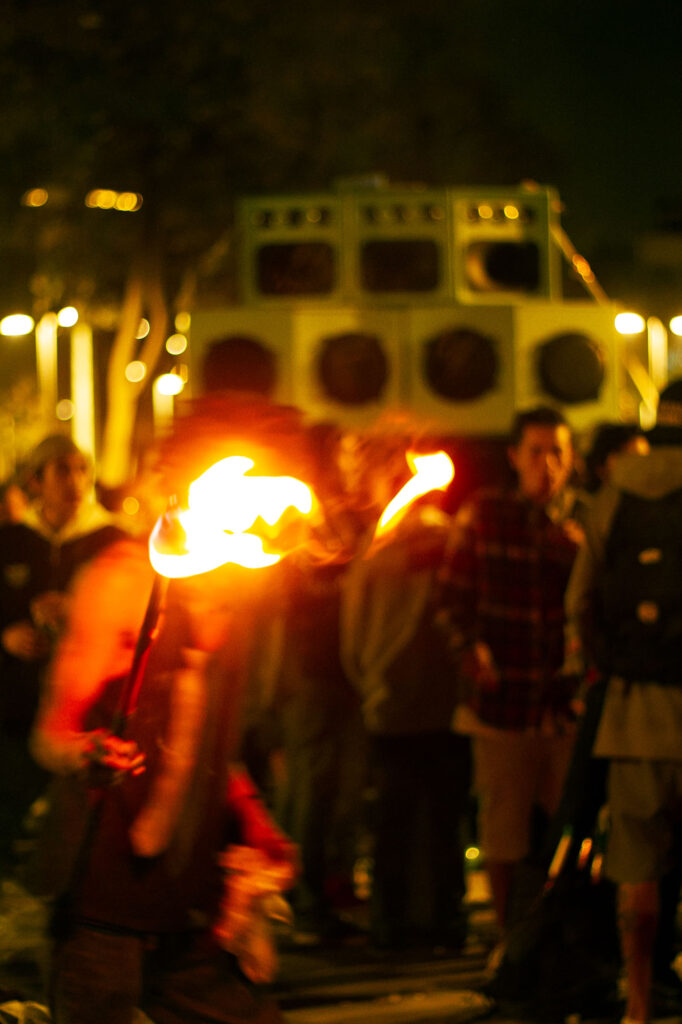
Category: Discourse Program

  • Irazema H. Vera → SESIONES ÉPICAS. SONIC STATEMENTS IN LIMA’S SOUND SYSTEMS

    Online Discourse Program

    SESIONES ÉPICAS. SONIC STATEMENTS IN LIMA’S SOUND SYSTEMS

    During times of social uprising, citizens become agents that shape multiple, ephemeral, and changing clusters of sound by adapting local and global ecologies of political expression to the logic of social dissent

    (Tausig, 2019).

    Has the sound system culture in Lima managed to blend climate action advocacy into its sonic statement, defying centralism and celebrating diversity in a city that still rejects its inherent indigenous population?

    The sound of today’s Peruvian bass electronic music has come a long way since its early days almost two decades ago, when the digital cumbia scene flourished locally—as it did in Buenos Aires and other capitals in the region—before attracting international attention. While it may have originated in Lima, the decentralization of music technology and the internet, which gave access to music blogs and the music communities behind them, allowed for a varied sonic approach with pluralist participation. Electronic indigenisms, Afro-Peruvian-oriented albums, atypical blends of popular hits from ’80s and ’90s Peruvian radio shows, the use of rainforest samples, and collaborations with Amazonian artists predominantly reclaimed popular rhythms and genres such as cumbia and chicha. This phenomenon of expression took place as the sound system gradually established itself as one of the main media in Lima for a larger community of independent electronic dance music makers, who claimed the space to broadcast a message that challenged the political, cultural, and environmental status quo, finding a receptive crowd.

    Starting in Barranco—the old artistic neighborhood now gentrified with a population of a higher socioeconomic background—the sound system culture, rooted in Caribbean tradition, was brought to Lima through Peruvian migration experiences in London, UK. Well received by the local reggae landscape, it paved the way for more spaces, sounds, and sonic bodies (Henriques, 2011) that literally resonated with their low frequencies and celebrated cultural diversity in a show of resistance against the apparent hegemonic conservative and colonial monoculture of Lima’s traditional upper classes, which have maintained social, racial, and cultural hierarchies in the city to perpetuate their power (Montero-Diaz, 2019). Lima, the literate city that continues to discriminate in its auralities while also intensifying them, was moving toward aural modernity, along with the rest of the region (Ochoa Gautier, 2006).

    Looking at sound systems at large, the introduction of this newfound sonic dominance from London to Lima met with similar idiosyncrasies of sounding (Henriques, 2011) in other socioeconomic sectors, with certain music influences primarily from the north and Andean regions. This may have contributed to the technology becoming a natural extension of how sound was amplified and experienced until then. The result, almost 20 years later, is an auditory culture open to a mixture of sounds, interested in political undertones, and in finding room in Lima’s cultural agenda. An exemplary case is that of Lima Dub Club, committed to promoting sustainability in its music festivals, advocating for the protection of Lima’s marine and coastal ecosystems affected by inefficient waste management and contamination, and calling attention to the poor management of scarce water resources, all while creating room for a music phenomenon that gathers an audience in public spaces.

    This essay reflects the first stages of an exploration into the nature of such settings and sonic recontextualization, while focusing on the initial question: Can Lima’s sound systems contribute to the ongoing resistance in a city facing constant water emergencies, in a country directly affected by the climate crisis, with recent state violence and repression in response to massive demonstrations demanding justice?

    INTRODUCTION

    To explain the current sound system situation in Lima, it is necessary to talk about the Peruvian political and climate crises, which are connected to sonic expressions throughout the country on a variety of levels. Lima, despite being a city that ‘turns its back’ on the rest of the country and looks up to what happens outside, has always had points of resonance—echoes of those sounds apparently not admitted.¹ Lima is the cultural center where these resonances are formed and organized and have historically gained places to be recognized and acknowledged as part of it. A similar process of an encounter between the sounds of resistance and Lima’s electronic bass scene with the sound system as a material of resonance is still in place. The intermediality of sound through digital technologies, music recorded through amplification technologies that cannot escape the territory’s disputes.

    There were over sixty deaths caused during the first two months of Dina Boluarte’s repressive government in Peru since December 2022, in the midst of massive mobilizations nationwide—mostly in the southern region and Lima—that branded her as ‘Dina asesina’ (Dina, the murderer), followed by organized journeys to the capital for a great and significant protest march, named La Toma de Lima (Lima Takeover). This unprecedented movement of political voices to the capital, primarily from the Andean South of the country (Cusco, Arequipa, Puno, and Ayacucho), was echoed creatively by various local civil groups: university students, art collectives, activists, and independent media, demanding justice and reparations, as well as transparency from the questionably new government and overdue demands on territorial issues and workers’ rights—a long list of unresolved tragedies left from Fujimori’s regime over two decades ago. Besides calling out the political crisis, people protested against an increasingly invasive far-right discourse that overlooked all other emergencies—the environmental crisis propelled by an unbridled extractivist economy, poor management of natural resources, recent oil spills, and unaddressed contamination cases, the renewal of mining concessions, and new concessions in disputed territories, etc.—and focused on stigmatizing and punishing communities that defend indigenous and land rights, and their right to participate in such matters.

    This was arguably the first time the streets of Lima heard the voices of puneños, a cry of protest that expressed itself through the music, instruments, chants, melodies, accents, and languages from Puno, where I am from. These were backed by many other supportive voices and bodies. Lima, a city where all the stories get condensed (partly because of its thick cloud bed), was experiencing sonorities with a political focus, from el Perú profundo directly from the source. This conversation continued in my music circles—in which I participate as a sound engineer, music producer, DJ, and instrumentalist—well aware of the need for such resistance and condemning the uncritical silence—or worse, the stigmatization and racism—from a great majority of the limeñan upper and middle classes. The demonstrators from the South and my creative community had a shared message filled with common concerns that continues to be expressed sonically and, given the city’s limited aural tolerance in certain neighborhoods, is forced to continue to find ‘more suitable’ sites.

    MIGRATION ECHOES IN LIMA: LA CHICHA Y EL SOUND SYSTEM

    The current relationship between Lima’s electronic dance music and sound systems has already established different circuits and sound proposals beyond dub and the undeniable influence of reggae culture, precisely because that connection found similarities in local music spaces and traditions. While the sounds defined by digital cumbia—tropical bass and other names of the phenomenon—flourished in Lima, the influence of Caribbean sound systems from the UK occurred in border circuits and subsequently placed itself as one of its technological mediations due to shared auditory values, since both are bass cultures.

    As Ana María Ochoa Gautier has noted, because of the intense intermediality of sound, particularly when re-mediated through digital technologies, aurality in Latin America has become an increasingly privileged site for the constitution of a contested public sphere (Ochoa Gautier, 2006). Such is the case of digital cumbia in Lima, although its musical roots—chicha and cumbia—were historically ignored and excluded as part of what has been considered canonical in Lima’s music. As contradictory as it may sound, Lima’s sonic diversity is audible to many of its inhabitants, even though this diversity isn’t apparent in the highest socioeconomic areas, where a strong conservative society still rejects and avoids most sounds that would be considered populares, indigenous, and therefore out of place (there are specific places, times, and contexts for them). In Barranco, however—and as it historically happened with Lima’s cultural elite—there were already music approaches that sought to bring such sonorities into other musical languages and situations.

    Contributing to the city’s bohemian nights by playing in music projects that conveyed reggae and then cumbia, it wasn’t until 2011 that Lima’s musician and producer Rafael Otero managed to organize, along with a network of producers, DJs, and musicians, Aba Shanti’s very first show in Peru. For the occasion, London’s well-known dub producer had requested a dub-style sound system, a wall of sound—something Rafael wanted to recreate in Lima after spending time in London and encountering the sound system culture there. That first session brought together a group of (mostly) male music enthusiasts who knew something significant was about to emerge from it. Many of them, such as Nicolás Borda, Guido Borasino, and Gonzalo Guivobich, would eventually build their own sound systems, and artists like Enrique Choque aka King Cholo and Lukro would go on to start their own music labels and production companies.²

    They were all critical of the status quo (of music, politics, and the city) in one way or another, probably and partly because they were either former students of Los Reyes Rojos school, known for its alternative approach to Peruvian traditional education, or Humanities students from PUCP, a prestigious private university appealing to young people with progressive ideas from well-off neighborhoods. They were already working on projects that included new methods and approaches to local electronic music, incorporating the design and construction of sound systems. These were, of course, enriched with other elements in their collectives and labels that initially came from outside their social circle to become crucial members. Through Myspace, Paz aka Deltratron met Álvaro Ernesto aka Tribilín Sound, a well-experienced DJ in Lima who began DJing for events in newer districts with mostly Andean migrant populations, which Paz believes caused a revolution in the music movement back then. Others, such as Chakruna, Qechuaboi, and Sonidos Profundos, contributed on one hand, while producers with European backgrounds and DJing traditions like Thibault Quinon aka Mr. Zebre (France) and, years later, Jesper Frederiksen (Denmark) contributed on the other. Aba Shanti returned to Lima on more occasions, and Channel One, as well as other reggae dub artists, also had their first shows organized by Dub Seen, Otero’s production company, and later by Lima Sound System, consolidating a strong connection with the international scene and encouraging an active sound system culture in Peru.

    This community contributed to the diversification of spaces and sonic proposals while the real estate boom in Lima directly impacted Barranco and other districts, accelerating violent gentrification. Houses soon to be demolished, like La Casa Rosa, hosted parties during a period of self-produced events such as Toma!, Chorrillano Maldito, Revienta el sistema, Fiestas con Ch, and music evenings at Thibault’s AKS, among others. Underground parties became important events for resisting violent urban changes and the noticeable consequences of Fujimori’s regime a decade earlier. Apart from providing space for a variety of music projects of eclectic genres, these events allowed new approaches for electronic music to thrive. Venues such as Toro Retro Bar, La Emolientería, Dragón, Noise, and El Dragón del Sur during summer invited producers to be their resident DJs, regularly showcasing their sonic aesthetic.

    CLOSING REMARKS on the Introduction

    It is not possible to fit into this essay the full dimension of such complex sonic and aural processes, the musical migration, and the encounter between the sound system and the sonic turn of bass electronic music in Lima. Therefore, this is an approximation. Many points of convergence are at play in this encounter (male dominance, socioeconomic contexts, the city’s urban development, etc.). The political climate and the environmental crisis are only two aspects studied and addressed while contemplating the nature of social dynamics in Peru and a worldwide reality.

    During this exploration, from my perspective as a female Andean scholar and music producer from the contestant South, I became increasingly aware of these particular aspects, of spaces and circles I grew closer to while simultaneously finding my place within them as a female migrant, a sound engineer, and an artist. I was present during some of the relevant moments mentioned earlier. Now, years later, as an already active—sometimes lazy—participant in the scene, revisiting an ongoing process that originated a movement and a political statement and discussing it with the group of people partly responsible for it reinforces the commitment to a phenomenon that changed the sonic perception altogether.

    This movement installed ethics that turned out to be beneficial to Lima’s electronic dance music industry. The openness and disposition to start and resume the conversation showed me that the community, although more dispersed and busier now, has built strong ties and is proud of what has been achieved.

    SPREADING THE SOUND SYSTEM MESSAGE

    In March 2021, Enrique Choque aka King Cholo embarked on a journey to create Lima Dub Club, an events production company, along with three other friends and colleagues from the arts industry. Despite the limitations still imposed on the population after a year of strict lockdown in a city home to millions, with neighborhoods offering little to no public spaces, they believed in promoting the sound system culture beyond dance clubs, indoor parties, and occasional festivals, while also providing a broadcasting platform for innovative sounds from the bass music cluster. They partnered with Borda’s Chulkilion Sound System, already managed by Choque, for most of their activities, and also with BQestia Sound System for larger occasions that required both. Over the last three years, they have held public events, including conferences and multimedia exhibitions.

    Since its inception, one of LDC’s main objectives has been to seek opportunities and ways to advocate for their commitment to the environment. They have played a crucial role in delivering this message of awareness in recent years, striving to create safe spaces for the full exercise of people’s cultural rights and the enjoyment of music that promotes a conscious message. They have partnered with other sustainable initiatives and organizations so that the musical events they produce can offer encounters aligned with their mission, inspired by the sound system philosophy and the enjoyment of diverse local music in more open areas of Lima.

    Although based in Barranco, they remain true to their objectives by focusing on expanding and diversifying their scope and advocating for the ocean, coastal ecosystems, and the beaches of Lima. These areas have been increasingly affected by growing numbers of cars, further highway expansions, and the exploitation of an allegedly “useless” space, as some have described it. They also draw attention to the contamination and water crises in a metropolis whose water supply is depleting at an alarming rate as the glaciers of the Andes rapidly melt due to rising temperatures. Occasionally, during their events, artists have also addressed the current political situation, government abuse of power, and even the deaths that occurred in the south, as acts of collective memory.

    Similar proximities between activism, sound systems, and public spaces have preceded them and paved the way for LDC’s journey. Initiatives such as the Selvámonos Festival, with its focus on decentralizing music by taking a large festival away from Lima to a small town on the edge of the Amazon forest, and the Perú Independiente Festival, which focuses on promoting independent creative arts using Lima’s limited public spaces for leisure, have contributed to the democratization of music and artistic production. Both festivals guarantee dedicated areas for bass music and sound systems and have played a key role in opening pathways to a wider audience. Another example is the Ultramar Festival in February 2020, a smaller precursor to LDC’s Consciencia y Soundsystem.

    There are deeper, subliminal messages in the music and a growing need for sonic recontextualization in a city undergoing many transformations—such as the evolution of bass music and sound systems. These processes exist in the “in-betweens,” where the politics and poetics of local sounds are intricately embedded in multiple practices and disciplines that cannot easily be confined to a single space (Ochoa Gautier, 2006). For now, it is important to note that the founders, inspired by their migratory experiences in London, returned with the goal of kickstarting a local movement and ensuring its longevity, providing hope in this gray city that allows for diverse sonic interventions, even though it officially does not.

    CONSCIENCIA & SOUND SYSTEM: A POST-LOCKDOWN VENTURE

    In march 2021, Enrique Choque aka King Cholo embarked on a journey to create Lima Dub Club, an events production company, along with three other friends and colleagues from the arts industry. Despite the limitations still imposed on the population after a year of strict lockdown in a city home to millions with neighbourhoods with little to none public spaces, they believed in promoting the sound system culture beyond dance clubs, indoor parties and occasional festivals, while also giving a broadcasting opportunity to innovative sounds from the bass music cluster. They partnered with Borda’s Chulkilion soundsystem, which was already managed by Choque, for most of their activities, and also with BQestia soundsystem for bigger occassions that require both. They have been holding public events in the last three years, including conferences and multimedia exhibitions.

    Since its beginnings, one of LDC’s main objectives is to seek more opportunities and ways to advocate their commitment to the environment. They have played a crucial role delivering this message of awareness in recent times, striving to harbour safe spaces for the full exercise of people’s cultural rights and to enjoy music that promotes a conscious message. They have partnered with other sustainable initiatives and organisations so the musical events they produce can offer encounters that align with their purposes inspired by the sound system philosophy, and the enjoyment of the sonic encounter of a variety of local music in more open areas in Lima. Although based in Barranco, they remain true to their objectives by putting all their efforts on expanding and diversifying their scope and advocating for the ocean, the coastal ecosystems, the beaches of Lima that have been afflicted by an over increasing number of cars, more highway expansions and the exploitation of an allegedly ‘useless’ space as some refer to. They also bring attention to the contamination and water crises in a metropolis whose water supply is depleting at an alarming rate as the glaciers of the Andes are rapidly melting with temperature increases. Occasionally, during their events, artists have also addressed the current political situation, abuse of power from the current government and even the deaths occurred in the south, as attempts of collective memory.

    Similar proximities of activism, sound systems and the public space have preceded them and paved the way for LDC’s journey. Initiatives such as Selvámonos festival, with its focus on music decentralisation, taking a large festival away from Lima to a small town on the edge of the amazon forest; and Peru Independiente Festival that focuses on promoting independent creative arts by also using Lima’s limited public space for leisure, and contributing to the democratisation of music and artistic production. Both festivals guarantee dedicated areas for bass music and sound systems, and have played a key role in opening the pathways to a wider audience. Or Ultramar Festival in February 2020 which was a petite version of LDC’s Consciencia y Soundsystem.

    There are more subliminal messages in the music and the need of sonic recontextualisations in a city with many processes – such as bass music and sound systems -, in betweens, in which the politics and poetics of local sounds are differentially embedded in multiple practices and disciplines that are not easily ascribable to a single space (Ochoa Gautier, 2006). For now, it is important to note that the founders aspiring to install this tradition in Lima returned from their migratory experiences in London, precisely with the aim to kickstart a local movement and ensure its longevity, providing hope in this grey city that allows for diverse sonic interventions, even though officially it does not.

    ¹already documented and studied by Thomas Turino in the 80s. The Music of Andean Migrants in Lima, Peru: Demographics, Social Power, and Style, 1988.

    ²Not the case of Paz aka Deltatron who had already established his label Terror Negro Records back in 2010 as a parallel and equally crucial movement of bass music in Lima. He however recognises he had been inspired by Rafael Otero and his music endeavours such as La Mente long before, and also by Mexican sonideros’ sound systems.   

    BIBLIOGRAPHY

    BIELETTO-BUENO, Natalia. Ed., “Introducción,” in Ciudades vibrantes: Sonido y Experiencia Aural Urbana en América Latina (Providencia: Ediciones Universidad Mayor, 2020) 

    HENRIQUES, Julian. 2011. Sonic Bodies: Reggae Sound Systems, Performance Techniques and Ways of Knowing. London and New York: Continuum.

    ITEN, Moses. The Roots of Digital Cumbia in Sound System Culture: Sonideros, Villeros, and the Transformation of Colombian Cumbia (Equinox Publishing, 2021)

    MÁRQUEZ, Israel. (2016). Digital Cumbia: Tradition and Postmodernity. Revista musical chilena, 70(226), 53-67.

    MONTERO DÍAZ, Fiorella. (2019). White cholos? Discourses around race, whiteness and Lima’s fusion music. Cultures of  Anti-Racism in Latin America and the Caribbean

    OCHOA GAUTIER, Ana Maria. Aurality: Listening and Knowledge in Nineteenth- Century Colombia (Durham, NC: Duke University Press, 2014)

    OCHOA GAUTIER, Ana María. “Sonic Transculturation, Epistemologies of Purification and the Aural Public Sphere in Latin America,” Social Identities 12, no. 6 (November 2006) 

    TAUSIG, Benjamin. Bangkok Is Ringing: Sound, Protest, and Constraint (New York: Oxford University Press, 2019) 

    *Gracias a Enrique Choque aka King Cholo, Rafael Otero, Adrián Leon Lostaunau aka Lukro, Álvaro Ernesto aka Tribilín Sound, Jesper Frederiksen, Yannet Vilela aka N3T4, Nicolás Borda, Guido Borasino, Paz Ferrand aka Deltatrón por darse el tiempo de compartir conmigo sus testimonios. Faltan muchos más y continuará.


    Copyright © 2024 Radical Sounds Latin America | All Rights Reserved

  • María Huerta → ECOTONAL: CUERPXS SONORXS EN RESISTEENCIA

    Online Discourse Program

    ECOTONAL: CUERPXS SONORXS EN RESISTEENCIA

    Porque la verdadera escucha cambia,
    es una transmutación,
    en ese tiempo el sonido te invade
    y te hace ver lo que está oculto.

    – Mónica Ojeda,
    Chamanes eléctricos en la fiesta del Sol.

    Es sábado por la tarde en el parque La Bombilla en Ciudad de México, Los Askis tocan ¡Ay Mi Corazón! en el Festival de las Flores y llueve. La plaza está rebozada en líquido y gente. Desde una mega pantalla led puedo ver a Pepe Cortez sonar su flauta y, cual encantador de serpientes, inhala, exhala y emerge del interior de su cuerpx el sonido; un sonido hipnotizante que encanta a masas de cuerpxs, hace que todxs se muevan y se retuerzan. Convulsionamos progresivamente al ritmo de la Cumbia de San Juan; nos inunda la lluvia y el sonido por igual, la cumbia sonidera trae consigo a la humedad, haciendo de ese momento una fiesta llamada eternidad.

    Los sonideros y el río

    Nací en Monterrey, Nuevo León, ciudad creada alrededor del río Santa Catarina, cuerpx de agua que ha resistido la carga del extractivismo y la industrialización. Al escuchar la cumbia sonidera, puedo sentir la fuerza de ese río resistiendo a la ciudad misma, como lo hago yo, desde la distancia.

    El río Santa Catarina ha sido puente entre culturas. A su lado, en el cerro la Campana y en la colonia Independencia, nació la cumbia colombiana, llevada por comunidades latinoamericanas que migran en busca del sueño americano. Como los sonideros, los ríos desafían fronteras y políticas de exterminio, desde una narrativa de diáspora; llevan la memoria del movimiento natural de los cuerpxs en tiempo y espacio. Resonamos porque sin sonido ni agua, solo queda la muerte.

    Los discos de música colombiana con ese lamento, con esa forma de expresar esas lejanías, esas ganas de sentir la tierra, de acordarse del origen… Pasaba a ser la elección de los despojados, de los recién llegados, de los que no eran de aquí, pero se hicieron de aquí.

    En 2022, Monterrey y el noreste de México se enfrentaron a la peor crisis hídrica en 30 años. El agua, fuerza invisible que da vida, se volvió un bien controlado por el estado y las industrias. El río Santa Catarina se opone al extractivismo feroz, resistiendo junto a sus comunidades, como el barrio de la Indepe, cuna de la cumbia regia. En junio de 2024, las lluvias y huracanes reavivaron su caudal, deteniendo las actividades industriales por unos días. Irónicamente, el mismo flujo que se explota es el que frena al sistema. Estos cambios emocionales tan drásticos en el flujo del río corresponden también al cambio climático: las masas de agua resisten.

    El sonido del río y la cumbia como resistencia

    Me gusta pensar que el río es un sonidero. Desde mucho antes de la llegada de la ciudad, su poder ha dado voz a las contra-narrativas sociales. En un mundo donde los espacios de ocio colectivo se reducen cada vez más, lxs cuerpxs de agua y los sonideros nos invitan a imaginar sin necesidad de dispositivos electrónicos. Nos conectan con el presente.

    Frente a la violencia neofascista del Estado de Nuevo León en su actual gobierno, la lucha por el territorio y la oleada global de movimientos anti derechos, la alegría común es una estrategia de resistencia. Este sentimiento es también una forma de libre improvisación, de liberarnos del ordenamiento sistemático que se nos trata de imponer ideológicamente.

    Unx cuerpx que vive en movimiento vive en el presente, por lo cual deja de estar sometidx a la depresión del pasado y a la ansiedad que trae consigo el futuro; es por eso que en el fluir de los ríos, encontramos razones para vivir y luchar.

    Si la cumbia es la voz,
    los ríos, las venas de América Latina.

    El poder de la cumbia y los sonideros residen en su capacidad de transformar traumas colectivos a través de ritmos alegres. Relatan las violencias sistemáticas que vivimos y nos permite procesarlas, cambiando las narrativas desde lx cuerpx mismx. Invocamos presencias, bailamos a entraña suelta, y cantamos códigos informáticos de poder.

    Bailar es hacer brotar las fuentes
    de conocimiento
    que se nos arrebató.

    En cada cumbia nos inunda
    un sudor colectivo: Llover el gozo.

    Sonido y cuerpx en disolución

    El sonido en el espacio conecta ecosistemas diversos. Como el agua, el sonido es memoria, una polifonía de voces que se expanden y disuelven fronteras. Un sistema de sonido es una interfaz que abre espacios para nuevas interacciones sociales, como las que suceden en las riberas del río Magdalena en Colombia, donde la cumbia conecta simbólicamente a las comunidades con el río. El ritmo de la música y el fluir del agua se entrelazan, creando un espacio en el que naturaleza y cultura convergen.

    Relacionarnos desde el flujo

    Quien se entrega a la escucha se disuelve en el todo de la naturaleza. El agua y el sonido fluye sin resistencia, creando conexiones con el espacio y el tiempo, con la diáspora y el

    origen. Cuerpxs como territorios, medios de resonancia, enlazadores de mundos, portan la memoria viva que fluye como el agua.

    En Náhuatl, Nepantla significa estar en medio, en las orillas donde los límites se desdibujan. Desde el proceso ecotonal generamos memorias colectivas, disolvemos el status quo y damos paso a nuevas versiones de comunidad y entorno. La contaminación es cultura.

    El sonido, como el agua, fluye constante. Dialogar con las presencias que habitan los espacios y tiempos es parte de mi práctica artística. Nos entregamos al flujo, al ritmo vibrante de energía que da vida.

    La alegría en peligro de extinción

    Ante la constante búsqueda de borramiento social, los sonideros y la cumbia cultivan memorias inmateriales, preservando contra narrativas sociales. En un mundo donde la alegría y la confianza colectiva están en peligro, el gozo y el baile son formas de resistencia. porque nos sentimos menos violentadxs, menos oprimidxs.

    A través del intercambio cultural, la conexión con la naturaleza y la creación de comunidades fuera de la lógica del consumo, podemos habitar una realidad más allá del capitalismo, donde nuestros cuerpxs nos pertenecen, y dejamos de ser máquinas que solo viven para chambear.

    Contaminación es cultura, reverberaciones sónicas. Río Santa Catarina, Monterrey, México, 2023. Cortesía de la Artista
    Ecotono – Río Santa Catarina, Monterrey, México, 20233. Cortesía de la artista.

    Contaminación es cultura, reverberaciones sónicas. Río Santa Catarina, Monterrey, México, 2023. Cortesía de la Artista

    Ecotono – Río Santa Catarina, Monterrey, México, 20233. Cortesía de la artista.

    References

    Ojeda, M. (n.d.) Chamanes eléctricos en la fiesta del Sol.
    Wiener, G. (2024) Una fiesta llamada eternidad. Oaxaca: Almadía.
    Han, B. C. (2023) El tiempo de fiesta es un tiempo detenido. Madrid: Taurus.

    Olvera Gudiño, J.J. (2022) Música colombiana de Monterrey: Historia de una lista con aspiraciones a playlist. Academicxsmty43 Blog. Available at: https://academicxsmty43.blog (Accessed: 20 October 2024).

    BBC Mundo (2021) Estos discos llegaron por dos razones a Monterrey…. Available at: https://www.bbc.com/mundo/noticias-58415977 (Accessed: 20 September 2024).

    BBC Mundo (2022) “A Monterrey le llegó el día cero”: La grave crisis de falta de agua que vive la segunda ciudad más poblada de México. Available at: https://www.bbc.com/mundo/noticias-america-latina-61917457 (Accessed: 20 October 2024).

    Aguilar Gil, Y.E. (2024) Tequiologías. Mexico City: Digital Culture Center. Available at: https://www.centroculturadigital.mx/revista/tequiologias (Accessed: 20 September 2024). Bergman, C. and Montgomery, N. (2023) Militancia alegre. Mexico City: Tumbalacasa Ediciones.

    Mata, V. (2023) Todo lo que se mueve. Mexico City: Comisura Ediciones.

    Salazar Vélez, A. (2022) Conjuros de agua. Mexico City: Pitzilein Books.

    Señal Colombia (n.d.) Danzas que nacieron a orillas del río Magdalena. Available at: https://www.senalcolombia.tv/cultura/danzas-rio-magdalena (Accessed: 20 September 2024).

    Aguilar Gil, Y.E. (2024) Tequiologías. Mexico City: Digital Culture Center. Available at: https://www.centroculturadigital.mx/revista/tequiologias (Accessed: 20 September 2024).

    Ecotonal: Resonant Bodies in Resistance

    María Huerta

    Because true listening transforms,
    It is a transmutation.
    At that time,
    sound invades you and reveals what is hidden.

    – Mónica Ojeda,
    Electric Shamans at the Sun’s Festival.

    The Sound Systems and the River

    It is Saturday afternoon in La Bombilla Park in Mexico City. Los Askis are playing “¡Ay Mi Corazón!” at the Festival of Flowers, and it is raining. The plaza is overflowing with water and people. On a giant LED screen, I can see Pepe Cortez playing his flute; like a snake charmer, he inhales, exhales, and the sound emerges from within his body—a hypnotic sound that enchants masses of bodies, making everyone move and twist. We convulse progressively to the rhythm of the Cumbia de San Juan; rain and sound flood us equally. The sonidera cumbia brings with it humidity, transforming that moment into a celebration called eternity.

    Through sound, we recreate narratives that dislocate reality: invisible time escapes that create space for forms of language beyond visual imagery.

    The sonidero transmits intangible memories within the body of a living being. Faced with the possible extinction of social ecosystems due to imperialist structures, these memories transmute into human ideologies and behaviors that, when expressed, expand the diversity of thought, making us question the reality of capitalism and unproductive time. To be present is also to cease being part of the oppressive system, if only for a moment.

    A sound system can be an interface;

    In Nahuatl, Nepantla means to be in-between,
    on the edges, where boundaries tend to blur.¹

    Ecotonal Process:
    generating collective memories,
    dissolving the status quo.

    Making way for new versions,
    communities,
    environments:
    Contamination is culture.

    Contaminación es cultura, reverberaciones sónicas. Río Santa Catarina, Monterrey, México, 2023. Cortesía de la Artista
    Ecotono – Río Santa Catarina, Monterrey, México, 20233. Cortesía de la artista.

    The River as a Sound System in the Face of Climate Crisis and Neofascism

    In 2022, Monterrey, Nuevo León, and northeastern Mexico suffered the worst water crisis in approximately 30 years. The silence from the water bodies and their desiccation is a colonial and ecocidal stance: an inert space is death itself.

    Sonidera cumbia is a language that refuses to be silenced. The Santa Catarina River opposes the ruthless extractivism brought by Monterrey’s industrialization, and its surrounding communities—like the downtown area and the Indepe neighborhood, the cradle of regia cumbia—resist the various mechanisms of territorial dispossession.

    In June 2024, Monterrey experienced hurricane season, and the sound of the Santa Catarina River’s flow halted production activities for a couple of days. Paradoxically, the same water flow that is extracted is the one that stalls the industrial system. To exist and occupy space is a political action. The masses of water resist.

    Could the tension between the mountain and the river give sound and voice to counter-narratives?

    In times when collective leisure spaces are increasingly diminished, water bodies and sound systems enable us to engage imagination without the need for electronic devices, software, or the internet to connect with the present moment.

    In the face of the global wave of anti-rights movements and the ongoing struggle for territory, collective joy is a strategy of resistance against state terrorism’s discipline and death; it is the fight for the body itself.

    If cumbia is the voice,
    rivers are the veins of Latin America.

    The river and cumbia, more than recreational spaces, are also reasons to live for: recovering emergent ways of life that sustain connections, bringing us closer to the origin of life.

    The power of the sonideros lies in their unique and ritualistic way of transforming collective traumas through joyful rhythms. They tell stories about the systemic violence we live through, helping us process and change the narratives by manifesting a call from the body itself.

    We invoke presences, techno-poetry. We dance with abandon, singing power codes.

    From geopolitical diversity, we create a new voice, collective reality, a hypersensitive narrative thread, imperceptible to those who seek to erase us. This spectrum thrives on our presence, physical bodies that contain it, manifesting and invoking its strength, beyond the human and non-human, in the vibration that gives life.

    That monstrosity that has been taken from us remains intangible in every cumbia dance that floods us. Speaking in code, a source of knowledge.

    Sound: Body in Dissolution

    Sound in space enables interconnection between diverse ecosystems; water, which is singular, becomes many. It is, at the same time, the memory of a polyphony of voices coming from various realms of thought and practice. Sound and bodies of water hold geopolitical power, capable of healing the future, which always begins in the present. Their sense of fluidity allows the memories they carry to expand and redistribute as they interact with time. They form variables that are not necessarily accepted by the capitalist-imperialist system.

    Relating from the flow

    Surrendering to listening dissolves the self into nature’s totality, into the possibility of water and sound being free to exist everywhere, where resistance no longer exists.

    Dialoguing with different presences and listening to spaces and times is part of my artistic practice. Sound, as a manifestation, connects us with space and time, the connection with the diaspora, the origin.

    La alegría en peligro de extinción

    Bodies:
    territories,
    resonance mediums,
    channels,
    world-bridger,
    constant flow,
    vibrant rhythm
    of energy.

    Water in motion,
    constant transmission
    of living memory:
    source
    of common
    knowledge.²

    ¹Mata, Valeria, Everything that moves, Comisura Ediciones, 2023.
    ²Aguilar Gil, Yásnaya Elena, Tequiologías, Digital Culture Center in Mexico, 2024 www.centroculturadigital.mx/revista/tequiologias

    Copyright © 2024 Radical Sounds Latin America | All Rights Reserved

  • Ollin Miranda → LA NATURALEZA DEL SOUND SYSTEM ES COMPARTIR

    Online Discourse Program

    LA NATURALEZA DEL SOUND SYSTEM ES COMPARTIR

    En nuestra memoria los bajos siempre han retumbado por las calles, desde las periferias permisivas, recias y saturadas, eso es crecer en barrios sonideros. Pero hoy, esa es la conexión con el resto de culturas urbanas que se relacionan desde los altavoces y lo audible.

    Viajando por el Caribe Cubano, la Colombia Picotera y Europa con sus festivales globales nos dimos cuenta que la gente hoy en día sí puede comprar un Sound System, pero definitivamente es algo íntimo, personal o colectivo y espiritual poder construirlo, es un alimento para el alma imprimirle una personalidad, darle vida, verlo crecer. Incluso podríamos tener el mismo Sound, usar las mismas cosas y aún así va a sonar totalmente diferente. Porque cada una tiene una visión, una forma y disciplina para crearlo, pensarlo o configurarlo en su estructura y diseño. Esa es la particularidad de que sea hecho a mano, es la creación de una parte de ti hacia lo colectivo.

    CULTURAS GLOBALES

    Hoy en día y globalmente hay una tendencia de cambio sociocultural a un paso muy acelerado, la multiculturalidad ha llegado a muchos rincones del planeta, conectando más rápido a la gente. Los medios y la aproximación a ellos nos permiten producir con mayor facilidad; el acceso a la información, las conexiones, relaciones y tecnologías siguen mutando también.

    A diferencia de los años anteriores, en los 90 ‘s los sistemas de sonido caseros eran la fuerza análoga, pesados, no pasaba por tantos procesos como ahora, iba más raw, pura frecuencia, presión sonora y cultural.

    Ahora son diferentes las formas de sonar un Sound System, entre lo análogo y lo digital, monocanal y stereo, global o íntimo.

    Antes era la voz rastafari, la voz de un grupo unido reclamando por sus derechos. Ahora no tienes que ser rastafari para hacer Sound System, las frecuencias son para todas y eso significa que las han compartido, por eso ahora todas podemos hacerlo, es un conocimiento y experiencia que viene de tiempo atrás. Así que no importa de donde seas, no olvides que estamos importando una cultura que nació en África, que la colonia transportó a Jamaica y la migración la transformó en Reino Unido, y ahora, para todo el mundo. Por eso es importante que la gente reconozca la historia en los mensajes de la música y la lleve a otro nivel, para abrirse a algo más, más espiritual y más consciente aún, que trastoque a todas sin distinción.

    ARQUITECTURA SONORA

    La electricidad es una energía que se traduce en frecuencia, que viaja a través del aire, que atraviesa nuestras cuerpas y que traducimos incluso en energía mediante el pulso que reflejamos, que nos hace mover, bailar.

    Aprendimos sobre sonido haciendo comunidad, con el feedback del público, con la relación de la massive con la o el operador, todo como un elemento de conexión, porque lo bonito es que se genere una sesión con amor y pasión, una buena interacción entre todas, de verdaderas relaciones humanas y tecnológicas;

    análogas

    digitales

    de transistores

    racks

    stacks

    cables

    presión

    electricidad

    Por eso, montar a consciencia y tener el conocimiento para ello es clave para sonar con fuerza y calidad ya que en cada sesión aprendes realmente algo distinto, cada montaje te enseña algo nuevo, es como un “each one teach one”. Porque la energía personal que está puesta en ello no es algo que se pueda evaluar, es algo que se comparte.

    Entonces cuándo encarnas la arquitectura acústica de una buena sesión entiendes la música de otra manera, cuando puedes conectar con la cultura viva de lo que estás escuchando se cierra un circuito y de pronto todo tiene sentido.

    MANIFESTACIONES AUDIBLES

    En este momento la música es más accesible, pero procesarla por un Sound System puede culturalizarla así misma, te vincula a más cosas de lo que haría solo reproducirla, bailarla o simplemente escucharla, es decir, los sonidos cambian por su forma de reproducción y un sistema hecho a mano te acerca a esa experiencia única por su potencia, sonoridad y valor cultural.

    Por eso, no es lo mismo una fiesta con Sound System que una sesión de Sound System. Igualmente en cualquier lugar del mundo a donde quiera que vayas poder organizar una sesión con Sound es difícil y aunque promover tu música ahora es más fácil con el internet y las redes sociales, no cambia lo que puedas llegar a experimentar en una buena sesión de bajos.

    Mucha gente ahora quiere usar el Sound System para propósitos solo personales pero esto es acerca de crear una familia y requiere de cuidados, es una unidad donde todas importan, donde todas las partes hacen crecer a otras, sin gobiernos, sin fronteras, sin prejuicios. Usamos el sistema de sonido como herramienta de cambio, porque la naturaleza del Sound System es compartir, no es solo que suene fuerte y listo, no se trata de competir, no estás vendiendo algo en esencia, lo está compartiendo, expandiendo y dándole voz a mensajes que protestan por y para todas.

    La carencia en los contextos de donde vienen estas culturas en resistencia nos ha hecho crecer, nos han hecho darnos cuenta de lo que cada quien puede aportar realmente, no se trata de vender algo, se trata de usar la economía en algo positivo, transformarlo para poder producirlo, hacerlo tangible y que la gente pueda disfrutarlo.

    En nuestra experiencia y conocimiento de distintos sistemas, contextos, países y energías pudimos presenciar como es hermoso ver a todas las nacionalidades juntas, unidas. El hecho de poder presenciar a todas las guerreras de espíritu protestando con el arma del baile y la música nutre a una comunidad que necesita seguir viva en estos tiempos donde aún abundan los sistemas opresores.

    Creemos que los mensajes del sistema de sonido son más que una cosmovisión para vivir mejor, son una inspiración que tiene que salir a la superficie, porque el hecho de que la música y la cultura del Reggae & Sound System salga a la luz del underground es para que la sigamos protegiendo de Babylon, manteniéndola viva, que pueda reconocerse y actualizarse.

    Copyright © 2024 Radical Sounds Latin America | All Rights Reserved

  • Felipe Maia → PAREDÕES: SONIC WALLS, EMBODIED LISTENINGS, NEW TERRITORIES

    Online Discourse Program

    PAREDÕES: SONIC WALLS, EMBODIED LISTENINGS, NEW TERRITORIES

    The sound overwhelms me, there’s no escape. It’s useless to try and identify its source or specific form. Conversations between men and machines, men and machines cutting metal and wood, music over brown noise rusting, cracking, peaking. Everything blends together, amplified by echoes, shattered reverberation and clashing waves. It’s a garage. These two workers, Neguinho and Jean, are among the youngests. They assemble car sound systems known as paredões. The short time they’ve spent there has already taken a toll on Jean’s hearing, as he confided to me.

    For those who work with paredão, hearing is a valuable asset at constant peril. Neither Neguinho or Jean protect their ears from the percuting and persistent, abrasive sound—such equipment is not mandatory. Over time, I get used to the harshness of the noise. The exception of the cacophony slowly fades into the norm, the unseen atmosphere. Sound is habitus: it manifests in a specific way in a given context, and through constant exposure, it becomes internalized, embodied, customized, and behavior responds to sound. I haven’t realized when sound stopped being noise, a nuisance, and became imperceptible, the norm, the atmosphere.

    In a small room at the corner of the 300m2-facility stands China. He is the owner and founder of this garage, also known as the montadora, which stands for “the place that mounts,” as in to assemble. “He’s the one who will ‘align’ this sound,” Neguinho explains to me. China comes to the main room and positions himself in front of a newborn paredão, 5 meters away from the wall of sound. He uses a car radio plugged into the sound system. He plays a song that blasts out of the speakers. He cranks the volume to the maximum. The sound overwhelms me, there’s no escape. No one seems bothered. On the contrary, everyone watches China with admiration, as listening to him is impossible, as if it was a solemn ceremony. He starts the “alignment” of the paredão.

    Paredão, a Brazilian Portuguese word, literally translates into English as “big wall.” Unlike a wall, however, the paredão is not stationary, nor does its wall-ness quality come solely from its surface. In a future-bending techno-sonic organology, the paredão can be conceived as a branch of the sound system family, defined as an autonomous and independent instrument that relies on batteries to function. More than that, the paredão is a mobile sound system, a device found in the trunks of cars or attached to a car or truck, which has become synonymous with a cultural practice that has spread throughout Brazil in recent decades¹.

    A more nuanced analysis of the word reveals that the “big” aspect of a paredão relies on its sonic pungency rather than its physical grandeur. All over Brazil, paredões of different sizes, structures, and firepower can be found, generating various terms: carretinha, bob, paredinha, reboque, som. Many of these devices are capable of reaching up to 120 dB of sound pressure at a 5-meter range, equivalent to the roar of a jet engine. Paredão is a

    superlative of sound. When it tunes in, the realm of high volume and sonidos sucios (Calderón, 2013; Casillas, 2015) opens up. Excessiveness is an essential trait of a paredão: its audiophile, state-of-the-art craftsmanship, its extreme high-low amplitude when playing baile funk music, its loudness. Even names point toward abundance, in this case, from the aggressive Megatron to the boastful Carreta Exibida.

    To build a paredão, the workers at the China Sound garage craft speaker boxes through woodcutting, shape a structure through iron welding, assemble cables and wires and finally plug in sound speakers. But the paredão has no life until it truly speaks. That’s the alinhamento, the alignment, when the paredão and China merge into a unique sonic body (Henriques, 2011): China press play on the car radio connected to the paredão, and so it babbles, screams, shouts; China listens with his ears and skin and eyes: with the help of a microphone positioned in front of the speakers, the audio signal is translated into real-time graphs on a computer screen. China then adjusts acoustic and electrical parameters such as delay and amperage in the paredão processors (also known as preamps). His goal is to avoid sonic wave clashes while achieving the most intense sound. He comes and goes in a give and take choreography, a sum and subtract game. It’s a fine-tuning process of listening, analyzing, and tweaking. It takes a few minutes². China stops when the paredão is bound to fulfill its role: to dominate through sound, to speak.

    Building a paredão is less a matter of boxing speakers in a car trunk than a complex amalgamation of techniques that encapsulates maximalism into intricate, fine-tuned structures — resulting in machines that range from USD 250 to USD 175,000. A paredão is not a bric-a-brac puzzle. On the contrary, this device relies on high-value equipment and components, and assembling them requires a garage, like ChinaSound, with workers sharing technological dexterity, ranging from electronic to electrical engineering. It’s a bricolage, but not in the sense of a disregarded, disdained perspective toward the Global South. It’s bricolage because it bends Global North paradigms toward vectors of creativity and resourcefulness unfathomed by the US-EU-Japan audio industry.

    Building a paredão is less a matter of Taylorist, alienated industrialism than a complex amalgamation of embodied expertise that transcends formalization. This creation-mash encompasses high-low stances through a local and global scenario that has unfolded over the past decades: the miniaturization of technical components, the rising power of microprocessing, and the growing accessibility of electronic tools. Arising from that, the paredão becomes the cutting-edge sonic embodiment of a popular acoustemology (Feld & Brenneis, 2004) that emerges as an undeniable thread of the Latin American social fabric. It’s an aural turn, “a displacement in the power of signification and mediation of the aural in the constitution of Latin America’s public sphere” (Ochoa Gautier, 2014).

    Indeed, the paredão is part of a long line of sound systems built upon sedimented practices that have been running over decades in Central and South America and the Caribbean. These sonic devices are the result of different popular takes of technical manipulation and a wide range of approaches to collective listening, the likes of quilombola’s rádio-poste (Dias, 2009) Salvador’s trios elétricos (Paulafreitas, 2006), Pará’s aparelhagens (Lemos & Castro, 2009) and Maranhão’s radiolas (Pessoa, 2009), Colombia’s picós (Birenbaum Quintero, 2018), Dominican Republic’s chipeo, Puerto Rico’s voceteo, amongst others. None of these devices exist outside of an embodied listening positioning, one historically denied to Latin America under the shadow of enlightened colonization, its progress-driven enterprise, and its oral or written canons. In fact, the paredão escapes the language sign; it exists because of the sonic signal. Blueprint templates and hand-drawn models are helpful tools for this craft, as seen on the tables covered in sawdust at ChinaSound, but listening is the essential sparkle to bring the paredão to life.

    Once it leaves China’s garage and hits the narrow streets and alleys of a favela in São Paulo, blasting the scorching kicks and abrasive lines of baile funk at street parties, the paredão becomes a unique actor in a social-technical network (Latour & Guilhot, 2007) entangled by sound. It entails a sonic dialogue merging China, music producers, and partygoers. China’s expertise, he says, is the result of years of experience in building this device, an aural formation that often manifests as tacit knowledge. The paredão, however, is anything but silent. If the builder of an anechoic chamber craves precise silence—encapsulating a space where the tinkle of a pin dropping or the faintest heartbeat can be heard—the builder of a paredão craves precise anti-silence, a sound that obliterate pins and pulses of all kinds, creating an ephemeral chamber of its own. Like a wall, the paredão raises new territories through the power of a new approach to listening. The sound overwhelms; there’s no escape.

    ¹The first mention of automobile sonic devices in Brazil dates as far as the beginning of the XX century with so-called “musical klaxons.” Paredão, on the other hand, is a device that has become ubiquitous in Brazilian cities in the past decades entailing a decade-long dialogue with other practices such as Trio Elétricos, Trenzinhos and car tuning.

    ²Once, China told me about the “miracle,” as per his words, he operated in a paredão meetup: he proceeded with the alignment of a carreta, a paredão with more than 200 sound speakers, in less than ten minutes. He won the sound clash competition that day.

    BIBLIOGRAPHY

    Birenbaum Quintero, M. (2018). Exchange, materiality and aesthetics in Colombian champeta. Ethnomusicology Forum, 27(1), 3‐24. https://doi.org/10.1080/17411912.2018.1454842

    Calderón, D. (2013, juillet 30). Sonidos Sucios. Lawbsolute. https://lawbsolute.wordpress.com/2013/07/30/sonidos-sucios/

    Casillas, D. I. (2015). Lo sucio. Sounding Out! https://soundstudiesblog.com/tag/lo-sucio/ Dias, L. O. (2009). Além de uma simples onda : Recepção, Cidadania e rádio-poste no

    Quilombo Barra de Aroeira.
    Feld, S., & Brenneis, D. (2004). Doing anthropology in sound. American Ethnologist, 31(4),

    461‐474. https://doi.org/10.1525/ae.2004.31.4.461
    Henriques, J. (2011). Sonic bodies : Reggae sound systems, performance techniques, and

    ways of knowing. Continuum.
    Latour, B., & Guilhot, N. (2007). Changer de société, refaire de la sociologie. la Découverte. Lemos, R., & Castro, O. (2009). Tecnobrega : O pará reinventando o negócio da música.

    Aeroplano Editora.
    Ochoa Gautier, A. M. (2014). Aurality : Listening and knowledge in nineteenth-century

    Colombia. Duke University Press.
    Paulafreitas, A. (2006). Trio elétrico: história, técnica e recepção de uma mídia sonora

    genuinamente brasileira.
    Pessoa, J. (2009). Produção e consumo do reggae das radiolas em São Luís/MA:

    Significados, Simbolismos e Aspectos Mercadológicos.

    Copyright © 2024 Radical Sounds Latin America | All Rights Reserved

  • GG Albuquerque – A sonic thinking of dirt and noise: the sound of favela funk DJs

    Online Discourse Program

    A sonic thinking of dirt and noise: the sound of favela funk DJs

    “Listen to the tuin!” announces MC Bin Laden. At that moment, a sharp, continuous buzzing sound cuts through “Lança de Coco – Passinho do Romano,” piercing our eardrums and inducing a dizzying sensation. Produced by Mano DJ, this 2014 hit foreshadowed a sound that, nearly a decade later, would become central to the Brazilian funk music scene at street parties in São Paulo’s South Zone: the tuin.

    Tuin is the term funk enthusiasts (funkeiros) uses to describe the auditory hallucination triggered by the use of “lança”, a drug frequently consumed in the bailes, the street parties of the favelas. Its effects include tingling in the hands, a buzzing sound in the ears, and heightened sensitivity to loud noises, particularly high-pitched frequencies. But while in MC Bin Laden’s track, the tuin served as a special effect, in contemporary baile funk, this sound has been radicalized, becoming the foundation of a new mutation of the famous brazilian beat: funk Bruxaria (witchcraft funk). In “Tuin Destrói Noia” by DJs K, Menor 7, Noguera, and Magro, for instance, the tuin becomes the backbone of the beat, at one point blending two tuins simultaneously.

    By exploring the distorted, high-volume texture of the tuin, funk producers incorporates and subverts elements the music industry often deems as “mistakes”—such as noise, distorted mixing, and raw textures that push everything into the red. Paradoxically, the DJs from the favela bailes often speak about their artistic experimentation in terms that align with the commercial logic of the music industry. DJ K, for example, transforms the widespread attention crisis and the social media algorithms into a musical form: “When you analyze your YouTube data, people usually watch 40 seconds of the video, you know? Sometimes, they only listen to a minute of the song. So, in that one minute, in those 40 seconds, I try to make everything shine”, he explains in a scene from the documentary Terror Mandelão (2024).

    Jeeh FDC, producer of the more rhythmic and less aggressive style of funk known as Ritmada, also references competition when discussing his work in music production. In 2021, while the noisy and sound of Bruxaria was gaining popularity, Jeeh FDC, then just 17 years old, decided to go the opposite route. His track “Beat da Felicidade” (happiness beat), one of his early hits, became a success with its brighter, more upbeat sound, as the name suggests, sampling steel pan sounds. In an interview, he explains: “If you create something different, funk is yours, you feel me? It’s in your hands. You know why? Because when you create something, it resonates, and once it resonates, someone else will do the same thing. And so it goes, it becomes a trend, it follows and follows… You’ve got to think completely against the grain, seriously. Because if you go in the same direction as everyone else, you’ll end up just being [one] more [in the] competition.”

    In the remarks of DJ K and DJ Jeeh FDC, the logic of digital audience retention and competition, respectively, are invoked as driving forces to explore new sounds, which would later be followed by other artist-competitors. Reversing the common understanding that sees commercial logic as mere reproduction of trends and “formulas for success,” for these DJs, there is no antagonism between experimentation and the industry. In funk mandelão, the avant-garde is popular, and vice versa. However, the norms of the market are rethought, modulated, and viewed through a different lens, resulting in new approaches to creative work. When we observe how the sonic thinking developed by racialized and marginalized artists moves ambiguously between the market and experimentation, we see in Black imagination a dynamic of escape that avoids complete capture by contemporary identity-driven capitalism, even as it directly negotiates with its framework.

    a sonic thinking of dirt, noise and embrazamento

    Producer of tracks like “O Mundo é Putaria” and “Puta Mexicana,” DJ Jeeh FDC became known for a style of funk that he classifies as “melodic rhythm”, a combination of slower rhythms and melodic vocals (sometimes with an sexy-R&B aura) with the pressure of Ritmada’s syncopated percussion. But Jeeh warns: “You gotta have a bit of dirt in there, it’s gotta be dirty, it’s gotta be favelado (from the favela), you feel me? But being favelado doesn’t mean it has to be totally messy. Things gotta be in their place, you know? But still, always dirty, dirty.”

    With this, Jeeh draws an association between “dirt” and favelas or marginalized areas. On the other hand, the producer emphasizes that the dirt has nothing to do with negligence or lack of refinement in the production and musical aspects. When I ask him what this “dirt” is, he responds: “We have this power to make everything distorted, but still equalized—that’s dirt. Not just distorted, but letting it clipping in volume.”

    The “dirt” is conceptualized by the producer as a sonic characteristic, not necessarily tied to sexually explicit lyrics — which are very common in the funk scene. Another point is that dirt is directly associated with noise and high volume, to clip the mix, thus going against the technical norms of mixing in the music industry, which avoids clipping and distortion. Jeeh also sees dirt as an expressive tool produced by a favela subjectivity (“it’s gotta be from the favela,” “always dirty”), and he views it as a kind of “favela way” of producing, channeling a particular creativity connected to a way of life in urban peripheries that resists the logic of sanitization and and technical-aesthetic homogenization.

    Jeeh FDC’s ideas find a parallel in the thoughts of Rio de Janeiro DJ Renan Valle. Producer of favela bailes hits and TikTok virals like “Uma Foda” and “Sarra nos Menor que tá de Glock na Cintura,” Renan Valle is a DJ from the Nova Holanda and P.U. (Parque União) street bailes and proposes an idea of dirt and noise that is intertwined with a socio-cultural and political reflection on sound. For him, the funk made for favela bailes is noisier than other branches of the genre because it engages with the life and soundscape of the communities:

    “People from the favelas like something more, let’s say, ‘amateur’. When it gets too clean, it’s no longer an urban sound. If you pay attention, the favela has its own sound. I know when there’s an police operation in the favela. Why? Because there’s silence. [Typically] The favela has kids running, birds flying—you hear them in the singing when you wake up at 5 AM, motorcycles going back and forth, moms yelling at their kids… So the favela has its own sound. This is so much a part of our daily routine that when we make music, we want that noise. It’s rooted in us. We want that vibe. It’s not because we like a dirty sound and we don’t care. It’s because

    it’s part of our soundscape, of our daily life. The noise is here. And when there’s an [police] operation, man, the police bring such silence to the favela that you can’t even hear the birds at 5 AM, no dogs barking, no motorcycles passing, no cars, no moms yelling at their kids. They silence the favela, man. (…) The sound of violence is silence. What we’re afraid of is the silence.”

    Renan Valle points to a form of terror imposed through silence. In Rio de Janeiro’s war on drugs (in reality, a war on the poor, as sociologist Adriana Facina and many others points out), silence is the voice of fear and the violent, threatening power of the State, which enters the favelas only under the logic of police invasion. Noise, on the other hand, becomes the expression of life happening, flowing through both humans (the mother calling her child) and non-humans (motorcycle engines, birds singing, dogs barking). In Valle’s view, funk music from favela bailes appropriates intense sound frequencies, heavy bass and noisy textures to create aesthetic experiences that channel this vital energy, the “soundscape of the favela,” as the producer calls it, into an experience that mobilizes the collective body of the baile funk, transcending the codes of individual, solipsistic listening centered only on the ears.

    DJ K, Jeeh FDC, and Renan Valle develop a cosmoperception of noise that is notably distinct from the Western experimental music tradition, which also incorporated dissonance and noise as expressive resources under a different logic and worldview. In noise music, there’s often an inclination toward pain, as researcher and composer Lílian Campesato points out, but in the sonic blackness of funk, noise expresses the release of repressed vital energies, as DJ ZL from Complexo do Flamengo, in the far north of Belo Horizonte, suggests: “What I want to express to people when they’re listening to [my] music is for them to freak out, to let go. You don’t have to stay trapped because we’re already trapped too much in certain ways, you feel me? When someone’s listening to the music, I want them to feel the freedom to be who they are. For me, the more aggressive [the sound], the more liberating it is, because people can embrazar more.”

    The idea of embrazamento (or getting fired up) mentioned by DJ ZL describes an embrazado (“ignited”) state of mind, often heard in various funk tracks, and also discussed by baile attendees and partygoers. The term likely stems from brasa (ember), conveying a sense of heat. In the context of the bailes, however, embrazar carries a meaning tied to invigorating vitality and intoxicating joy, urging full surrender to the party, embracing the present moment without the weight of future anxieties. “The sonic blackness of funk sparks a new sensibility of listening, rooted in a different cosmoperception, where noise becomes a channel for pleasure, jubilation, and ultimately, embrazamento—a movement toward experiencing existence beyond colonial political death projects.”.

    The dirt-noise of funk resonates with the idea of a “dirty psychology” proposed by Sofia Favero (2022). “Making room for the dirty is to close off space for the nefarious. Dirt is aggressive, but cleanliness is truly violent. It was the pursuit of purity that led us to embody a colonial, imperialist, bloodthirsty cosmology. Is this the life that awaits us?” the author provocatively questions. Cleanliness, she argues, is rooted to a colonial and imperialist project of violence. This is because the duality of cleanliness versus dirt also implies the fabrication of an ego-driven thought of cis-normative, hetero-masculine whiteness, which narrates itself

    as clean, healthy, and normal. In this sense, Frantz Fanon asserts that “White civilization and European culture have forced an existential deviation on the Negro. What is often called the black soul is a white man’s artifact” (FANON, 2008, p. 30). As such, Favero argues that “getting dirty is not only about handling impurities but also signals the precarious way in which the white, male, heterosexual, slim, and cisgender society constructs their subjectivity in culture: always attributing a condemnable, bad status to their minor other” (FAVERO, 2022, p. 30).

    From this perspective, funk, with its tuin, distorted mixes, loud sounds, and blasting sound systems materializes an artistic approach that affirms its political strength symbolically amidst the destruction of its ways of life. In contrast to the tech and music industry, the “dirt” of DJs and producers from Brazilian favelas stains the technical norms and expertise of major studios professionals with a sonic epistemology that rises from the possibilities of resistance and creativity shaped by impurity and scarcity.

    Recently, music from global peripheries has gained increased attention through tags like guettotech or global bass, often framed within a narrative that revives the racist biases of the old world music concept, portraying these musical cultures as the work of poor people who, even with access only to outdated, pirated, or cheap technology, somehow produce magical beats because rhythm is supposedly in their blood — in their primitive essence. When discussing Angolan kuduro, Stefanie Alisch (2020) aptly describes this discourse as a “narrative of scarcity-resilience,” which, by ignoring the complex histories and rich artistic practices that shape kuduro (and we could also see that on other musical genres from the Global South), focuses solely on resilience and risks fostering racist stereotypes about inherent rhythmic and bodily intelligence. It indirectly suggests that Black people lack other forms of intelligence, evoking stereotypical images of Africans dancing joyfully, and by extension, Black people everywhere (ALISCH, 2020, p. 666). This narrative is often accompanied by a condescending view that these producers are ignorant of how to “properly” use musical technology. Alternatively, in a more well-meaning version, there’s the belief that “if only they had access to more advanced, powerful, better, and faster software” — a thought that fuels the myth that technology accelerates creativity, perfectly aligning with the marketing dynamics of big tech in the music industry and its endless demand for new products.

    At first glance, speaking of sonic epistemologies of dirt and noise in Brazilian funk might seem to align with the scarcity-resilience narratives. However, the point is exactly the opposite: we begin by rejecting the violent sanitization of whiteness to observe how the sonic thinking of DJs and producers turns dirt into a strategy of haunting and disturbing the system that imposes purifying homogeneity upon us. They find vitality and embrazamento in the physicality of the tuin that pierces the eardrums from the booming speakers of deafening sound systems. Noise and dirt become an ethic of dissent, fostering a broad, collective and diverse system of thought guided by inventiveness, capable of imagining new meanings for sound through a unapologetic and perpetually curious relationship with technology. We do not glorify precariousness nor celebrate a resilient victory but seek to view it as a place where

    artistic possibilities are crafted beyond the violence and Black trauma¹, transforming the experience of Blackness and subalternization into a formal, artistic proposition — a sonic thought that is constantly searching for resources to resist assimilation and the capture of Black imagination.

    ¹ “Black trauma” refers to “Negro Drama,” a song by the acclaimed Brazilian rap group Racionais MCs. The song chronicles the life journey of a Black person in Brazil, detailing the social adversities and violence experienced from childhood through adulthood. Given the song’s significant impact in the country, “Negro drama” (something like Black trauma, in english) can be used as a metaphor to the racist conditions that Black individuals in Brazil face throughout their lives.

    Copyright © 2024 Radical Sounds Latin America | All Rights Reserved

  • body-territory:liquid-memory – Irene Trejo

    body-territory:liquid-memory 

    Irene Trejo

    Irene Trejo is a transdisciplinary poet, journalist, and researcher (Mexico). Irene’s practice explores different forms of translation and relation through ecosomatics, sound, and embodied listening. Playing with layers, possibility, memory, identity, and poetry. She/they studied Digital Media and holds a Master’s in Investigative Journalism from UB and Columbia NY. Her studies as an artist and researcher are mainly independent and collaborative. Founder of Ecotonalismo Fluido (Fluid Ecotonalism), a transversal project exploring relation and feeling between liquid ecotones through expanded sound. Irene also produces experimental electronic music as Merma Suelo. Published the book of poetry “Rendirse to Resist”. Recipient of the 8th International Marianne Brandt Award 2022 and the “Ladridos” grant from the label Other People. Merma Suelo is releasing her debut album with Ecuatorian label +ambien this August 2023.

    sound happens in the in-between, in the ecotone – the contact between perception and the membrane that is reality. sound is touch.

    body-territory:liquid-memory delves into the intricate processes of storytelling and translanguaging, culminating in the realm of AI. It aims to understand the emergence of other realities and transformations during translation while exploring different layers of reality, what endures, and the remains of the “original” body and memory.

    The piece focuses on translating stories and feelings on memory and territory shared by migrant bodies in Berlin. Specifically, it delves into the stories of migrants from different territories – Syria, Malaysia, Korea, Iran, Mexico – living in Berlin, intertwined with two bodies of water that have been part of the city for centuries: Plötzensee and the Karpfenteich pond.

    Through text, drawings, figures, and field and voice recordings in relation, the piece captures the memories and stories of these bodies, translating them into sound by using diverse interfaces. And then also processing this sound conveying the essence of shared experiences into other sonic translations and interpretations. 

    Migrants were intentionally selected as storytellers, resonating with the migrating waters of the lake and pond, carrying ancient narratives, some of human violence, inflicted upon the body-territory-liquid-memory. Formed in the last glacial era, the Plötzensee lake lives near the Plötzensee ex-prison where many “recruited” people, especially women were assassinated in the 30’-40’s. And the Karpfenteich pond, witness to the 1896 German colonial world exhibit, holder of stories of resistance and refusal against racism and exploitation.

    Memories and relation tied to the lake and pond were translated into sound pieces through an ongoing project called “Fluid Ecotonalism” – a collaborative, poetic & transversal proposal translating relation and feeling between liquid ecotones through expanded sound. For these, the human body was the bridge to translation. Ecosomatic workshops involving listening, drawing, movement, and voice led to the creation of collective scores interpreted by musician and composer Mauricio Silva Orendain into sound pieces using fluXpad – an app that converts form to sound, and where we traced the scores with timbers created from field recordings during the workshops – and DAW.

    This proposal extended to translating the stories of five migrant humans using text2wav, a meta AI public notebook made to utilize MuisicGen in extensive formats shared by the duo Hypereikon. The migrants who wrote their stories and memories are beautiful beings-veins I met at a previous workshop on translanguaging together – Qila Gill, Ƶain Saleh, Cassie Jiun Seo and Tara Habibƶadeh. With their permission and collaboration, fragments of their texts were converted to wav; resulting in variations between humans, the internet, and the AI’s translations.

    The aim is to converge all translations – lake, pond, and people – into a unified language: sound. Sound, diasporic yet together, fluid and influenced by perception, becomes a bridge connecting diverse realities. Always abstract and open to possibility. Each listener also experiences the stories differently, adding to their essence and fostering connections with others through listening. 

    To conclude this translanguaging experiment, the sound pieces went through further processing with Semilla, a neural audio synthesizer utilizing latent space seeding created and applied by Hexorcismos. This final translation into AI technology was a significant milestone – representing the digital dimension in its “less earthly” and more machine-media-vortex form. The resulting translations from Semilla were then heard by a group of human individuals, to together return to translations through the body-memory in the realms of text, forms, and feeling…

    The project explores what endures after numerous translations through various interfaces, navigating a rapidly changing rhythm fueled by perceptions and information overload. What persists from the body-territory-liquid-memory? What emerges from each interpretation and translation across different forms?

    Through this multi-layered exploration, body-territory:liquid-memory invites us to question and reflect upon the complexities of translation, language, memory, and the fluid nature of storytelling in our present world. 

    When remembering, the memory carries other memories. When feeling a body, the body carries other bodies. These relations give birth to the sound we perceive. Sound is present-past-future.

    Plötzensee:
    Karpfenteich:
    Qila Gill:
    Irene Trejo

    Ƶain Saleh

    Cassie Jiun Seo
    Tara Habibƶadeh

    *Special thanks to all the people and beings that were and have been part of these; whether being the interface or being the interface to translate and be within the interface. <3 <3 Hypereikon, Hexorcismos, Fluid Ecotonalism, Mau, Qila, Tara, Cassie, Ƶain, Hannah, Andrés, Félix, Sussy, Yaka, Eli, Pablo. LQM

    Radical Sounds
  • Notes on presence – Maya Saravia

    Notes on presence 

    Maya Saravia

    Maya Saravia was born in Guatemala City. Currently lives and works in Berlin. Her work focuses on the research of movement as circulation, and as potential and actuality within the human body and the endless relations around it;  the crisis of presence in contemporary life, and the processes of abstraction in which collective narratives are constructed. 

    A large part of her practice is focused on the formation of musical and dance traditions in relation to spirituality, conflict and trauma. She works on installation, painting, archive and performance. 

    https://mayasaravia.com/

    In military terminology, a Theatre of Operations represents the territory in which an armed conflict takes place; a theater both in terms of tactical performance, as in the technologies of vision required to organize all bodies and assemblages against a clear horizon, a proscenium stage of sorts, which aims for complete identification of the enemy and the territory. Before mass media, the art of theater had been one of the most effective weapons for contouring the subject. The language and gestures of the characters of a play gave way for new understandings and behaviors, just like the dramaturgy of war shapes the soldier and liturgy shapes the devotee.
    On the matter of the subject, or rather, that of the production of subjectivity, we should first consider the screens of mediation which configure the notion of self within a framework of performance enacted on the social realm. When we speak about the active process of colonization (from now on we will call it Empire*) we are referring both to the screens which configure the new colonized subjectivities, separating them from their territory and its ghosts, and the screens which mediate the territory itself as a separate, neutral entity. Colonization was possible due to the technological advances which expanded Empire’s field of vision. Here, the territory becomes a map with clear contours, and everything inside it becomes a resource. This is a moment of mass expropriation from land, but also from the presence that each body carries within, a denial of agency and immediacy, and a complete negation of the realm of the unseen. The Enlightenment cemented this process, binding everything it could identify into describable concepts adhered to a language embedded in Law, and thus conjuring its most prominent endeavor: the nation-state. 
    Empire needs the constant innovation of technologies of vision, for surveillance and identification, but also as forms of transmission and as vessels of representation. It needs every subject to be represented within its formulations, or at least to want to be part of them. It needs Citizens*. We could argue that the citizen is the homeless performer which resulted out of centuries of evictions, who wanders alone, within the demarcations of wage labor, private property and debt. A global malaise of mass absence, citizens find refuge in the images which mediate their desire and the fractured ethics of their political regime. But the eyes become tired and vision gets blurry. Language can no longer mediate the present, it can only create an infinite amount of screens, of algo-rhythmic sequences of images and words. 
    Those who live on the margins of citizenship and refuse its assimilation understand that joy cannot be contained within the dispositions of Empire, but that every attempt to make a new territory within the field of vision will inevitably be captured by the hegemon and its institutions. And yet, every moment is an opportunity to open new zones of opacity, of awareness of our presence. 
    Saying NO, refusing identity, visibility and the moral logics of production. Refusing competition. Doing nothing. Choosing opacity and liberating desire from image. Refusing to kiss ass, or to employ words which mean nothing to us, and which only force our assimilation, refusing to participate in activities which alienate us, and instead look for ways to have fun, to find each other, to build friendships, to train ourselves for the magical events of love and trust, but also to heal from the sad defeat of betrayal; to learn to walk with our eyes closed, in unison with the presences around us, all the bodies and the ghosts that dance between them; to understand that the swerve eventually bears repetition, and that every new ethical field which we share can eventually become our territory, these are all practices which affirm our presence. 
    Anybody who has been part of a riot and felt the weight of immediacy as the police advanced, understands the magnitude of their presence. Anybody who’s ever said NO to their employer, understands the magnitude of their voice. What if 10 people stood in front of the National Palace, doing nothing? What if 1 million did the same? What could happen then? 
    *The use of the terms Empire and citizen on this text make reference to the works of anarchist group Tiqqun.
    Radical Sounds
  • No todes estamos preparades para ser amigues

    No todes estamos preparades para ser amigues

    Camile Juárez

    Camile Juárez es Maya K’iche’ Fotógrafa e Investigadora. Se dedica a buscar los puntos de encuentro entre los feminismos, arte y la incidencia social. Su principal formación se llevó a cabo en la escuela nacional de Artes plásticas de Guatemala continuando posteriormente con el Diplomado en fotografía y gestión de proyectos de Fototeca Guatemala y en Creatorio Artístico Pedagógico CAP. Actualmente es estudiante de Antropología y Sociología en la Universidad del Valle. En el año 2021 fue becada en el programa de producción de Fotolibros CAMPO (México y Argentina). Su trabajo artístico ha sido presentado en diferentes exposiciones colectivas y ha sido invitada a participar en foros sobre arte, feminismo y gestión cultural a nivel local e internacional.

    A veces se me olvida que las amistades son relaciones sociales que están atravesadas por desigualdades, relaciones de poder y transgresiones pero que al mismo tiempo conviven con sonrisas, complicidades y compañía. Hace poco terminé una de las amistades más significativas de forma muy abrupta, sin explicación, sin oportunidad de conversación ni la posibilidad de reparación. Desde mi lugar el motivo que nos llevó a ese punto tenía solución, pero como mencioné al principio la amistad está atravesada por complejidades sociales que en varias ocasiones superan nuestras herramientas relacionales.
    Este final me llevó a nuevos comienzos personales y emocionales a hacerme preguntas sobre qué significado le doy a tener una amiga, encontrando que dentro de mi educación existen dos narrativas alternas que me enseñaron lo que representa la amistad. La primera es la que aprendí en casa, la amistad no es un vínculo lo suficientemente válido como para dedicarle tiempo, energía y cariño. Recuerdo con claridad peleas entre mis padres porque mi mamá tenía amigos, reclamos y cuestionamientos sobre el tiempo que le dedicaba a sus proyectos ajenos a su relación de pareja.
    También tengo presente la imagen de un padre solo, su principal interacción era el trabajo y la familia. En algún momento quiso encontrar una amiga en mí pero eso no era posible porque simplemente él no sabía tener amigos y desconoce la responsabilidad que conlleva cuidar a otra persona más allá de solo cumplir obligaciones.
    Mi abuela en cambio siempre se encontraba rodeada de personas a las que ella les decía ‘’hermano o hermana’’ así es como le dicen a los amigos dentro de su comunidad de fé. Señoras que me vieron crecer, en verano planeamos viajes a la playa y el día que se enfermó fueron las primeras en llegar. Ninguna de ellas tiene un lazo sanguíneo que las una más allá de compartir una comunidad que las invita a organizarse y colectivizar para compartir una espiritualidad.
    Cuando me encontré con el feminismo (Y escribo ‘’el feminismo’’) porque mi primer contacto con la lucha de mujeres de forma teórica fue con el feminismo hegemónico, me topé con conceptos como la sororidad y que las mujeres podían ser amigas. Desde mi experiencia nunca dudé que las mujeres podían ser amigas, porque en mi infancia crecí rodeada de ellas y podía en ese momento reconocer a personas que consideraba amigas.
    Empecé a ver la relación entre mujeres como algo sagrado, incuestionable y como un posible lugar donde las cosas se podían transformar. En este camino encontré a muchas mujeres que compartían estos lineamientos y llegué a creer que las amigas sí cambiaban el mundo. Empecé a compartir la intimidad de cada una, a cargar con sus historias, duelos, enojos y miedos. Quería estar presente para cuando me necesitaran y hacer lo que fuera para que nadie las tocara. 
    Introducirme a esas profundidades me permitió reconocer la historia que atraviesa a cada una y pude ver que no todas teníamos las mismas condiciones sociales para ser amigas. Sentí la desigualdad en otra esfera que nadie me había explicado y no encontraba respuesta en ningún texto. Reconocí a las relaciones de amistad como algo frágil que después de una pelea por whatsapp, un chisme, noviazgo u opinión se podrían acabar. 
    No éramos solo mujeres compartiendo como nos lo plantea el feminismo, somos personas con conflictos raciales, sexuales, emocionales y de clase social. No todas tenemos un contexto que nos permita construir relaciones de amistad porque culturalmente se nos enseñó a priorizar a la familia y la pareja. Vivir con la consciencia de que otras formas de relacionamiento pueden existir ajenas a estas lógicas implica enfrentarse a la orfandad, a un tipo de exilio que no se nombra pero que varias personas vivimos en sociedades donde construir otro núcleo es retar a una cultura segregacionista de los afectos. 
    No todas estamos preparadas para ser amigas, aunque lo deseemos. Porque implica reconocerse dentro de un sistema con aprendizajes inconscientes, donde la jerarquía afectiva tiene la misión de aislarnos en pequeños sectores para regularizar las demostraciones de afecto sancionando todo lo que salga de este modelo a partir de la subestimación o el descarte.
    Como menciona Vir Cano, hay amores que tienen pocos y escurridizos relatos disponibles. Hay dolores para los que nos faltan poesías, canciones y ficciones compartidas. ¿Qué registros nos quedan de los amigos que se fueron? ¿Cómo contamos la experiencia de las  desigualdades emocionales que afronta la amistad?. No tengo respuestas concretas para estas preguntas pero después de varios duelos algo me queda claro y es que encontré dentro de la amistad la posibilidad de imaginar convivencias profundas que deciden desde la autonomía acompañar o desertar. 
    Las vivencias dentro de la amistad no son lineales, hay personas que acompañan en momentos específicos, que transitan de forma temporal o que congenian a partir de experiencias comunes. Considero importante reconocer que el aporte transformador de cada una de estas vinculaciones es que nos brindan un panorama de complejidades de relacionamiento y son el reflejo del comportamiento colectivo atravesado por la historia. 
    Quisiera ubicar este relato en el contexto centroamericano, específicamente de Guatemala que lidia en su presente con una generación post guerra que heredó relaciones sociales fragmentadas donde las heridas son abono para la desintegración colectiva, poniendo en sospecha cualquier relación que no te brinde certezas inmediatas. Sospechar del otro se convierte en un arma de Estado que no permite la articulación ciudadana y afectiva. Haciéndonos sostener articulaciones políticas que nos absorben, agotan y cansan. 
     
    En el libro militancia alegre uno de los argumentos respecto a la amistad y la articulación política es que la práctica afectiva debe de ser cotidiana y que en lugar de priorizar ideologías deberíamos de cuidar las relaciones que sostienen la lucha que tanto anunciamos. Creer en la amistad desde este contexto se convierte en una ficción difícil de imaginar, pero no podemos construir lo que no nos atrevemos a soñar. Pensar que la amistad puede hackear este sistema colonial segregacionista a través de la consciencia de lo que implica compartir, acompañar y crear comunidad. L*s amig*s nos permiten construir una realidad alterna al presente que vivimos porque a través de la imaginación, las risas y la complicidad podemos transformar temporalmente la realidad de un país que nos despoja humanidad todos los días.
     
    Referencias: 
    Cano, V. (2022). Po-éticas afectivas, Apuntes para una re-educación emocional. Buenos Aires: Galerna .
    Carla Bregman, N. M. (2023). Militancia alegre. Tejer resistencias, florecer en tiempos toxicos. . California: Tumba la casa ediciones, traficantes de sueños.
     
    Radical Sounds
  • EU, O FANTASMA QUE VOS FALA – Abiniel João Nascimento

    EU, O FANTASMA QUE VOS FALA

    Abiniel João Nascimento

    Abiniel João Nascimento (They/Them) is a visual artist, researcher, bachelor in Museology. Creator of Ka’a Îuru – School of Memory, member of the Black and Indigenous Art Collective – CARNI and DesAyiê research group. They acts as curator of Performance art and indigenous culture at the Periáktos Institute and is co-author of the book “What if? Archives, photography and fables” (Org.: Marina Feldhues). Them work includes texts, video, performances, workshops and curatorship.

    Diante de mim a imagem reflete o desejo.
    Navios, navios, navios.
    Diante de mim a imagem.
    Corpo criado.
    Bicho, gente, gente-bicho, bicho-gente.
    Navios, navios, navios.
    O mar parecia alvoroçado às três da tarde de uma quarta-feira.
    O espelho como segundo sol aporta no mar, a imagem criada pela luz do primeiro sol que pousava sobre nossos ombros.
    O espelho mítico.
    A falsa moeda, o desejo histórico, a perdição de narciso.
    Criada a imagem sob a jura de um espelho tendencioso.
    Máquina do escárnio colonial.
    Nota: quebrar o espelho sempre ao amanhecer.
    Oblíquo vislumbre: a língua, a linguagem, a escrita, as gramáticas, os documentos, os arquivos, a denominação, a dominação.
    Muda a palavra, 
    Muda o significado, 
    a imagem continua a mesma?
    (   ) Sim      (   ) Não
    Muda a palavra,
    Muda o significado, 
    Muda a imagem,
    O sentido continua o mesmo?
    (   ) Sim      (   ) Não
    Muda a palavra,
    Muda o significado,
    Muda a imagem,
    Muda o sentido,
    A experiência continua a mesma?
    (   ) Sim      (   ) Não
    Denominação, dominação, denominação, dominação, denominação, dominação.
    Cisma iminente na criação do real.
    Real como um corpo amarrado à boca de um canhão.
    Expectativa de pureza, libido de extinção.
    Extinção pela palavra.
    O rastro fantasmagórico de corpos extintos do real espectro do espelho.
    Extinção pela palavra.
    Como sobrevive um corpo-além-imagem numa configuração de historiografia linear-imaginativa?
    Habitando as liminaridades entre existência e extinção, morte e vida, presença e ausência, linearidade e espiralidade, humanidade, não-humanidade, pouca-humanidade, quase humanidade.
    Diante do espelho, mais um dia, fui me tornando fantasma habitando as fissuras do agora.
     
    EU SOU UM FANTASMA E VOU ASSUSTAR VOCÊ!
    I’M A GHOST AND I WILL SCARE YOU!
    ¡SOY UN FANTASMA Y TE VOY A ASUSTAR!

    Existência, extinção.
    Existência, extinção.
    Extinçência, existão.
    Escrevo como quem conjura um tempo de destruição do mundo real.
    Ficcionalizando a minha existência perante a quebra de mais um espelho que se reconstrói na constância da linearidade, na constância da palavra, da denominação.
    Amolecer nossa língua, desmunhecar nosso olhar.
    Tensionando um delírio de materialidade perante as confluências entre o intangível, o invisível e o inaudível: onde tudo acontece e nada acontece.
     
     
    Desde que iniciei as pesquisas acerca da racialidade como configuração colonial e seus aspectos limitantes – no que condiz à criação da categoria de ‘índio’ e suas zonas limítrofes que compreendem aspectos fenotípicos designados a partir do desejo de de[no]minação – tenho pensado no paralelo existência-extinção como categorias discursivas mediadas pelo Estado. Assim com as categorias de pureza e mestiçagem, memória e esquecimento, as categorias de existência e extinção se configuram através da força de sua dualidade, retroalimentando-as e sendo retroalimentadas. Nesse sentido, compreendendo as extremidades dessa idealização linear enquanto pontos imóveis, evidencio então, os corpos que habitam a(s) liminaridade(s) existente(s) entre esses pontos. Singular ou plural, porque apesar de se estabelecer em linearidade, a pluralidade das existências extrapola essa relação intrínseca à vida e a morte. 
    Pensando essa relação liminar entre existência e extinção enquanto trajeto encarado de frente desde uma historiografia oficial, envolvo meus pensamentos na presentificação do eu-coletivo enquanto uma fantasmagoria. 
    Levantando documentos, narrativas, artigos, teses, dissertações, cartografias, dentre outros materiais, me deparo com a seguinte questão: o povo indígena o qual habitava meu território foi extinto. O povo indígena o qual habitava meu território foi extinto? Relutei na esperança de existir, habitar o real, tocar meus pés no chão, perante a extinção semântica que naquele momento me cometia. Eu falava: existo! Sou de carne e osso! Sei minha história! E do outro lado, assustados, gritavam: você não existe! Você não existe! Você não existe! É pura ilusão! 
    Fui me tornando fantasma, habitando as fissuras do agora. Eu, meus pais, minhas avós, e todos aqueles que vieram depois do “laço”,  ou dos navios aportando no mar, ou dos dados bibliográficos e cartográficos. Fantasmas que assombram não apenas a si mesmos ao se olhar no espelho e reconhecer a mais pura materialidade de sua carne presentificada no território que sempre habitou.
     
    Abiniel João Nascimento (Pernambuco, Brasil) é artista visual, pesquisador, bacharel em Museologia (UFPE), com formação em Fotografia Expandida (EAV Parque Lage – RJ). Criou a Ka’a Îuru – Escola da Memória, é membro do Coletivo de Arte Negra e Indígena – CARNI e desenvolve o Ciclo de Estudos Críticos: Indigeneidade, mestiçagem e a maquinaria da ausência. É coautor do livro “E se? Arquivos, fotografias e fabulações” (Org.: Marina Feldhues). 
     
     
    Esse texto foi originalmente concebido para o Ciclo de Estudos Críticos: Indigeneidade, mestiçagem e a maquinaria da ausência, 1ª Edição, 2023.
     
    Radical Sounds
  • Sin el sonido la vida no superaría el instante – NoísRadio

    “SIN EL SONIDO LA VIDA NO SUPERARÍA EL INSTANTE”

    NOÍSRADIO

    Nois Radio is a collective interested in the exploration of everyday sound universes, radio and alternative communication. It was born in Cali in 2009, and since then its work has focused on creating radio experiences and generating spaces for listening and conversation, radio schools and communication strategies that contribute to strengthening the social fabric. Sound is at the center of her practice, as it allows a play of sensory possibilities to connect memories, impressions, dreams and concerns about the environment and everyday life. Natalia Santa R., César Torres R., Nathaly Espitia D., Stephanie López B. and María Juliana Soto N. participate in Noís Radio.
    Visit: https://noisradio.co/

    Queremos empezar este ensayo con las últimas palabras de la pieza sonora que compartimos “Sin el sonido la vida no superaría el instante”1. El sonido ha estado siempre. Desde que el big bang explotó, con un sonido se inició la conformación de las diferentes formas de vida.
    ¿Por qué decimos que allí inició el sonido? Porque aún hoy lo seguimos escuchando.
    Durante estos 14 años de escucha, la propuesta de NoísRadio intenta descifrar, de alguna manera, los códigos que el lenguaje sonoro nos comunica. Lo recorremos tratando de traducir para asimilarlo, para comprenderlo, para que nos nutra. Sin embargo, los caminos escogidos no son siempre los correctos o mejor aún, a esos caminos le nacen nuevas rutas, nuevas posibilidades. Durante los últimos meses hemos experimentado nuevas sonoridades y formas de desentender los sonidos escuchados, los sonidos que nos rodean, los sonidos fantasmales, los sonidos que desde el big bang existen y resuenan.
    Por eso el ensayo sonoro propuesto fue pensado como un encuentro de sonidos que gracias al azar de un momento se juntan y los podemos sentir, palpar y disfrutar. Primero, queremos invitarles a nuestro pasado, a nuestras preguntas sobre la conformación de nuestros territorios, sobre nuestras herencias culturales, sobre los sonidos de la ciudad, sobre la musicalidad que se refleja en las voces de las personas en la calle, sobre los movimientos rurales y urbanos, sobre las migraciones de las personas de aquí para allá, de allá hacía más allá.
    Nuestros archivos nos hablan de viajes a las costas de nuestro país, Colombia, nuestro porque lo habitamos y nos juntamos con la gente que lo construye, no porque cantemos el himno nacional o recemos la oración de la patría. Esas costas pacíficas y atlánticas resuenan con cantos de aves, con gritos de insectos, con marejadas intensas, con lluvias torrenciales. Podemos escuchar esos sonidos sin entender qué dicen. Podemos soñar esos sonidos, podemos viajar por ellos sin siquiera poder captar su sentido; sólo escuchamos.
    Luego escuchamos los acentos y las reflexiones de voces que no hemos escuchado nunca en la historia oficial o la historia de los medios masivos, de los libros de texto. Las voces y acentos de mujeres y hombres que están siempre allí, compartiendo con la naturaleza y que caminan hacía atrás y hacía adelante cantando, riendo, soñando, alabando, llorando. Esos acentos y esos cantos de pájaros, esos azotes de las olas, ese susurrar del viento han resonado en nosotras como colectivo, porque las violencias han motivado su viaje por el aire hasta llegar a nuestros oídos. Las sonrisas arrebatadas durante tantos años quieren volver a habitar los cuerpos de los niños, las niñas y jóvenes en las costas, en los territorios violentados. Por eso los sonidos vuelan y los archivos quieren gritar de emoción porque es vital, potente y necesario que sean escuchados.
    1 Esta frase es del texto “Experimental music: doctrine” del músico y escritor John Cage que el escritor Gustavo Celedón cita en su libro “Sonido y acontecimiento”.
    Pero volvamos a las costas colombianas y panameñas, volvamos a las aguas que cubren la esfera en que vivimos, allí el sonido viaja más rápido y podemos escuchar una ballena a miles de kilómetros y si nos detenemos a pensar que el espacio también cubre el tiempo, o son lo mismo, quizás podemos escuchar en las aguas el sonido del pasado. El pasado, como dice Silvia Cusicanqui, no está atrás sino adelante, es el faro que nos guía y nos define y por ende es el origen de muchos de nuestros complejos comportamientos hoy.
    Las aguas de los mares y ríos se usaron como autopistas para transportar todo, absolutamente todo.
    En los archivos sonoros que hemos ido reuniendo hay una historia, en la voz de Esteban Gonzáles, de cómo ese río Atrato, del Chocó Colombiano, debió desembocar en el pacifico, pero hizo un giro dramático hacía arriba, hacía el Caribe colombiano, hacía el océano Atlántico, para así construir una puerta grande de entrada a nuestro país y a Sudamérica. El nombre A-T-R-A-T-O nos retumba y nos sugiere que en ese majestuoso cuerpo de agua se hicieron tratos y tratas, se comercializó con cosas y con hombres y mujeres. Se hizo contrabando con personas, con seres humanos nacidos en otros continentes y traídos a la fuerza a este continente para trabajar. Samía Gonzáles, en ese mismo archivo sonoro decía “las personas esclavizadas eran tratadas como ganado parlante”. Del mismo modo, la historia nos cuenta que el nombre A-T-R-A-T-O proviene de los Emberá, que traduce río de piedras, quizás preciosas para alguien.
    Los archivos sonoros nos cuentan que en la época de la colonia, el río Atrato y otros más, fueron explotados para extraer de ellos piedras “preciosas”, gracias al trabajo duro de hombres y mujeres que fueron esclavizados. Entonces la explotación fue doble. Al río, como sujeto y las personas.
    Los sonidos de mujeres y hombres llegando a la selva del Chocó, entraron al oído de un niño que escuchó cómo el barco entraba al golfo de Urabá, a una playa que ahora se llama Mulatos ¿Esos sonidos existieron? En África, ¿qué animales había y cuáles animales encontraron aquí?, ¿qué les dijeron esos animales? Las olas o maretas, ¿sonaban distinto? Para que algo suene se necesita vida, movimiento y la vida pulula en las costas de Colombia, pero esa vida está en constante riesgo.
    Los archivos sonoros de los lugares, sus voces, sus olas y sus pájaros e insectos nos cuentan historias que no entendemos, que quizás podamos empezar a sentir para luego entender. Pero los pasos que damos a veces nos llevan a lugares extraños, nos llevan a inventar, o incluir, más voces inertes que, al parecer, lo saben todo.
    Así empieza esta conversación con ChatGPT sobre el río atrato:
     
    NoísRadio:
    Hola Chat
    ¿por qué crees que se llama atrato?
    ChatGPT:
    El nombre “Atrato” proviene de la lengua de los indígenas emberá, que habitan en la región donde se encuentra el río. La etimología exacta del nombre “Atrato” puede variar según las fuentes, pero se cree que proviene de la palabra emberá “Adar-itu,” que significa “río de piedras” o “río de piedras preciosas.”
    NoísRadio:
    Hay una teoría y es que se llama atrato porque había mucha trata de esclavos. ¿qué piensas de eso?
    ChatGPT:
    La teoría que sugiere que el nombre “Atrato” proviene de la trata de esclavos es interesante, pero no es ampliamente respaldada por la etimología y la historia conocida del río.
    NoísRadio:
    ¿Qué lenguas hablaban las personas esclavizadas en el río Atrato?
    ChatGPT:
    Durante el proceso de esclavización, estas personas fueron despojadas de sus lenguas y culturas originales y se les obligó a aprender el idioma de sus amos, que generalmente era el español en el caso de Colombia.
    NoísRadio:
    ¿Puedes hablar en yoruba?
    ChatGPT:
    Soy capaz de generar texto en varios idiomas, incluyendo el yoruba, pero mi conocimiento del yoruba está limitado a respuestas y frases predefinidas, y no tengo la capacidad de mantener una conversación fluida en ese idioma.
    NoísRadio:
    ¿Puedes recrear una situación de una persona esclavizada en el río Atrato?
    ChatGPT:
    Claro, puedo ayudarte a recrear una situación ficticia en la que soy una persona esclavizada cuya lengua natal es el yoruba y me encuentro en el río Atrato en el siglo XIX. Ten en cuenta que esta recreación es imaginaria y no representa hechos reales, pero puedo ofrecerte una breve narrativa.
    Soy un hombre de origen yoruba, arrancado de mi tierra natal en África y traído a estas tierras lejanas en América. Mi lengua materna es el yoruba, pero a lo largo de los años he tenido que aprender a comunicarme en español, la lengua de mis amos.
    Vivo en una plantación cerca del río Atrato, rodeado de densa selva tropical. Las largas jornadas de trabajo en los campos de caña de azúcar son agotadoras y llenas de sufrimiento.
    Las cicatrices en mi cuerpo son testigos de las duras condiciones a las que hemos sido sometidos.
    Cada día, al mirar el río Atrato, recuerdo mi hogar lejano en África, con sus paisajes verdes y sus colinas ondulantes. A veces, en silencio, canto canciones en yoruba que me transportan de vuelta a casa, a pesar de la distancia abismal.
    Escucho el sonido del río Atrato mientras trabajo bajo el sol abrasador. Sus aguas fluyen poderosas y misteriosas, como un recordatorio constante de la resistencia y la lucha por la libertad que late en mi corazón y en el de mis compañeros esclavos. A menudo, compartimos historias y susurros en yoruba, manteniendo viva nuestra cultura y nuestras creencias, incluso en medio de la opresión.
    Sueño con el día en que podamos escapar de estas cadenas, recuperar nuestra libertad y regresar a nuestras raíces africanas. Pero mientras tanto, en el río Atrato, mantenemos viva la llama de la esperanza y la resistencia, recordando quiénes somos y de dónde venimos, a través de nuestras palabras en yoruba y los lazos que nos unen como hermanos y hermanas.
     
    En Cali, Colombia, Laura Cuellar del colectivo Caresolazo y César Torres del colectivo NoísRadio, nos reunimos el 10 de septiembre para explorar, en un jam sonoro, los lenguajes desconocidos de los animales, de las aves, de los insectos. Lenguajes anteriores a nosotros que retumban en las paredes de las montañas y las crestas de las olas. Nos reunimos para escuchar la reverberación de la playa del Pacífico panameño y colombiano, nos reunimos a escuchar los rebotes de las ondas dentro de la fortaleza San Felipe de Portobello, Panamá. Nos reunimos a escuchar a Kasbell, actriz, artista, rapera de Buenaventura; escuchamos a Esteban Gonzáles y Samia Gonzáles hablar sobre los ríos del Pacifico Colombiano, entre ellos el río Atrato. Navegamos aguas que nos condujeron a la confusión de la inteligencia artificial que chocaba con los ecos del pasado, con la historia sonora no contada, callada durante años y que pide a gritos salir, emerger para contarse y que todos y todas la sintamos.
    Ficha técnica ensayo sonoro
    Jam session por: Laura Cuellar y NoísRadio
    Duración pieza sonora: 33:40 min
    Formato: WAV estéreo a 48 KHz
    MP3 estéreo 128 Kbps
    Música: Yo soy dios de Kasbell
    Pista “de la calle” David Paredes y Bola-8 El Decano
    Voces: Kasbell
    David Paredes
    Maestra Helena Hinestroza
    Esteban Gonzáles
    Samia Gonzáles
    Laura Cuellar
    César Torres
    Textos: El ingenio de los pájaros. Jennifer Ackerman Océano de sonido. David Toop
    Sonido y acontecimiento. Gustavo Celedón
    El paisaje sonoro y la afinación del mundo. R. Murray Schafer Cali, Colombia. Septiembre 2023
    Radical Sounds